
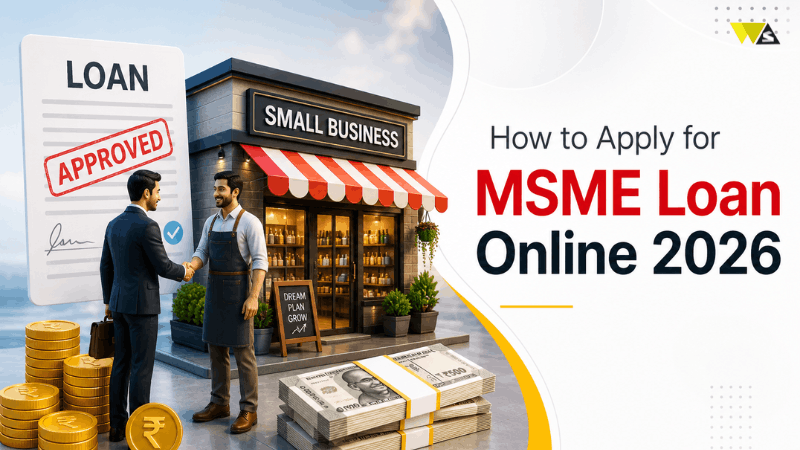
Starting a business needs money. You need funds for buying products, paying staff, and managing daily work. This can be hard for many people. MSME loans are a simple solution. The process is easy and quick. You don’t need to visit offices or wait in long lines. In this guide, you will learn how to apply, who can apply, and other important details.
What is an MSME Loan?
An MSME loan is a type of loan given by banks and NBFCs to small and medium businesses. These loans are offered with low or no collateral and at reasonable interest rates. Some government schemes also provide MSME loans at lower interest rates for needs like buying machines, expanding the business, or upgrading technology.
An MSME loan for a new business helps in daily operations and growth. It can be used to buy equipment, stock, pay employee salaries, and improve the overall financial condition of the business.
How to Apply for MSME Loans?
You can apply for an MSME loan in two ways: online and offline. Here are the steps to apply online:
Step 1: First, go to the bank or lender’s website. Select the MSME loan option and click on the Apply button to begin your application.
Step 2: Complete the application form with the required details and submit it.
Step 3: After you apply, someone from the bank will contact you to confirm your details.
Step 4: After verification, the bank will ask you to submit the required documents to move forward with your application.
Step 5: After checking your documents, the bank will approve your loan if everything is correct.
Step 6: After approval, the lender will send you a loan agreement. You need to review and accept it to complete the process.
Step 7: Once you sign the agreement, You will get the loan amount in your account within 48 hours.
If you prefer offline, you can visit a nearby bank or financial institution. Ask for the loan form, fill in your details, and submit it with the required documents. The bank will verify and approve your loan.
All MSME Loan Details 2026
Here we are combining all your MSME loan details in one place:
| Scheme / Type | Loan Amount | Purpose / Use | Key Benefits | Eligibility / Notes |
| Mudra (Shishu) | Up to ₹50,000 | Small/startup needs | Easy access, low amount | For micro businesses |
| Mudra (Kishore) | ₹50,000 – ₹5 lakh | Business growth | Flexible funding | Growing businesses |
| Mudra (Tarun) | ₹5 lakh – ₹10 lakh | Expansion | Higher funding support | Established businesses |
| Mudra (Tarun Plus) | ₹10 lakh – ₹20 lakh | Large expansion | More capital | Advanced businesses |
| PMEGP (Manufacturing) | Up to ₹25 lakh | New business setup | 15–25% subsidy | Only new projects |
| PMEGP (Service) | Up to ₹10 lakh | Service businesses | Subsidy benefit | New businesses only |
| CGTMSE | Varies | Collateral-free loans | 75%–90% guarantee cover | No collateral needed |
| SIDBI Loans | ₹3 crore – ₹50 crore | Expansion, projects | Large funding support | For established MSMEs |
| 59 Minute Loan | Up to ₹5 crore | Quick funding | Fast approval (59 mins) | Online process |
| General MSME Loan | ₹50,000 – ₹5 crore | Working capital & growth | Flexible use | Scheme dependent |
| Working Capital Loan | Short-term | Daily expenses | Improves cash flow | Business operations |
| Term Loan | Medium/Long-term | Expansion, assets | Structured repayment | Long-term needs |
Who Can Apply for an MSME Loan?
MSME loans are a great option if you need money quickly for your business. The process is simple and does not have complicated conditions. It is helpful for traders, service providers, manufacturers, and self-employed individuals.
If your business is doing well and earning regularly, you can easily apply for this loan.
Benefits of MSME Loan
MSME loans offer many benefits for your business:
- Helps business grow: You can use the loan to expand your business or start new work.
- Better cash flow: It helps you manage daily expenses easily.
- Buy new machines: You can purchase equipment or upgrade technology.
- Tax benefit: You may get tax savings on the interest you pay.
- Government support: Some loans come under schemes like Mudra and others, which offer extra benefits.
MSME Loan Eligibility Criteria
Before applying for an MSME loan, you should know the basic eligibility rules. This helps avoid rejection.
- Your business should be in trading, service, or manufacturing
- Your credit score should be 750 or above
- Your income should be at least ₹2 lakh per year
- Your business turnover should be around ₹10 lakh
- You should have a good repayment record and no loan default
Also:
- Your age should be between 21 to 65 years
- You should have at least 3 years of business experience
You can apply if you run:
- A private or public company
- A sole proprietorship
- A partnership or LLP
Documents Required for MSME Loan
Before applying, make sure you have these documents ready:
ID Proof: Aadhaar Card and PAN Card
Address Proof: Rent agreement or electricity/gas bill
Income Proof: Bank statements for the last 12 months
Business Proof: GST registration or business proof
Types of MSME Loans
There are different types of MSME loans available. Some of the common ones are:
- Working Capital Loan: This loan helps you handle your daily business needs like paying staff, bills, and other expenses. It is usually a short-term loan offered by banks and financial institutions.
- Term Loan: A term loan helps you grow your business. You can use it to expand, buy machines, or invest in assets. It is given for a fixed time by banks and lenders.
MSME Loan Government Schemes
In India, there are many MSME loan schemes to support different business needs like daily expenses, growth, and technology improvement. Let’s look at some popular government and bank loan options:
- Pradhan Mantri Mudra Yojana (PMMY)
This scheme gives loans up to ₹20 lakh to small and micro businesses (non-farm, non-corporate). You can get this loan from banks, small finance banks, MFIs, and NBFCs. You can also apply online through the JanSamarth Portal.
Loan Types:
| Loan Category | Loan Amount |
| Shishu | Up to ₹50,000 |
| Kishore | ₹50,000 to ₹5 lakh |
| Tarun | ₹5 lakh to ₹10 lakh |
| Tarun Plus | ₹10 lakh to ₹20 lakh |
Prime Minister’s Employment Generation Programme (PMEGP)
PMEGP is a government scheme that helps people start new small businesses. It gives a loan with subsidy to create self-employment. Only new business projects are allowed under this scheme. You can apply online through the PMEGP portal.
Loan & Subsidy Details:
| Category | Details |
| Manufacturing Business | Up to ₹25 lakh |
| Service/Business Sector | Up to ₹10 lakh |
| Subsidy | 15% to 25% of project cost |
Credit Guarantee Trust Fund for Micro & Small Enterprises (CGTMSE)
This scheme helps small businesses get loans easily without security. The government gives a guarantee to the bank, so it becomes easier for you to get a loan.
Key Points:
| Point | Details |
| Government Support | Government gives guarantee to banks |
| Guarantee Coverage | 75% to 90% of the loan amount |
| Micro Loan Coverage (Up to ₹5L) | 85% guarantee cover |
| Application Process | Banks apply through CGTMSE website |
Interest Subsidy Eligibility Certificate (ISEC)
This scheme gives loans to khadi institutions at a low interest rate of 4%. The government pays the extra interest amount to the bank through Khadi and Village Industries Commission.
To apply, you need an ISEC certificate from KVIC and submit it to the bank.
Small Industries Development Bank of India MSME Loans
SIDBI provides many types of loans for MSMEs, such as machinery loans, project loans, and working capital loans. These loans help businesses buy equipment, build factories, and manage daily expenses.
Key Points:
| Feature | Details |
| Loan Amount | ₹3 crore to ₹50 crore |
| Purpose | Business growth and expansion |
| Application Process | Apply through SIDBI website |
MSME Business Loan for Startups in 59 Minutes
This scheme by the Government of India provides quick online loan approvals for MSMEs. The entire process is digital, with approvals typically granted within 59 minutes.
- Loan types: term loans, working capital, and Mudra loans
- Maximum loan amount: ₹5 crore
- Applications can be submitted via the PSB Loans in 59 Minutes
Strategy for MSMEs in Budget 2026
- A ₹10,000 crore fund was created to help MSMEs grow without taking heavy loans
- Credit guarantee limits increased, Getting loans without security is now easier
- Faster payments through the TReDS platform
- Special loan schemes for women, SC/ST, and new entrepreneurs
- GST and compliance made simpler
- More focus on digital and fintech services for easy loans
- Continued interest support for sectors like manufacturing and exports
- Extra funding support through the Self-Reliant India Fund
Overall, the budget focuses on easy loans, faster payments, and simpler business processes for MSMEs.
MSME Loan Interest Rate 2026
MSME loan interest rates depend on factors like loan amount, time to repay, business type, and your credit score. Below are the interest rates offered by different banks and NBFCs:
| Bank / NBFC | Interest Rate (p.a.) |
| State Bank of India | 8.00% onwards |
| Canara Bank | 9.20% onwards |
| Punjab National Bank | 9.60% onwards |
| Indian Bank | 8.80% onwards |
| Union Bank of India | 10.95% onwards |
| Mahindra Finance | 7.20% onwards |
| Fullerton India | 17% onwards |
| Muthoot Fincorp | 18% onwards |
| Lendingkart | 1.25% per month onwards |
Conclusion
MSME loans are a great way to start or grow a business in India. They help business owners manage daily expenses, buy machines, and expand their work without financial stress. Today, the application process is very easy and can be done online in just a few steps.
With the support of government schemes, lower interest rates, and faster approvals, getting a business loan has become much simpler. If your business is stable and you meet the eligibility criteria, an MSME loan can be a smart choice to improve your business and achieve long-term growth.
FAQs (Frequently Asked Questions)
1. What is an MSME loan and how does it work?
An MSME loan is given to small businesses. It helps with expenses, machines, and business growth. You pay it back in monthly installments.
2. Who can apply for an MSME loan in India?
Any small business owner, startup, trader, manufacturer, or service provider can apply for an MSME loan. The applicant should have a stable business, good income, and a decent credit score.
3. Is collateral required for MSME loans?
You don’t always need collateral for an MSME loan. Many government schemes like Credit Guarantee Trust Fund for Micro & Small Enterprises offer loans without security. However, for higher loan amounts, lenders may ask for collateral.
4. What is the minimum credit score required for MSME loan approval?
Most lenders prefer a credit score of 700 or higher. A higher score improves approval chances and may result in lower interest rates.
5. How long does it take to get an MSME loan approved?
The approval time depends on the lender. Some loans can be approved within 59 minutes (online schemes), while others may take a few days after document verification.
6. What documents are required to apply for an MSME loan?
To apply for a loan, keep these documents ready: Aadhaar card, PAN card, address proof, bank statements, and business proof like GST registration or a business certificate.
7. Can a new business or startup apply for an MSME loan?
Yes, startups can apply for MSME loans. Schemes like the Prime Minister’s Employment Generation Programme and Pradhan Mantri Mudra Yojana are specially designed for new businesses. But some lenders may prefer businesses that have been running for at least 1–2 years.
8. What is the maximum loan amount I can get under MSME loans?
Loan amount ranges from ₹50,000 to ₹50 crore. Government schemes give smaller loans, while the Small Industries Development Bank of India offers higher funding.
9. What is the interest rate for MSME loans?
MSME loan interest rates are different for everyone. They depend on your lender, loan amount, and credit score. Rates usually start from around 7% and may increase based on risk.
10. Can I apply for an MSME loan online?
Yes, you can easily apply online through bank websites or government portals. The process is simple, quick, and does not require visiting a branch.