
E-waste refers to abandoned electronic products. Countries like India have been experiencing e-waste-related problems due to its impact to the environment and to the society. It is important to emphasize that even if e-waste has in itself very useful and recyclable materials, it cannot be denied that it also has certain negative aspects. There are existing management and e-waste recycling plant setup in India strategies that needs proper recognition and improvement.
Implementing an effective waste management and recycling strategy can only be accomplished by raising public awareness of the negative effects that e-waste has on society.
Requirements for E-Waste Recycling Plant Setup
- Dismantling Infrastructure: Since dismantling is a step in the recycling process, the person doing the dismantling needs a number of license and certificates to run the system and make sure that the environment is safe and that little waste is produced. Waste management standards for disassembling involves the right setup, usage of the equipment, labelling of the specifications, NOC for pollution, and authorization from the relevant SPCB to dismantle the waste. When thinking of setting up an e-waste recycling plant in India, this is a crucial step.
- Recycling: In order to separate and treat outdated electronic junk without losing the valuable metals in an environmentally responsible way, the e-waste recycling factory will need to develop an efficient system.
- Recovery: Recovery strategies can be employed while creating an e-waste recycling factory in India. But when choosing the real processing path and setting up the e-waste recycling plant, mechanical process and physical separation are the most important factors.
- Treatment & Disposal: Hazardous waste must be treated, stabilized, and disposed of in relation to the scrap that is produced during the dismantling process. To dispose the non-recyclable waste in a way that is profitable, recycling plant often need the help of other waste treatment facilities.
- Recycling Network: If the business owner agrees to integrate all the processes listed above, full planning of the management of e-waste is going to be needed. However, if you’re considering to start an e-waste recycling plant, it’s not a good idea to skip any of these steps.
Key Steps involved in E-waste management in India
The Central Pollution Control Board (CPCB) is in charge and regulates the managing and recycling e-wastes in the country according to the E-Waste (Management) Rules of 2022. Guidelines for putting these regulations into effect are created by CPCB.
- Inventory Management: It is the monitoring the amount of electronic equipment that is in stock.
- Production Process Management: These methods are used for reducing waste with the help of waste materials, production techniques, and product development protocols.
- Volume Reduction & Recovery: These methods are used to distinguish between hazardous and non-hazardous wastes, which lowers the amount of e-waste produced. The process of source segregation is used to do this.
- Reuse: The recycling and reuse of waste materials minimizes the degree of hazardous components and reduces waste while also helping to conserve the environment.
Eligibility Criteria for E-waste Recycling License in India
As per the rules of the Ministry of Environment, Forests and Climate Change (MoEFCC), the following organizations are eligible to apply for an E-waste recycling license in India:
- Any Individual
- Any Registered Society
- Any Organisation
- Any Designated Agency
- Any Company or
- Any Association
In accordance with these rules, any organization that handles, gathers, stores, and recycles electronic trash needs to obtain an electronic waste license through the State Pollution Control Board (SPCB).
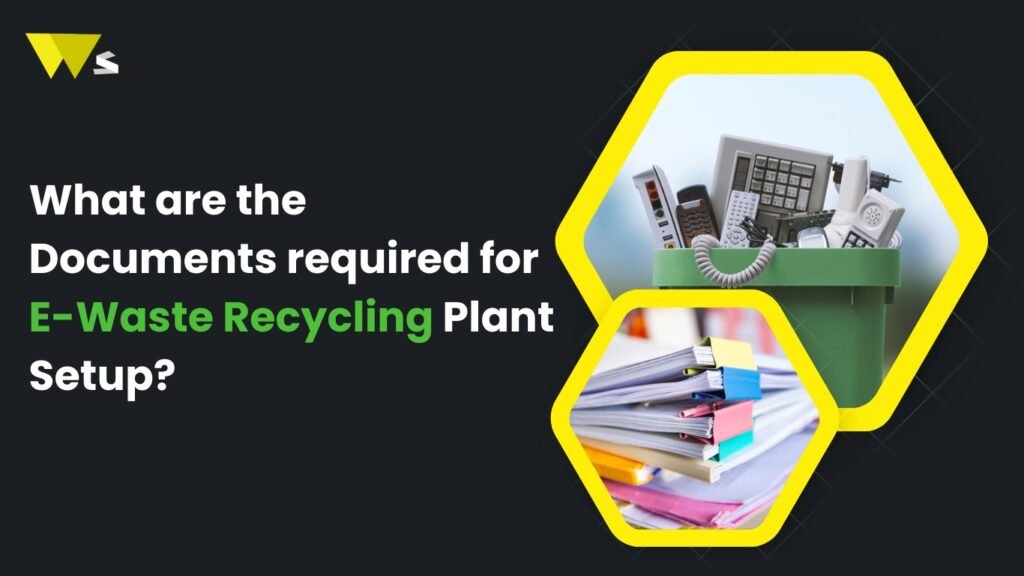
Documents Required for E-Waste Recycling Plant Setup
In India, obtaining an e-waste recycling license often requires a number of documents and details. These records and data support your dedication to appropriate e-waste management and adherence to pertinent laws. This is a list of the documents and information that are usually required:
- Provide Address proof.
- Exporter/Manufacturer legal paperwork.
- The incorporation certificate.
- IE Code.
- Industry Directorate.
- certificate issued by local bodies or municipal corporations.
- Contact Information.
- A copy of the PAN card.
- Information and Records of the Authorized Individual.
- Product Specifics.
- A copy of the BIS license.
- Information on RoHS Compliance.
- Information on the Recycler.
- E-waste management estimate.
- The Electronic Producer Responsibility Estimated Budget.
- Information about the Awareness Campaign.
- EPR Plan.
- A copy of the agreements.
- Content of the Website.
Application Procedure for E-Waste Recycling Plant Setup
There are multiple steps involved in obtaining an E-waste recycling license in India, which can be summarized as follows:
Open the Online Single Window Portal and Register:
- Open the online single-window portal of the Central Pollution Control Board.
- Create an account on the portal using your contact and personal information.
- Get a password via email or SMS to access the account.
- Enter the user ID and password that have been issued to access the online site.
Create a Unit and complete the Common Application Form:
- Fill out the Common Application Form once you’ve logged in.
- Add a unit within the portal.
Request a Permit, Certificate, or NOC
- Choose “Certificate/NOC/Permission Application.”
- Select the unit.
- Choose the departmental board.
- Select the “Authorization and Registration under E-Waste” service.
- Continue submitting the application.
Make the Necessary Payment:
- Go to “Pay Your Consolidated Fee” by navigating.
- Pay the applicable fee.
Concerned Regional Office (RO) Reviews the Application:
- The application will be forwarded to the relevant regional office (RO) for consideration following the successful payment of the fee.
Examining and Resolving Queries:
- The department could carry out the required examinations.
- Within seven days of receiving the application, the department will address any questions or concerns.
- Answers to the questions must be provided by the applicant via the portal.
Evaluation and Acceptance/Denial:
- After reviewing the application, the RO will determine whether to accept or deny the consent.
Get the Complete Certificate:
- After clearance, the candidate can access the final certificate via the portal and download it.
Charge and Method of Payment:
- The charge for getting the E-Waste license is changeable and can be paid online using the Online Consent Management & Monitoring System.
Conclusion
The e-waste recycling business encompasses numerous works including, collection and buying of waste from different businesses, sorting and separating the functional parts, and extracting and reclaiming the usable materials and metals, plastics. Electronic waste disposal and recycling is a sector that holds great potential. To be successful, though, a great deal of successful planning and execution will be needed.