

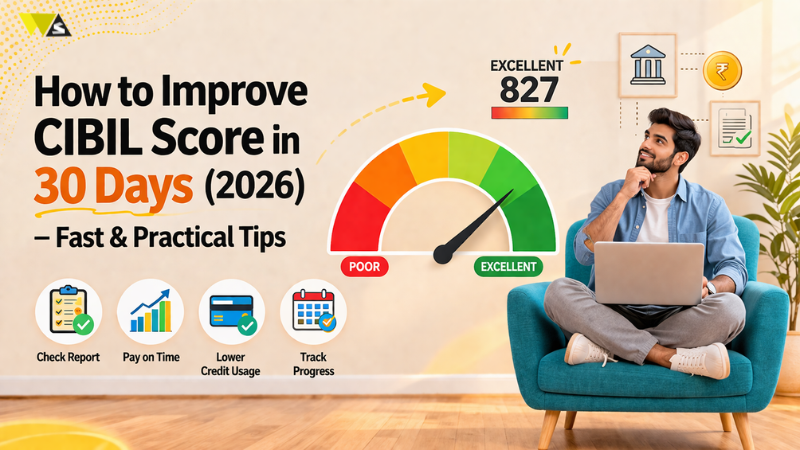
If your CIBIL score is low, getting a loan or credit card can be difficult. Many banks may reject your application or charge high interest rates.
The good news is that you can improve your CIBIL score in 30 days by following simple steps. A CIBIL score is very important for getting loans and credit. A good score helps you get better loan offers, lower interest rates, and more credit options.
If you follow good money habits and use credit wisely, you can improve your CIBIL score. A higher score helps you get better financial benefits in the future.
This article will show you a step-by-step daily plan to increase your score quickly.
Table of Contents
ToggleWhat is CIBIL Score?
CIBIL score is a 3-digit number about your credit, that shows your credit history. It is provided by TransUnion CIBIL. The score ranges from 300 to 900. A higher score means better chances of loan approval.
Can You Improve CIBIL Score in 30 Days?
Yes, you can improve your CIBIL score in 30 days, but the increase may be limited. Small improvements are possible if you fix errors, pay dues, and manage credit properly.
Improving your CIBIL score from 500 to 700 in 30 days is not easy. Your score changes slowly because it depends on your past habits. But if you take the right steps, you can see some improvement in 30 days.
Even a small increase can help you. It can make loans easier, reduce rejection, and improve approval chances.
Banks do not only check your score. They also check how you manage money and pay bills on time. Your score can improve with good habits. Focus on improving now and don’t worry too much about past mistakes.
Who Should Follow This 30-Day Plan?
- People with low CIBIL score (below 650)
- People planning to apply for a loan soon
- Credit card users with high usage
30 Days Plan to Improve CIBIL Score
Improving your CIBIL score in 30 days is possible if you follow the right steps every day. You may not see a huge jump, but even a small improvement can help. This 30-day plan will guide you step by step to build better financial habits, fix mistakes, and manage your credit wisely. By following this plan, you can start improving your score and move closer to a better credit profile.
Week 1 : (Day 1–7) Plan
Check Your CIBIL Report
Start by downloading your CIBIL report from the official website or app. Check all details like your name, loans, payment history, and credit card usage. This helps you know your current credit condition. Many people don’t know their real score or what is affecting it, so this step gives you a clear starting point.
Find and Report Errors
While checking your report, look for any errors. This can include wrong personal details, unknown loans, wrong payment history, or duplicate entries. Even small mistakes can reduce your score. If you find any error, report it to CIBIL on their website or app. Fixing these errors can help improve your score quickly.
Pay All Pending Dues
If you have any unpaid EMIs, credit card bills, or old dues, try to pay them quickly. Late or missed payments can lower your CIBIL score. Paying on time shows you handle money well. Even paying the minimum amount on your credit card is better than missing the payment.
Reduce Credit Card Usage
Try to use less of your credit limit. If you use most of your credit card limit, it can lower your score. Try to use only a small part, like less than 30%. This shows that you are not fully dependent on credit and can manage your money well.
Summary: In the first week, your goal is to fix basic problems and start strong. Check your report, correct mistakes, pay your dues, and use less credit. These simple steps help you begin improving your CIBIL score.
Week 2 : (Day 8–14) Plan
Pay All EMIs on Time
This week, focus on paying all your EMIs and credit card bills on time. Payment history is very important for your CIBIL score. Even one late payment can reduce your score. Always pay before the due date. You can set reminders or use auto-pay so you don’t miss any payment.
Avoid New Loan or Credit Card Applications
Do not take any new loan or credit card right now. Every time you apply, it can lower your score. Applying too many times can make banks think you are risky. It is better to wait and apply only when you really need it.
Keep Credit Usage Low
Keep using less of your credit limit. Try to stay below 30%. If possible, pay your credit card bill early. This helps keep your usage low. Low usage shows you manage your money well.
Summary: In Week 2, your goal is to build good habits. By paying on time, avoiding new applications, and using less credit, your score becomes stable and starts improving slowly.
Week 3 : (Day 15–21) Plan
Continue Timely Payments
This week, keep paying all your EMIs and credit card bills on time. Do not miss any payment. Paying on time helps build trust with banks and slowly improves your CIBIL score. Staying regular is very important.
Maintain Credit Balance
Keep your credit use low and balanced. Do not use too much of your limit. Try to stay below 30%. If you already reduced it before, keep doing the same. This shows you use your credit wisely.
Monitor Your Credit Activity
Keep checking your credit accounts regularly. Make sure there are no mistakes or unknown transactions. If you see anything wrong, fix it quickly. This helps you stay in control of your credit.
Summary: In Week 3, your goal is to stay regular and careful. Keep following good habits and check your credit. This helps your score improve slowly.
Week 4 (Day 22–30) Plan:
Keep All Payments on Time
In the last week, keep paying all your EMIs and credit card bills on time. Do not miss any payment. Paying on time shows you are responsible and helps improve your CIBIL score. By now, this should become your daily habit.
Avoid Unnecessary Spending
Try to control your spending, especially on credit cards. Do not spend on things you don’t need. Using less credit helps keep your score safe. Smart spending is important for a good credit score.
Maintain Good Financial Habits
Keep following the good habits you learned. Pay on time, use less credit, and avoid extra loans. These habits help you keep and improve your score over time.
Summary: In Week 4, your goal is to stay regular and disciplined. Keep following good habits and avoid mistakes. This helps your credit score improve clearly.
How Much Your Score Can Improve in 30 Days?
|
Week |
Focus Area |
What to Do |
Expected Result |
|
Week 1 |
Fix Basics |
Check CIBIL report, find & report errors, pay pending dues, reduce credit usage below 30% |
Strong foundation for improvement |
|
Week 2 |
Build Good Habits |
Pay EMIs on time, avoid new loans/credit cards, keep credit usage low |
Score becomes stable |
|
Week 3 |
Stay Consistent |
Continue timely payments, maintain credit balance, monitor credit activity |
Gradual improvement in score |
|
Week 4 |
Maintain Discipline |
Keep payments on time, avoid unnecessary spending, follow good financial habits |
Noticeable improvement in score |
Biggest Mistakes to Avoid in CIBIL Score
Avoiding these common mistakes helps keep your CIBIL score safe. Even small mistakes can lower your score and make it harder to get loans.
- Missing EMI Payments: If you miss your EMI or credit card payment, your score can drop quickly. Always pay on time.
- Paying Only Minimum Due: Paying only the minimum amount keeps your balance high and increases interest. Try to pay the full amount.
- Using Full Credit Limit: Using all your credit limit shows high dependency on credit. Keep your usage low (under 30%).
- Applying for Many Loans: Applying for many loans at once can lower your score. Apply only when needed.
|
Mistake |
Why to Avoid |
|
Missing EMI payments |
Lowers your score quickly |
|
Paying only minimum due |
Increases interest and keeps debt high |
|
Using full credit limit |
Shows high credit usage |
|
Applying for many loans |
Reduces score due to multiple checks |
Tips for Faster Improvement in CIBIL Score
These easy tips can help you improve your CIBIL score faster. Follow them regularly for better results-
- Set Auto-Pay for Bills: Set auto-pay for your EMIs and credit card bills. This helps you not miss payments and keeps your score safe.
- Keep Old Credit Cards Active: Do not close your old credit cards. Older accounts help build a longer credit history, which is good for your score.
- Increase Credit Limit (if possible): If your bank allows, increase your credit limit. This helps reduce your credit usage and improves your score.
- Maintain Credit Mix: Try to use different types of credit, like loans and credit cards. This shows you can manage both well.
|
Tip |
Benefit |
|
Set auto-pay for bills |
Avoids missed payments |
|
Keep old credit cards active |
Builds long credit history |
|
Increase credit limit |
Reduces credit usage |
|
Maintain credit mix |
Improves credit profile |
How much can your CIBIL Score improve?
Set realistic goals. Going from 500 to 700 is possible, but it is not common unless many errors are fixed. But your score can increase by 30 to 100 points if you follow the right steps.
Your score can improve if you:
- Fix big errors in your report
- Pay your dues on time
- Report and remove wrong details
- Use less credit
Focus on small progress, not perfection. Even a small increase is okay. Banks look for regular and responsible credit behavior. When you show this, your chances of getting a loan also improve.
When to Apply for a Loan After Improving Your CIBIL Score?
You should apply for a loan only after your credit score starts improving and your financial habits become stable. Make sure you have been paying your EMIs and credit card bills on time for the last 3–6 months, your credit usage is under control, and your total debt is stable. Applying at the right time helps you get your loan approved easily and gives you better loan options.
Conclusion
Your CIBIL score can improve in 30 days if you take simple actions. Fix errors in your report, pay all your dues on time, and use less credit. Even a small improvement is helpful. The most important thing is to build good money habits and continue them. A better CIBIL score helps you get loans easily and at lower interest. Stay regular and patient, and your score will improve over time.
FAQs
Q1. Can I improve my CIBIL score in 30 days?
Yes, small improvements are possible if you follow the right steps.
Q2. What is the fastest way to increase CIBIL score?
Pay your dues on time, use less credit, and fix report errors.
Q3. How many points can increase in 30 days?
Usually, your score can increase by 20 to 100 points depending on your situation.
Q4. Does paying a credit card bill increase my score?
Yes, paying on time helps improve your score.
Q5. Can errors in report reduce score?
Yes, errors can lower your score, and fixing them can improve it.
Q6. Should I pay full credit card bill or minimum due?
It is better to pay the full bill. Paying only the minimum keeps your debt high.
Q7. How much credit should I use?
Try to use less than 30% of your credit.
Q8. Does applying for many loans affect score?
Yes, too many applications can lower your score.
Q9. How often should I check my CIBIL report?
You should check it regularly to find errors and track your progress.
Q10. Can I get a loan with a low CIBIL score?
Yes, but it may be harder and you may get higher interest rates.
Q11. Does checking my CIBIL score reduce it?
No, checking your own score does not affect it.
Q12. How long does it take to improve CIBIL score?
It depends, but small changes can be seen in 30 days, while bigger improvements take a few months.
Q13. Is a CIBIL score of 750 good?
Yes, 750 or above is considered a good score for loans and credit cards.
Q14. Can closing a credit card affect my score?
Yes, closing old cards can reduce your credit history and may lower your score.
Q15. What is the minimum CIBIL score required for a loan?
Most banks prefer a score of 700 or above for easy approval.
Read our article:How to Increase CIBIL Score from 600 to 750 (2026) – Real Steps That Work Fast