

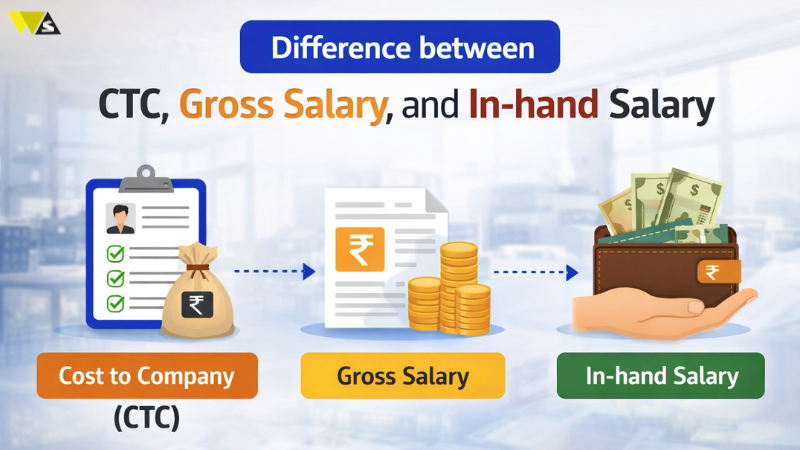
Many people get confused between gross salary, net salary, and CTC. These are not just difficult payroll terms, they actually affect how much money employees earn and how businesses manage salaries. When you understand these terms, it becomes easier to create clear and attractive salary packages. This blog will help you understand the difference between gross salary, net salary, and CTC in a simple way.
Table of Contents
ToggleWhat Is In-Hand Salary or Net salary?
In-hand salary, also called net salary or take-home pay, is the money you actually receive in your bank account every month after all deductions. It is the amount of money you actually have for your daily needs, savings, or investments.
What Is the Cost to Company (CTC)?
Cost to Company (CTC) is the total amount a company spends on an employee. It includes basic salary, allowances, bonuses, and other benefits. CTC is usually shown in job offers to tell the total salary package. But it is not the same as the salary you get in hand, because it also includes taxes and other deductions.
What is Gross salary?
Gross salary is the total salary an employee earns before any deductions like taxes are taken out. It includes basic salary, house rent allowance (HRA), other allowances, and bonuses.
Formula:
Gross Salary = Basic Salary + HRA + Other Allowances + Other Earnings
Common Parts of Your Salary
As per the 2026 labour rules, salary structure in India is now more organized. Your salary is usually divided into these parts:
- Basic Salary: This is the main part of your salary. It is usually around 50% of your CTC. It is fully taxable and is used to calculate PF and gratuity.
- House Rent Allowance (HRA): This is given to help with rent. It can be partly tax-free if you live in a rented house.
- Special Allowance: This is added to complete your total salary (CTC). It is fully taxable.
- Leave Travel Allowance (LTA): It helps you manage travel costs when you travel in India with your family.
- Bonuses/Incentives: This is extra pay based on your performance and is usually fully taxable.
Why do you get less salary in hand?
Your net salary is lower than gross salary because of some required deductions by law:
- Employee Provident Fund (EPF): About 12% of your basic salary is deducted. It reduces your monthly salary, but it helps you save money for the future.
- Income Tax (TDS): This is tax deducted from your salary based on the tax system you choose (new or old).
- Professional Tax (PT): This is a small tax charged by the state, usually around ₹200 per month.
- Employee State Insurance (ESI): This applies to employees with lower salaries and provides medical benefits.
Difference between CTC vs Gross Salary
It is important to understand that gross salary and CTC are not the same. See the table below for comparison.
|
Factors |
CTC |
Gross Salary |
|
Meaning |
Total money a company spends on an employee |
Total salary before any deductions |
|
Purpose |
Helps company plan expenses |
Used to calculate tax and earnings |
|
Includes |
Basic salary, allowances, bonuses, perks, and employer PF |
Basic salary, HRA, and other allowances |
|
Amount |
Higher than gross salary |
Lower than CTC but higher than net salary |
|
Changes |
May change with bonuses or performance |
Mostly fixed unless salary is updated |
Difference between In-Hand Salary or Net salary vs Gross Salary
Gross salary is what the company gives, but net salary is what you actually get in your bank account. That’s why you receive less money than what is offered. See the table below for comparison.
|
Category |
Gross Salary |
Net Salary |
|
Meaning |
Total salary before any deductions |
Salary you get after all deductions |
|
Includes |
Basic salary, HRA, and other allowances |
Salary after deductions like tax, PF, etc. |
|
Amount |
Higher amount before deductions |
Lower amount after deductions |
|
Calculation |
Add all salary parts |
Subtract deductions from gross salary |
|
Formula |
Gross Salary = Basic Salary + HRA + Other Allowances |
Net Salary = Gross Salary – (Tax + PF + Other Deductions) |
Understanding Gross Salary, Net Salary, and CTC
Below is a table that explains the difference between gross salary, net salary, and CTC.
|
Category |
Gross Salary |
Net Salary |
CTC |
|
Meaning |
Salary before any deductions |
Salary you get after all deductions |
Total cost company spends on you |
|
Includes |
Basic salary, allowances, bonuses, and benefits |
Salary after tax, PF, and other deductions |
Basic salary, allowances, bonuses, benefits, and company contributions |
How to calculate gross and net salary from CTC?
You can easily calculate CTC, gross salary, and net salary by knowing all the salary components. Let’s take a simple example to understand this. Suppose you offer a salary package to a new employee.
|
Salary Component |
Annual Amount (₹) |
|
CTC |
6,00,000 |
|
Basic Salary |
3,00,000 |
|
House Rent Allowance (HRA) |
1,20,000 |
|
Conveyance Allowance |
40,000 |
|
Medical Allowance |
30,000 |
|
Perquisites (meal coupons, etc.) |
8,000 |
|
Provident Fund (Employer Contribution) |
36,000 |
|
Provident Fund (Employee Contribution) |
36,000 |
Step 1: Calculate Gross Salary
Gross salary is calculated by removing perquisites and employer’s PF from CTC.
Formula:
Gross Salary = CTC – (Perquisites + Employer PF)
Calculation:
Gross Salary = 6,00,000 – (8,000 + 36,000)
Gross Salary = 5,56,000
Step 2: Calculate Net Salary
Now subtract income tax and employee’s PF from gross salary.
Assume income tax = ₹6,000
Formula:
Net Salary = Gross Salary – (Income Tax + Employee PF)
Calculation:
Net Salary = 5,56,000 – (6,000 + 36,000)
Net Salary = 5,14,000
This example shows that your CTC is always higher, but your in-hand salary is lower because of deductions like PF and tax.
Conclusion
Understanding the difference between CTC, gross salary, and net salary is very important for both employees and employers. CTC shows the total cost a company spends on you, gross salary is your total earnings before deductions, and net salary is the actual amount you receive in your bank account. Knowing these terms helps you clearly understand your salary structure, plan your finances better, and avoid confusion while checking your offer letter or payslip.
Frequently Asked Questions
- What is the difference between CTC and net salary?
CTC is the total amount a company spends on an employee, while net salary is the money the employee gets after all deductions.
- Why is my in-hand salary less than my CTC?
Your in-hand salary is lower because deductions like tax, PF, and other charges are removed from your CTC.
- What is the gross salary in simple words?
Gross salary is the total salary before any deductions like tax or PF are taken out.
- What is included in CTC?
CTC includes basic salary, allowances, bonuses, benefits, and employer contributions like PF.
- What is net salary or take-home salary?
Net salary is the actual money you receive in your bank account after all deductions.
- Is gross salary equal to net salary?
No, gross salary is always higher than net salary because deductions are applied.
- What deductions are taken from salary?
Common deductions include income tax, provident fund (PF), professional tax, and sometimes ESI.
- How can I increase my take-home salary?
You can get more salary by selecting the right tax system and using tax-saving options.
- Is CTC the same as offered salary?
Yes, CTC is usually the salary package mentioned in the offer letter, but it is not the amount you receive.
- Why is it important to understand salary structure?
It helps you manage your money better, understand deductions, and make smart financial decisions.