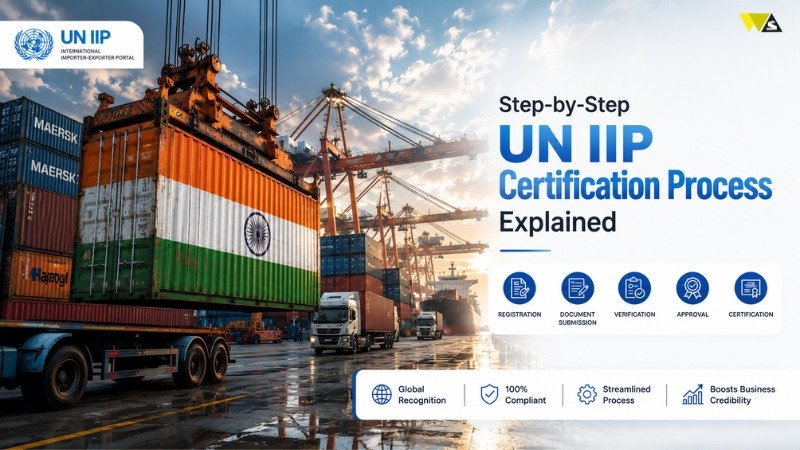


Today, many businesses transport hazardous goods across different countries. To transport dangerous items safely, companies need a UN IIP Certificate. This certificate shows that the packaging is tested and approved according to international UN safety rules for air and sea shipping. It helps ensure the safe handling and transportation of dangerous goods.
📌 KEY HIGHLIGHTS
- ✅ Mandatory certification for hazardous goods packaging
- ✅ Issued by Indian Institute of Packaging (IIP)
- ✅ Required for air & sea export shipments
- ✅ Packaging tested under UN safety standards
- ✅ Includes Drop, Leakproof, Vibration & Pressure Tests
- ✅ UN Mark Number issued after approval
- ✅ Validity: 9 Months to 48 Months
- ✅ Essential for international dangerous goods transportation
What is a UN IIP Certificate?
A UN IIP Certificate or UN Mark Certificate is an important certification issued by the Indian Institute of Packaging for packaging used in the transportation of dangerous goods.
The packaging undergoes various safety tests, including leakage, vibration, pressure, handling, and stacking tests, to ensure safe transport.
This certification is compulsory for exporting hazardous materials through:
- Sea transport as per IMDG Code
- Air transport as per ICAO/IATA Regulations
After successful testing, a UN marking code is provided to indicate that the packaging meets international safety requirements.
Documents Required for UN IIP Certificate
The following documents are commonly required for obtaining a UN Mark IIP Certificate:
1. GST Registration Certificate: The company must submit a copy of its GST registration certificate for verification purposes.
2. PAN Card Copy: A company PAN card copy is needed for application submission.
3. Import Export Code (IEC): A valid Import Export Code (IEC) issued by the Directorate General of Foreign Trade must be submitted by businesses involved in exports.
4. Company Registration Documents: The required documents may vary according to the business type. In some cases, businesses may also need to provide:
- Certificate of Incorporation
- MOA & AOA
- Partnership Deed
- MSME Registration Certificate
5. ISO Certificate: Companies with ISO certification may receive the benefit of longer certificate validity.
6. Authorized Signatory Documents: Applicants must provide the following details of the authorized person:
- Valid ID Proof
- Mobile Number
- Email Address
7. Material Safety Data Sheet (MSDS): An MSDS (Material Safety Data Sheet) of the chemical or hazardous product must be submitted for testing and certification purposes.
8. Packaging Details & Specifications: The following packaging information must be submitted during the application process:
- Packaging dimensions
- Packaging design or drawings
- Packaging material type
- Gross weight and net weight
- Physical state of the product (solid/liquid/gas)
9. Compatibility Certificate: Applicants must provide a compatibility certificate confirming that the packaging is safe and suitable for transporting the product.
10. Exporter Details: The exporter’s company name along with shipment details must be properly mentioned in the application form.
11. Sample Packages for Testing: Applicants are required to submit physical packaging samples to Indian Institute of Packaging laboratories for testing as per UN regulations.
12. Covering Letter & Undertaking: The following documents are required during the application process:
- Covering Letter
- Manufacturer Undertaking
- Exporter Undertaking
These documents should be properly signed and submitted on the company’s official letterhead.
13. Cancelled Cheque Copy: A cancelled cheque copy may be needed for verification and billing.
UN Certification Process in India
The UN IIP Certificate process generally involves the following steps:
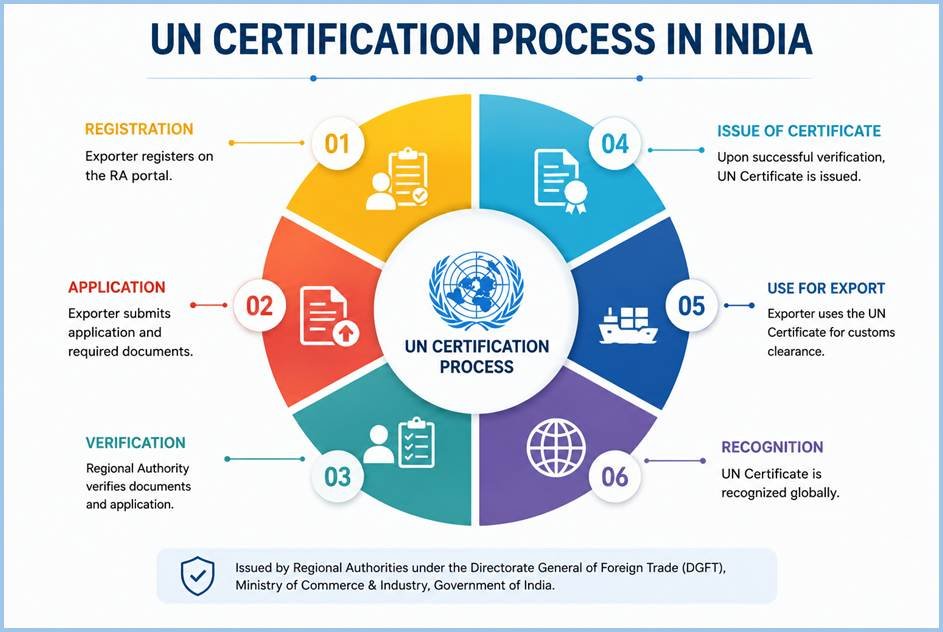
- Online application submission: The applicant submits an application to the Indian Institute of Packaging.
- Uploading documents on IIP portal: The applicant submits the required documents to the Indian Institute of Packaging.
- Payment: At the time of application, the applicant must also pay the required fees to the Indian Institute of Packaging.
- Laboratory testing by IIP: The sample is sent to the authorized laboratory of the Indian Institute of Packaging for testing of packaging parameters. The sample can be sent through courier, transport, customer, or marketing representative.
- Issuance of UN Mark Certificate: Once the Test Report and UN IIP Certificate are issued, the department also provides a UN Mark number to the applicant.
The packaging is tested under different safety parameters, such as:
- Drop Test
- Leakproofness Test
- Stack Load Test
- Vibration Test
- Hydraulic Pressure Test
Validity of UN IIP Certificate
The validity period of the UN IIP Certificate varies based on the company’s ISO certification status.
| Company Type | Validity Period |
| Non-ISO Certified Company | 9 Months |
| ISO Certified Company | 12 to 48 Months |
Conclusion
Businesses involved in exporting hazardous goods must obtain a UN IIP Certificate to ensure safe transportation and compliance with international standards. Proper documentation and packaging compliance are very important for smooth approval.
Before starting the application process, companies should keep all documents, packaging details, MSDS reports, and testing samples ready. Proper preparation helps save time and reduces the chances of delays during certification.
For more details and official guidelines, visit the official website of the Indian Institute of Packaging.
FAQs
1. What is a UN IIP Certificate and why is it important?
The UN IIP Certificate is an approval given by the Indian Institute of Packaging for safe packaging of hazardous products. It confirms that the packaging is strong and safe for export. Many countries and shipping companies require this certificate before transporting dangerous goods internationally.
2. Which businesses need a UN IIP Certificate?
Businesses involved in manufacturing, exporting, importing, storing, or transporting hazardous chemicals and dangerous goods usually need a UN IIP Certificate. This includes chemical companies, pharmaceutical industries, paint manufacturers, battery exporters, lubricant companies, agrochemical businesses, and many other exporters dealing with dangerous products. The certificate is especially important for companies sending goods through air cargo or sea shipments.
3. Which documents are required for applying for a UN IIP Certificate?
To apply for a UN IIP Certificate, companies must submit important documents such as GST Certificate, PAN Card, IEC Code, MSDS report, packaging specifications, and authorized signatory details. Proper documentation helps avoid delays during testing and approval.
4. What tests are performed during UN packaging certification?
The packaging is tested under several safety parameters to check whether it can safely transport dangerous goods. These tests generally include Drop Test, Leakproofness Test, Stack Load Test, Vibration Test, and Hydraulic Pressure Test. These tests ensure that the packaging remains safe during handling, shipping, loading, unloading, and storage conditions.
5. How long does it take to get a UN IIP Certificate?
UN certification approval time varies based on the packaging type and testing process. Companies with complete documents and proper packaging usually receive approval faster.
6. What is the validity period of a UN IIP Certificate?
The certificate validity depends on whether the company is ISO certified or not. Generally, non-ISO certified companies receive shorter validity periods, while ISO certified companies may receive validity from 12 months up to 48 months. Companies must renew the certificate before expiry to continue exporting hazardous goods without interruption.
7. Can a company export dangerous goods without a UN IIP Certificate?
Exporting hazardous goods without a UN IIP Certificate can create serious problems during shipping. The shipment may be stopped, delayed, or rejected by customs authorities or transport companies.
8. What is an MSDS and why is it required for UN certification?
An MSDS is a safety document that contains complete details about a hazardous chemical or product. It includes information about risks, storage, handling, and emergency precautions during transportation.
9. What happens if the packaging fails during testing?
If the packaging fails during laboratory testing, the applicant may need to modify the packaging design, material strength, thickness, or sealing quality. After making corrections, the company can submit new samples for retesting. Proper packaging quality is very important because unsafe packaging may create transportation risks and safety hazards.
10. Why is the UN Mark certificate number important?
A UN Mark number shows that the packaging has passed required safety tests and is approved for hazardous goods transportation by air and sea.
Read our article:How to Get a UN IIP Certificate in India?