

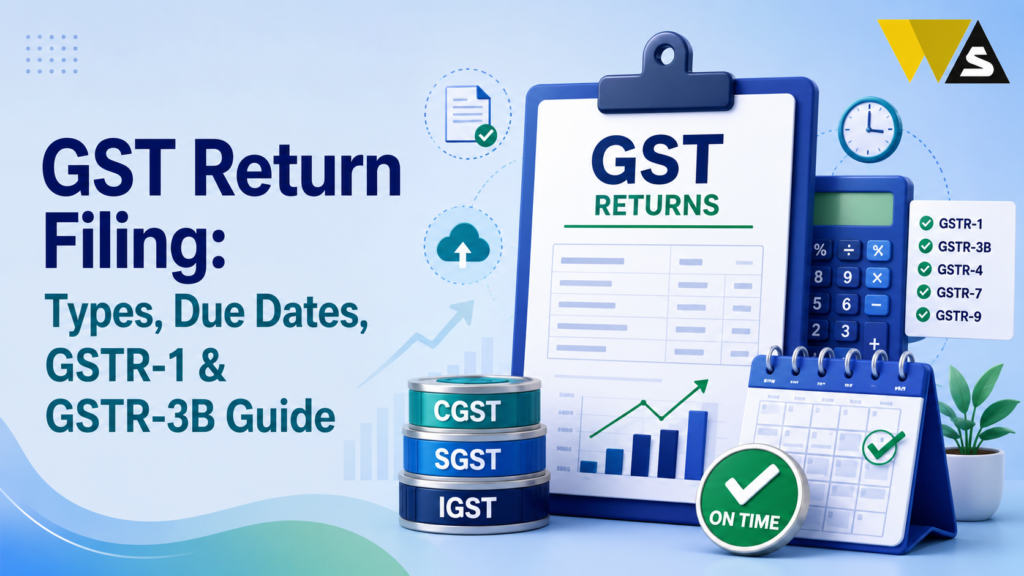
GST return filing means reporting your sales, purchases, tax collected, and Input Tax Credit (ITC) to the government on the portal gst.gov.in . For most businesses, only three returns matter: GSTR-1 (your sales details, due by the 11th of the next month), GSTR-3B (summary + tax payment, due by the 20th), and GSTR-9 (annual return, due by 31 December of the next year).
Small taxpayers (turnover up to ₹5 crore) can use the QRMP scheme to file quarterly while paying tax monthly. GSTR-3B is now “hard-locked” ; your sales figures are auto-filled from GSTR-1 and cannot be edited in GSTR-3B; any correction must be made in GSTR-1 or GSTR-1A first. Even nil (no-business) months need a return. Late filing costs ₹50/day (₹20 for nil) plus 18% interest.
Table of Contents
ToggleWhat is GST Return Filing?
A GST return is a form you file that tells the government about your business’s tax details for a period. In it, you report:
- Your sales (outward supplies) and the GST you collected
- Your purchases and the Input Tax Credit (ITC) you can claim
- The net tax you must pay (GST collected minus ITC)
Every GST-registered business must file returns regularly usually every month or quarter and an annual return once a year. Even if you had no business in a month, you must still file a nil return.
Why it matters:
- It is a legal requirement that non-filing brings penalties, interest, and suspension.
- It lets your buyers claim ITC on your invoices (so they want you to file on time).
- It keeps your GSTIN active and your business compliant.
- One missed return blocks the next one the system files in order.
GST Return Filing Overview 2026
| Detail | Information |
| Portal | gst.gov.in |
| Main Returns | GSTR-1, GSTR-3B, GSTR-9 |
| GSTR-1 (sales) | By 11th of next month (monthly) |
| GSTR-3B (summary + tax) | By 20th of next month (monthly) |
| QRMP (small taxpayers) | Quarterly returns, monthly tax |
| GSTR-9 (annual) | By 31 December of next FY |
| ITC source | Only from auto-generated GSTR-2B |
| 2026 Key Change | GSTR-3B hard-locked (auto-filled from GSTR-1) |
| Late Fee | ₹50/day (₹20 nil), capped by turnover |
| Interest | 18% per year on unpaid tax |
| Nil Return | Compulsory; can be filed by SMS |
Who Has to File GST Return?
Every GST-registered person must file returns but which returns and how often depends on your type:
- Regular taxpayers (turnover above ₹5 crore): File monthly — GSTR-1 and GSTR-3B every month.
- Small taxpayers (turnover up to ₹5 crore): Can choose the QRMP scheme — file quarterly but pay tax monthly.
- Composition dealers: File a quarterly payment statement (CMP-08) and one annual return (GSTR-4).
- E-commerce operators, non-residents, input service distributors, TDS/TCS deductors: File their own special returns.
Even nil-turnover months need a return. If you had no sales, you must still file a nil GSTR-1 and GSTR-3B which can even be done by SMS. If you are a small business, the QRMP scheme reduces your filing work from monthly to quarterly but you still pay tax every month with a simple challan.
GST Return: Which GST Return Do You Need to File?
There are about 22 return forms in GST law, but for most businesses, only three matter: GSTR-1, GSTR-3B, and GSTR-9. Let us understand each.
GSTR-1 — Your Sales Return
- It lists all your sales invoices (outward supplies) in detail.
- It is the base return — the data here flows into your GSTR-3B and your buyers’ ITC.
- Due date: by the 11th of the next month (monthly), or the 13th after the quarter (QRMP).
GSTR-3B — Your Summary + Tax Payment Return
- It is a summary of your sales, ITC, and net tax payable.
- This is the return where you actually pay the tax.
- Due date: by the 20th of the next month (monthly), or 22nd/24th after the quarter (QRMP).
GSTR-9 — Your Annual Return
- A yearly summary of all your monthly/quarterly returns.
- Due date: by 31 December of the next financial year.
- Businesses with turnover above ₹5 crore also file GSTR-9C (a reconciliation statement).
Master these three returns first they cover almost everything a normal business needs.
GST Return Due Dates 2026
Here are the key due dates in simple form:
| Return | Who / Frequency | Due Date |
| GSTR-1 | Monthly filers | 11th of next month |
| GSTR-1 (IFF optional) | QRMP (first 2 months) | 13th of next month |
| GSTR-1 | QRMP (quarterly) | 13th after quarter |
| GSTR-3B | Monthly filers | 20th of next month |
| GSTR-3B | QRMP | 22nd or 24th after quarter |
| CMP-08 | Composition | 18th after quarter |
| GSTR-9 | Annual | 31 December of next FY |
Note: The QRMP GSTR-3B split (22nd vs 24th) depends on your state; it is fixed by your state, not your choice.
Always treat the due date shown on the GST login portal as final, and set separate reminders for GSTR-1 and GSTR-3B.
The QRMP Scheme For Small Businesses
The QRMP (Quarterly Return, Monthly Payment) scheme is a big relief for small taxpayers with turnover up to ₹5 crore. Here is how it works:
- You file GSTR-1 and GSTR-3B quarterly, not every month.
- But you pay tax every month using a simple challan (PMT-06) for the first two months of the quarter.
- You can use the Invoice Furnishing Facility (IFF) to upload key sales invoices in the first two months, so your buyers can claim ITC without waiting for the quarter-end.
Why choose QRMP? QRMP means less GST filing work. You file returns quarterly instead of every month, but you still pay GST every month. It is a good option for small businesses that want less paperwork.
GSTR-3B Return Filing Hard-Lock Explained
From the July 2025 tax period onwards, the sales figures in GSTR-3B are auto-filled from your GSTR-1 (and GSTR-1A/IFF) and you CANNOT edit them in GSTR-3B anymore.
In simple words:
- Earlier, you could manually change the sales/tax figures in GSTR-3B.
- Now you cannot. GSTR-3B just takes the numbers from your GSTR-1.
- From November 2025, even Table 3.2 (inter-state supplies to unregistered persons, etc.) became non-editable.
What this means for you: Your GSTR-1 must be 100% correct, because whatever you file there flows straight into GSTR-3B and cannot be fixed later in GSTR-3B.
If you made an error in GSTR-1, fix it using GSTR-1A (an amendment return for the same period) before filing GSTR-3B. GSTR-1A updates the figures instantly.
Get your GSTR-1 right the first time, and use GSTR-1A to fix errors before GSTR-3B.
ITC Rule: You Can Only Claim From GSTR-2B
You can claim Input Tax Credit (ITC) only for invoices that appear in your auto-generated GSTR-2B.
- GSTR-2B is a read-only statement showing the ITC available to you, based on what your suppliers filed in their GSTR-1.
- If a supplier did not file or filed wrongly, that invoice won’t appear in your GSTR-2B, and you cannot claim its ITC.
- So you must reconcile your purchases with GSTR-2B every month.
The IMS (Invoice Management System): The new IMS lets you accept, reject, or keep pending each supplier invoice, which decides what goes into your GSTR-2B and ITC.
Check your GSTR-2B and IMS every month, and follow up with suppliers who have not filed otherwise you lose ITC and pay more tax.
How to File GST Return Online (Step-by-Step)
Here is the general process for filing your monthly returns on gst.gov.in :
Filing GSTR-1 (sales):
- Step 1: Log in to gst.gov.in and go to Returns Dashboard.
- Step 2: Select the financial year and month/quarter.
- Step 3: Open GSTR-1 and add your sales invoices (or upload them).
- Step 4: Check the details, then submit and file using DSC or EVC (OTP).
Filing GSTR-3B (summary + tax):
- Step 5: Open GSTR-3B — your sales figures are auto-filled from GSTR-1 (and are now non-editable).
- Step 6: Check your ITC (from GSTR-2B) and the net tax payable.
- Step 7: Pay the tax using your cash/credit ledger (create a challan if needed).
- Step 8: File the return using DSC or EVC.
Always file GSTR-1 first, then GSTR-3B the order matters, because GSTR-3B depends on GSTR-1.
What is a Nil Return, and How to File It?
A nil return is filed when you had no sales, no purchases, and no tax in a period. But it is still compulsory and you cannot skip it.
- You must file a nil GSTR-1 and nil GSTR-3B even for a no-business month.
- The easiest way: file a nil return by SMS (used by lakhs of dormant businesses each month), or file it quickly on the portal.
- The late fee for a nil return is lower about ₹20 per day but it still applies if you miss it.
Do not ignore nil returns; a missed nil return still brings late fees and blocks your next return.
Late Fees and Interest for Late GST Return Filing
Filing late costs money, so know the penalties:
- Late fee: ₹50 per day (₹25 CGST + ₹25 SGST) for a normal return, or ₹20 per day for a nil return.
- Late fee cap: the fee is capped based on turnover (commonly from about ₹2,000 up to ₹10,000).
- Interest: 18% per year on any unpaid tax, from the day after the due date.
- Important: Even if you paid the tax on time but filed GSTR-3B late, both interest and late fee still apply.
New for GSTR-9/9C: From 1 January 2026, late filing of the annual return (GSTR-9/9C) triggers an automatic late fee based on your turnover slab. The late fee keeps adding daily until you file so file as soon as possible, even if late.
The 3-Year Rule for GST Returns
This is a strict new rule every taxpayer must know.
- From the July 2025 tax period onwards, you cannot file a GST return after 3 years from its original due date.
- After 3 years, the return is permanently blocked on the portal there is no late-filing option and no penalty-and-file route. It is simply closed forever.
If you have old pending returns, file them before the 3-year limit otherwise you lose the chance permanently, which can cause serious compliance problems.
Never leave returns pending for years. Clear any old pending returns as soon as possible.
What Happens if You Miss GST Return?
- Late fees and 18% interest keep adding up.
- You cannot file the next return GST files in strict order, so one missed return blocks all future ones.
- Your buyers lose ITC on your invoices, so they may stop dealing with you.
- E-way bill generation can be blocked for repeated non-filing.
- Your GSTIN can be suspended or cancelled.
- After 3 years, the return is permanently blocked.
In GST, one missed return is not a small thing; it blocks the next one and multiplies costs. Filing on time, in order is essential.
Common GST Return Filing Mistakes to Avoid
- Wrong figures in GSTR-1 — now they hard-lock into GSTR-3B, so errors are costly.
- Not using GSTR-1A to fix GSTR-1 errors before GSTR-3B.
- Claiming ITC not in GSTR-2B — it will be disallowed.
- Skipping nil returns — they are compulsory.
- Filing in the wrong order — always GSTR-1 first, then GSTR-3B.
- Missing due dates — leads to late fees, interest, and blocks.
- Leaving old returns pending — the 3-year bar closes them forever.
- Not reconciling purchases with GSTR-2B every month.
Conclusion
GST return filing means submitting your GST returns on time. It keeps your business compliant and helps buyers claim ITC. The main returns are GSTR-1, GSTR-3B, and GSTR-9. Small businesses may use QRMP to file returns every quarter and pay GST monthly.
GSTR-3B hard-locking your sales figures are auto-filled from GSTR-1 and cannot be edited in GSTR-3B, so your GSTR-1 must be correct, and any error must be fixed in GSTR-1A before filing GSTR-3B. Also remember: claim ITC only from GSTR-2B, file even nil returns, and never leave returns pending after 3 years, they are permanently blocked.
Frequently Asked Questions (FAQs)
1. What is GST return filing?
GST return filing is reporting your sales, purchases, tax collected, and Input Tax Credit to the government on gst.gov.in. Every registered business must file returns regularly — usually GSTR-1, GSTR-3B, and an annual GSTR-9 — even in months with no business.
2. Which GST returns do I need to file?
For most businesses, three returns matter: GSTR-1 (sales details, by the 11th), GSTR-3B (summary and tax payment, by the 20th), and GSTR-9 (annual return, by 31 December). Small taxpayers can file quarterly under the QRMP scheme.
3. What are the GST return due dates in 2026?
For monthly filing, GSTR-1 is due by the 11th and GSTR-3B by the 20th of the next month. QRMP filers submit GSTR-1 by the 13th after the quarter and GSTR-3B by the 22nd or 24th, based on their state. GSTR-9 is usually due by 31 December of the next financial year.
4. What is GSTR-3B hard-locking?
From the July 2025 tax period, the sales figures in GSTR-3B are auto-filled from your GSTR-1 and can no longer be edited in GSTR-3B. Any correction must be made in GSTR-1 or the GSTR-1A amendment return before you file GSTR-3B.
5. What is the QRMP scheme?
QRMP lets eligible taxpayers with turnover up to ₹5 crore file GST returns quarterly and pay tax monthly. IFF can be used to upload invoices every month for timely ITC.
6. Do I have to file a return if I had no sales?
Even with no transactions, you must file nil GSTR-1 and GSTR-3B. Nil returns may also be filed through SMS. Missing the return can cause a late fee and affect your next filing.
7. How is Input Tax Credit (ITC) claimed now?
You can claim ITC only for invoices that appear in your auto-generated GSTR-2B, based on what your suppliers filed. Reconcile your purchases with GSTR-2B every month and follow up with suppliers who have not filed, or you will lose that ITC.
8. What are the late fees for GST returns?
If you file your GST return late, you may have to pay a late fee. It is generally ₹50 per day, or ₹20 per day for a nil return. You may also have to pay 18% yearly interest on unpaid tax.
9. What is the 3-year time bar for GST returns?
You cannot file a GST return after 3 years from its original due date. Once 3 years are over, the portal blocks the return. File old pending returns before the deadline.
10. What happens if I miss filing my GST return?
If you file your GST return late, you may have to pay a late fee and interest. It can also affect your next return and your buyer’s ITC. In some cases, e-way bills or your GSTIN may also be affected. Always file your returns on time.
Read our article:
Read our article:
Read our article:
Read our article: