

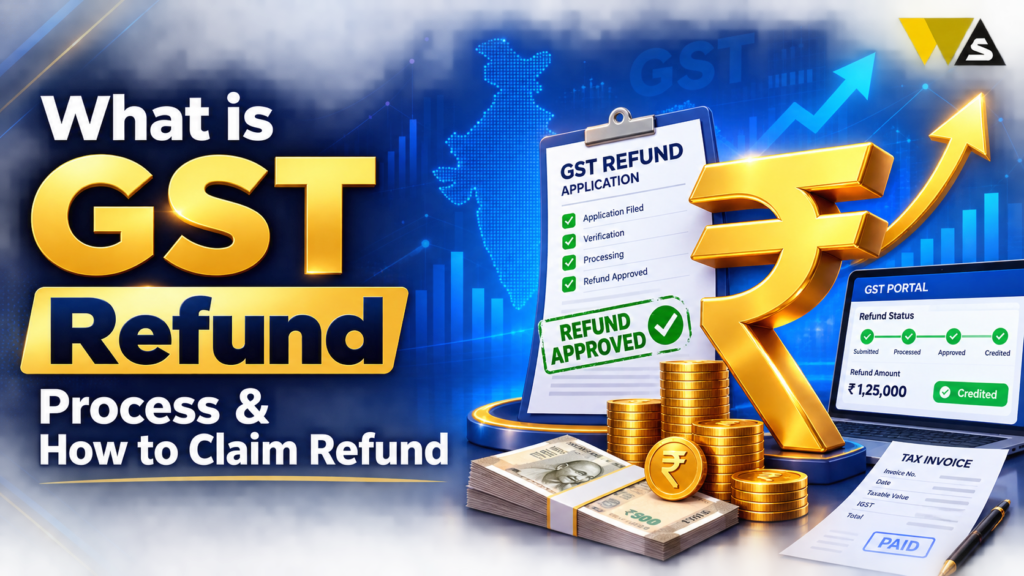
The GST refund process lets a registered taxpayer claim back GST paid in excess or unused Input Tax Credit (ITC). You claim it by filing Form GST RFD-01 online on gst.gov.in (Services → Refunds → Application for Refund), selecting the refund type, entering the amounts, uploading the supporting statements and documents, and submitting with DSC/EVC to get an ARN.
Refunds arise mainly from exports, inverted duty structure, excess cash ledger balance, SEZ supplies, and excess tax paid. You must file within 2 years of the “relevant date”, and the claim must be at least ₹1,000 per tax head. The officer should process it within 60 days; exporters get a 90% provisional refund within 7 days.
Table of Contents
ToggleWhat is a GST Refund?
A GST refund is the return of GST to a taxpayer when they have paid more tax than they owed, or have unused tax credit that they are legally allowed to get back. It is basically your own money coming back from the government.
Refunds are very important for cash flow especially for exporters and manufacturers, whose money can otherwise stay locked with the government.
Common situations where a refund arises:
- Exports (zero-rated supplies) — of goods or services
- Inverted duty structure — inputs taxed higher than the output
- Excess balance in the electronic cash ledger
- Excess tax paid by mistake
- Supplies to SEZ units/developers
- Deemed exports
- Refund from an appeal/assessment order
GST Refund Process Overview 2026
| Detail | Information |
| Application Form | GST RFD-01 (fully online) |
| Portal | gst.gov.in |
| Path | Services → Refunds → Application for Refund |
| Legal Basis | Section 54, CGST Act |
| Time Limit | 2 years from the relevant date |
| Minimum Claim | ₹1,000 per tax head |
| Acknowledgement | RFD-02 (within 15 days) |
| Provisional Refund | RFD-04 (90%, within 7 days for exports) |
| Final Order | RFD-06 (within 60 days) |
| Delay Interest | 6% per year after 60 days |
Who Can Claim a GST Refund?
- Exporters — of goods or services (with or without IGST payment).
- Manufacturers/suppliers with an inverted duty structure.
- SEZ suppliers — supplying to SEZ units/developers.
- Any taxpayer with excess balance in the cash ledger or excess tax paid.
- Deemed exporters and holders of appeal/assessment order refunds.
- UN bodies, embassies, and certain notified persons.
Exception: Composition scheme taxpayers cannot claim an ITC refund they can only claim a refund of excess balance in the electronic cash ledger.
Types of GST Refund 9 Main Categories
Under Section 54, refunds fall into about 9 categories. Knowing yours is the first step:
- Export of goods/services (zero-rated) — without IGST (refund of accumulated ITC) or with IGST (refund of tax paid).
- Inverted duty structure — accumulated ITC because inputs are taxed higher than output.
- Supplies to SEZ units/developers.
- Deemed exports.
- Excess balance in the electronic cash ledger.
- Excess tax paid by mistake.
- Refund on account of an assessment/appeal/any other order.
- Refund of tax on supplies later found exempt/not made.
- Refund to UN bodies, embassies, and notified persons.
IGST Refund on Export of Goods is Automatic
- For IGST paid on the export of GOODS, you do NOT file a separate RFD-01.
- The refund is processed automatically through the shipping bill route.
- The GST portal sends your GSTR-1 export data to ICEGATE (Customs), which matches it with the shipping bill and EGM, and credits the refund to your bank.
- You just need to file GSTR-1 and GSTR-3B correctly and ensure the shipping bill details match.
For export of services, exports without IGST (ITC refund), and most other categories, you must file RFD-01.
Documents Required to Claim a GST Refund
The documents depend on the refund type, but generally keep these ready:
- GST returns — GSTR-1, GSTR-3B (and GSTR-2B for ITC).
- Relevant statement — for example, Statement 2 (exports) or Statement 1A (inverted duty).
- Export documents — shipping bills, export invoices, BRC/FIRC (for exporters).
- Invoices related to the refund claim.
- A self-declaration that the tax burden was not passed on to anyone (the “unjust enrichment” declaration).
- Chartered Accountant (CA) certificate — required for claims above ₹2 lakh (in certain cases).
- Bank account details (validated) for the refund credit.
How to Claim GST Refund Online (Step-by-Step)
Here is the full process to file Form RFD-01:
Step 1: Log in to gst.gov.in with your username and password.
Step 2: Go to Services → Refunds → Application for Refund.
Step 3: Select the refund type from the drop-down (export with/without IGST, inverted duty, excess cash, SEZ, etc.).
Step 4: Select the tax period (month/year) for the claim.
Step 5: The form auto-populates some data from your GSTR-1 and GSTR-3B. Enter the refund amount, turnover details, Net ITC, and tax paid.
Step 6: Upload the relevant statement (Statement 2 for exports, Statement 1A for inverted duty, etc.) and supporting documents as PDF.
Step 7: Add your self-declaration (and CA certificate if above ₹2 lakh).
Step 8: Select the validated bank account for the refund.
Step 9: Submit using DSC or EVC (OTP).
Step 10: You receive an ARN (Application Reference Number) use it to track the refund status.
The GST Refund Process After You Apply (RFD Stages)
After you file RFD-01, your refund moves through these stages:
- RFD-01 — Application filed: You submit and get an ARN.
- RFD-02 — Acknowledgement: The officer acknowledges a complete application, usually within 15 days.
- RFD-03 — Deficiency Memo: If there are errors, you must correct and re-file (a new ARN is issued).
- RFD-04 — Provisional Refund: For exports/zero-rated, 90% is released within 7 days of acknowledgement.
- RFD-05 — Payment Order: The refund is approved for payment and sent to your bank.
- RFD-06 — Final Order: The final sanction, ideally within 60 days.
If delayed beyond 60 days: you are entitled to 6% yearly interest from the 61st day.
The 2-Year Time Limit (Relevant Date)
You must file the refund within 2 years of the “relevant date” (Section 54). The “relevant date” varies by refund type:
- Export of goods: the date the ship/aircraft leaves India.
- Export of services: the date of receipt of foreign exchange (or invoice date).
- Inverted duty structure: the end of the financial year in which the claim arises.
- Excess cash ledger balance: the date of payment.
- Order-based refund: the date of the order.
The Minimum Refund Amount Rule
- The refund claimed must be at least ₹1,000 per tax head (CGST, SGST/UTGST, or IGST).
- If it is below ₹1,000, the claim is not processed.
Provisional Refund: Get 90% Fast (For Exporters)
Exporters get a cash-flow benefit a provisional refund:
- For zero-rated supplies (exports/SEZ), 90% of the refund is released provisionally within 7 days of acknowledgement (RFD-04).
- The remaining 10% is paid after full verification (final order).
Common Reasons GST Refunds Get Rejected or Delayed
- Wrong refund category selected in RFD-01.
- Document mismatch — GSTR-1, GSTR-3B, invoices, or shipping bills do not agree.
- Deficiency memo (RFD-03) — errors force a re-file (clock restarts).
- Bank account validation failure — fix via Update Bank Account.
- Missing self-declaration or CA certificate (above ₹2 lakh).
- Claim below ₹1,000 per tax head.
- Filing after the 2-year limit — permanently lost.
Tips for a Smooth GST Refund
- Recheck your GSTR-1, GSTR-3B, and GSTR-2B before filing.
- Match your shipping bill and BRC/FIRC details with your GST records.
- Choose the right refund type.
- Make sure your bank account is validated.
- File the refund early instead of waiting for the 2-year deadline.
- Keep the required CA certificate ready for eligible claims above ₹2 lakh.
- Keep checking your ARN and respond quickly to any notice or deficiency memo.
Conclusion
The GST refund process is how you claim back excess GST or unused ITC — your own money locked with the government. You claim it by filing Form GST RFD-01 online on gst.gov.in , selecting the correct refund type (exports, inverted duty, excess cash, SEZ, etc.), entering the amounts, uploading the right statements and documents, and submitting with DSC/EVC to get an ARN.
File your refund claim within 2 years of the relevant date and make sure the claim is at least ₹1,000 under each tax head.
Frequently Asked Questions (FAQs)
1. What is the GST refund process?
GST refund means getting back excess GST paid or eligible unused ITC. Apply through Form GST RFD-01 on the GST portal. Enter the details, upload the required documents, and submit the application. You will receive an ARN to track the refund.
2. How do I claim a GST refund online?
Log in to gst.gov.in, go to Services → Refunds → Application for Refund, select the refund type and tax period, complete RFD-01 with the amounts and Net ITC, upload the relevant statement and documents, add your declaration, choose a validated bank account, and submit with DSC or EVC.
3. What is Form RFD-01?
Form RFD-01 is the universal online application for all GST refund claims (except IGST on goods exports, which is automatic). It replaced the older manual RFD-01A, which is now obsolete. It is filed on the GST portal for exports, inverted duty, excess cash, SEZ, and other refunds.
4. What is the time limit to claim a GST refund?
You must file within 2 years of the “relevant date” under Section 54. The relevant date varies — for goods exports it is the ship/aircraft departure date, for inverted duty it is the end of the financial year, and for excess cash it is the date of payment. Missing it means permanent loss.
5. What types of GST refunds can I claim?
There are about 9 categories — exports (with or without IGST), inverted duty structure, SEZ supplies, deemed exports, excess cash ledger balance, excess tax paid, provisional assessment, order-based refunds, and refunds to UN bodies/embassies. Choose the correct category in RFD-01.
6. Is IGST on export of goods refunded automatically?
Yes. For IGST paid on the export of goods, no separate RFD-01 is needed. The portal sends your GSTR-1 export data to ICEGATE, which matches it with the shipping bill and EGM and credits the refund automatically. You only need correct GSTR-1/GSTR-3B and matching shipping bills.
7. What is the minimum GST refund amount?
You can apply for a GST refund only when the amount is at least ₹1,000 under each tax head. Claims below ₹1,000 are not processed.
8. How long does a GST refund take?
The officer should acknowledge within 15 days and issue the final order within 60 days. Exporters get a 90% provisional refund within 7 days of acknowledgement. If the refund is delayed beyond 60 days, you are entitled to 6% annual interest from the 61st day.
9. Can composition taxpayers claim a GST refund?
Composition scheme taxpayers cannot claim a refund of Input Tax Credit. However, they can claim a refund of any excess balance lying in their electronic cash ledger.
10. Why do GST refund claims get rejected?
A GST refund may be rejected if the refund type is wrong, the documents do not match, the bank account is not verified, or required documents are missing. Claims filed after 2 years may also be rejected.