

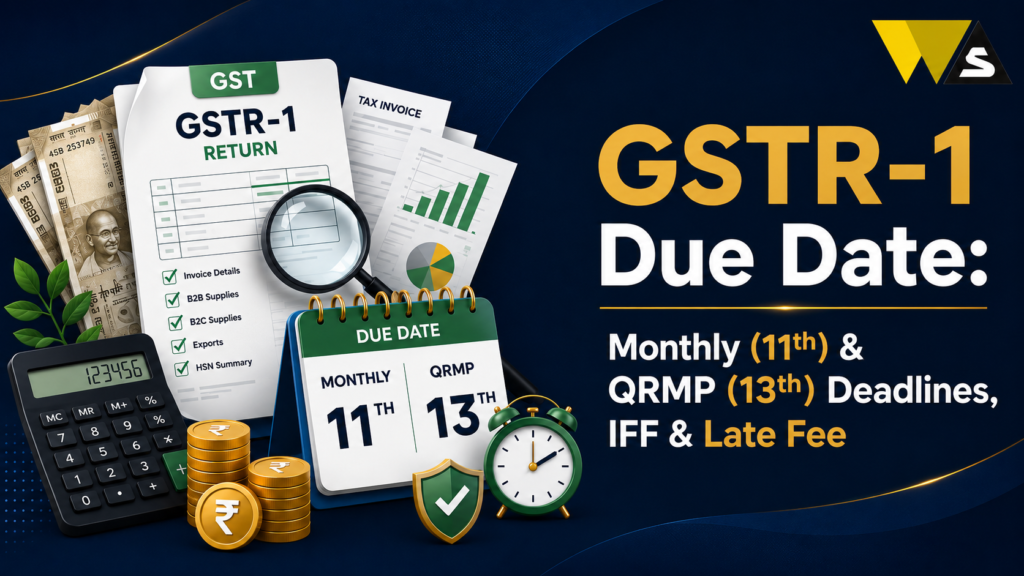
The GSTR-1 due date for monthly filers is the 11th of the next month (for example, June 2026 GSTR-1 is due by 11 July 2026) — this date is the same all over India, with no state-wise difference. For QRMP (quarterly) filers, GSTR-1 is due by the 13th of the month after the quarter, and they can optionally upload key invoices in the first two months using the IFF (Invoice Furnishing Facility) by the 13th of each month.
Filing GSTR-1 late attracts a late fee of ₹50 per day (₹20 for nil), capped by turnover. Whatever you file in GSTR-1 auto-fills your GSTR-3B and cannot be edited there, so GSTR-1 must be correct — fix any error using GSTR-1A before filing GSTR-3B. You must file GSTR-1 before GSTR-3B for the same period.
Table of Contents
ToggleWhat is GSTR-1?
GSTR-1 is the GST return where you report all your sales (outward supplies) in detail — every sales invoice, with the buyer’s GSTIN, invoice value, tax rate, and tax amount.
It is the base return in GST. The data you file in GSTR-1 does two important things:
- It auto-fills your own GSTR-3B (your summary + tax return).
- It decides your buyers’ Input Tax Credit (ITC) — the invoices you report appear in their GSTR-2B.
So GSTR-1 is not just your return it directly affects your buyers. If you file it late or wrong, your buyers cannot claim ITC on time, and they may stop dealing with you.
Key points about GSTR-1:
- Every regular GST taxpayer must file it (monthly or quarterly).
- It must be filed even for a nil (no-sales) month.
- It must be filed before GSTR-3B for the same period.
- From 2025–26, its figures are hard-lock into GSTR-3B and cannot be edited there.
GSTR-1 is the sales-reporting foundation of GST — file it on time and correctly, because everything else depends on it.
GSTR-1 Due Date Overview Table 2026
| Detail | Information |
| Return | GSTR-1 (sales / outward supplies) |
| Monthly Due Date | 11th of the next month |
| QRMP Quarterly Due Date | 13th after the quarter |
| IFF (optional, QRMP) | 13th of each of the first 2 months |
| State-Wise Difference? | No — same date across India |
| Frequency (above ₹5 cr) | Monthly |
| Frequency (up to ₹5 cr) | Monthly or QRMP (quarterly) |
| Late Fee | ₹50/day (₹20 nil), capped by turnover |
| Correction | Via GSTR-1A (same period, before 3B) |
| Order | File GSTR-1 before GSTR-3B |
GSTR-1 Due Date for Monthly Filers
If you are a monthly filer (turnover above ₹5 crore, or you chose monthly filing), your GSTR-1 due date is the 11th of the next month.
Examples:
- June 2026 GSTR-1 → due by 11 July 2026
- July 2026 GSTR-1 → due by 11 August 2026
- March 2026 GSTR-1 → due by 11 April 2026
This 11th date is the same all over India — there is no state-wise difference for GSTR-1 (unlike GSTR-3B under QRMP, which has a 22nd/24th state split). Every business with turnover above ₹5 crore must file GSTR-1 monthly.
GSTR-1 Due Date for QRMP (Quarterly) Filers
If you are a small taxpayer (turnover up to ₹5 crore) who chose the QRMP scheme, you file GSTR-1 quarterly, due by the 13th of the month after the quarter.
QRMP GSTR-1 quarterly due dates (examples):
- Apr–Jun quarter → due 13 July
- Jul–Sep quarter → due 13 October
- Oct–Dec quarter → due 13 January
- Jan–Mar quarter → due 13 April
Note: Unlike GSTR-3B under QRMP (which has a 22nd/24th state-wise split), the QRMP GSTR-1 date is the 13th for everyone — there is no state-wise difference.
Even though you file GSTR-1 quarterly, you can still let your buyers claim ITC monthly by using the IFF .
What is IFF (Invoice Furnishing Facility)?
The IFF is a helpful optional facility for QRMP filers. Here is what it does:
- Under QRMP, you file GSTR-1 only once a quarter — but your buyers may need their ITC every month.
- The IFF lets you upload your important B2B sales invoices in the first two months of the quarter, so your buyers can claim ITC without waiting for the quarter-end.
- IFF due date: the 13th of the next month (for the first and second months of the quarter).
- The third month’s invoices go into the quarterly GSTR-1 (due the 13th after the quarter).
IFF is optional, and it has a value limit consideration for what you upload,it is mainly for B2B invoices where the buyer needs ITC. Use IFF if your B2B buyers need monthly ITC while you continue filing GSTR-1 quarterly.
GSTR-1 vs GSTR-3B Due Dates
Many people confuse the two return dates. Here is the simple difference:
| Return | Monthly Due Date | QRMP Due Date | State-Wise? |
| GSTR-1 (sales) | 11th of next month | 13th after quarter | No |
| GSTR-3B (summary + tax) | 20th of next month | 22nd/24th after quarter | Yes (3B only) |
Key points:
- GSTR-1 always comes first (11th/13th), then GSTR-3B (20th/22nd/24th).
- The state-wise 22nd/24th split applies only to GSTR-3B under QRMP — never to GSTR-1.
- You must file GSTR-1 before GSTR-3B for the same period.
Remember the order — GSTR-1 (sales) first, GSTR-3B (tax) after — and set two separate reminders.
Monthly vs QRMP: Which GSTR-1 Applies to You?
Let’s See Who Files GSTR-1 Monthly and Quarterly
- Turnover above ₹5 crore: You must file GSTR-1 monthly — by the 11th. No QRMP option.
- Turnover up to ₹5 crore: You can choose — monthly GSTR-1 (11th) or quarterly GSTR-1 under QRMP (13th, with optional IFF).
Choose QRMP if you want fewer filings and your buyers’ ITC is handled via IFF; choose monthly if you prefer regular monthly reporting.
Late Fee for Missing the GSTR-1 Due Date
Filing GSTR-1 late now attracts a late fee (earlier it was often waived, but it applies now):
- ₹50 per day for a normal return (₹25 CGST + ₹25 SGST).
- ₹20 per day for a nil return (₹10 CGST + ₹10 SGST).
- The late fee is capped based on turnover — commonly from about ₹2,000 up to ₹10,000 per return.
- It keeps adding daily from the day after the due date until you file.
Filing GSTR-1 late also delays your buyers’ ITC and can hold up your own GSTR-3B, since GSTR-3B depends on GSTR-1.
Can You File GSTR-3B if GSTR-1 is Not Filed?
- You must file GSTR-1 first, then GSTR-3B, for the same period.
- Because GSTR-3B’s sales figures are now auto-filled from GSTR-1 (and are non-editable), your GSTR-3B is not ready until GSTR-1 is filed.
- So a pending GSTR-1 effectively blocks a correct GSTR-3B.
The order is fixed — GSTR-1 → GSTR-3B. Never leave GSTR-1 pending, or your whole month’s filing gets stuck. Always file GSTR-1 by the 11th so you have time to file GSTR-3B by the 20th.
GSTR-1A: How to Correct GSTR-1 Errors
Since GSTR-1 figures hard-lock into GSTR-3B, correcting mistakes is now more important than ever. Here is how it works:
- GSTR-1A is an amendment return that lets you correct or add invoices in your GSTR-1 for the same tax period, before you file GSTR-3B.
- Corrections made in GSTR-1A update your figures immediately, and these flow into GSTR-3B.
- So the right sequence is: file GSTR-1 → fix errors in GSTR-1A (if needed) → then file GSTR-3B.
You cannot edit the sales figures directly in GSTR-3B anymore — GSTR-1A is the proper way to fix them.
HSN Code Reporting in GSTR-1: Table 12
GSTR-1 requires HSN/SAC code reporting for the goods and services you sell, in Table 12.
- HSN codes classify your goods; SAC codes classify services.
- The number of HSN digits you must report depends on your turnover (more digits for larger turnover).
- Recent changes have made HSN selection more strict (choosing from a dropdown rather than typing freely, and separating B2B and B2C).
Keep your correct HSN/SAC codes ready, wrong or missing HSN can cause errors or notices. If unsure, check the HSN lookup on the GST portal or ask a tax professional.
What is a Nil GSTR-1 and How to File It?
A nil GSTR-1 is filed when you had no sales in the period but it is still compulsory:
- You must file a nil GSTR-1 even for a no-sales month.
- The easiest way is to file a nil GSTR-1 by SMS, or quickly on the portal.
- Skipping it brings a ₹20/day late fee and blocks your next return.
Do not ignore nil GSTR-1 a missed nil return still causes late fees and holds up your GSTR-3B.
GSTR-1 Must Be Filed Within 3 Years
A strict rule you must know:
- From the July 2025 tax period onwards, you cannot file GSTR-1 after 3 years from its original due date.
- After 3 years, the return is permanently blocked on the portal there is no late-filing option.
Why this matters:
If you have old pending GSTR-1 returns, file them before the 3-year limit, or you lose the chance forever — which can cause serious compliance problems and block your buyers’ ITC permanently. Never leave GSTR-1 pending for years. Clear old pending returns as soon as possible.
How to File GSTR-1 Before the Due Date
Filing on time is easy if you do it early:
Step 1: Log in to gst.gov.in and open the Returns Dashboard.
Step 2: Select the financial year and month/quarter.
Step 3: Open GSTR-1 and add or upload your sales invoices (B2B, B2C, exports, credit/debit notes).
Step 4: Enter the correct HSN/SAC codes in Table 12.
Step 5: Check all details carefully (remember, these flow into GSTR-3B and cannot be edited there).
Step 6: Submit and file using DSC (Companies/LLPs) or EVC (OTP).
File GSTR-1 a few days before the 11th/13th so you have time to correct errors via GSTR-1A before filing GSTR-3B.
Tips to Never Miss Your GSTR-1 Due Date
Follow these simple steps to avoid late fees and buyer complaints:
- Know your date: 11th (monthly) or 13th (QRMP quarterly).
- Use IFF (13th) if your B2B buyers need monthly ITC under QRMP.
- Set reminders a few days before the date.
- File early, not on the last day — the portal is crowded near deadlines.
- File GSTR-1 first, then GSTR-3B.
- File nil GSTR-1 too — it is compulsory.
- Keep correct HSN codes ready.
- Clear old pending returns to unblock the chain.
Conclusion
Your GSTR-1 due date depends on how you file: monthly filers must file by the 11th of the next month, and QRMP quarterly filers by the 13th of the month after the quarter — with the option to use IFF by the 13th in the first two months so buyers get monthly ITC. Unlike GSTR-3B, GSTR-1 has no state-wise 22nd/24th split — the date is the same all over India.
File GSTR-1 before GSTR-3B. Use GSTR-1A to correct eligible mistakes before filing GSTR-3B. Late filing can bring a daily fee and may delay your buyer’s ITC. A nil GSTR-1 is also required when there are no sales. From July 2025, you have 3 years from the original due date to file GSTR-1.
Frequently Asked Questions (FAQs)
1. What is the GSTR-1 due date?
For monthly filers, GSTR-1 is due by the 11th of the next month, the same across all of India. For QRMP (quarterly) filers, it is due by the 13th of the month after the quarter. There is no state-wise difference for GSTR-1.
2. What is the GSTR-1 due date for QRMP filers?
QRMP filers submit GSTR-1 quarterly by the 13th after the quarter. IFF can be used to upload invoices monthly and help buyers receive ITC sooner.
3. Is the GSTR-1 due date different for each state?
No. Unlike GSTR-3B under QRMP (which has a 22nd/24th state-wise split), the GSTR-1 due date is the same all over India — the 11th for monthly filers and the 13th for QRMP quarterly filers.
4. What is IFF in GSTR-1?
IFF (Invoice Furnishing Facility) is an optional facility for QRMP filers to upload important B2B sales invoices in the first two months of the quarter, due by the 13th of each month, so their buyers can claim Input Tax Credit without waiting for the quarterly GSTR-1.
5. What is the late fee for filing GSTR-1 late?
If you file GSTR-1 late, you may have to pay a daily late fee. It is generally ₹50 per day for a regular return and ₹20 per day for a nil return. Late filing can also affect your buyers’ ITC.
6. Do I have to file GSTR-1 before GSTR-3B?
Yes. You must file GSTR-1 first, then GSTR-3B, for the same period. Because GSTR-3B’s sales figures are now auto-filled from GSTR-1 and cannot be edited, a pending GSTR-1 blocks a correct GSTR-3B.
7. How do I correct a mistake in GSTR-1?
If you find a mistake in GSTR-1, use GSTR-1A to correct or add invoices before filing GSTR-3B. GSTR-3B does not allow you to directly edit sales details.
8. Do I need to file GSTR-1 if I had no sales?
You must file GSTR-1 even if you had no sales during the month. A nil GSTR-1 can also be filed by SMS. If you skip it, a late fee may apply and your next return filing may be affected.
9. What is the 3-year time bar for GSTR-1?
You have 3 years to file GSTR-1 from its original due date. After 3 years, the GST portal will not allow you to file it. Make sure you clear old pending returns before the limit.
10. How can I never miss my GSTR-1 due date?
Know your date (11th monthly or 13th QRMP), set reminders a few days early, use IFF if buyers need monthly ITC, file GSTR-1 before GSTR-3B, file nil returns too, keep correct HSN codes ready, and file a few days early to allow GSTR-1A corrections.
Read our article:
Read our article:
Read our article:
Read our article:
Read our article: