
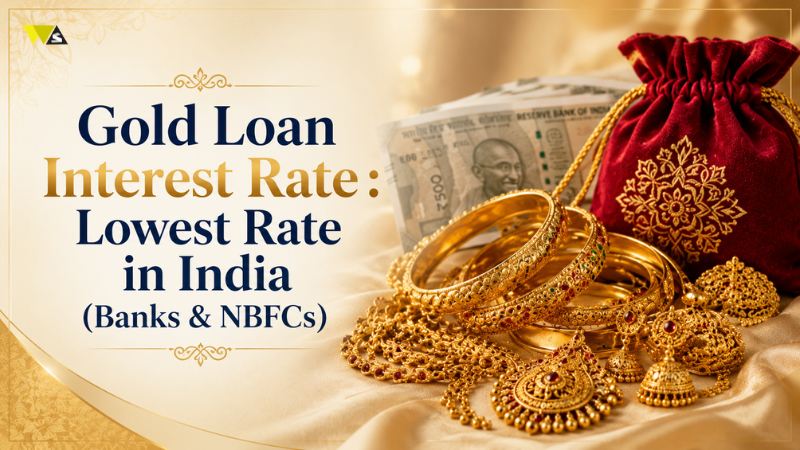
If you need quick funds, a gold loan can be one of the easiest borrowing options. Public sector banks generally offer lower interest rates, while NBFCs provide quicker processing and faster loan approval. The amount you can borrow depends on the purity and value of your gold jewellery.
Before choosing a lender, check the gold loan interest rates, processing fee, and the amount of the loan you will receive for your gold.
Table of Contents
ToggleWhat Is a Gold Loan?
A gold loan is a quick way to borrow money using your gold jewellery as security. You hand over your gold to a bank or lender, and they give you a loan based on its value. After you repay the loan and interest, your gold is returned.
Gold loans are popular because they are fast, require very little paperwork, and often come with lower interest rates than personal loans. They are widely used for emergencies, business expansion, agricultural needs, education expenses, and other short-term funding requirements.
Gold Loan Interest Rates Overview
| Detail | Information |
| Interest Rate Range | ~8.05% to 27% p.a. |
| Lowest Rates | Public sector banks (SBI, PNB) ~8.25%–9% p.a. |
| Loan Amount | ₹1,500 to ₹50 lakh+ |
| Gold Accepted | 18K–22K jewellery and ornaments |
| Max LTV (from 1 Apr 2026) | 85% (up to ₹2.5 lakh), 80% (₹2.5–5 lakh), 75% (above ₹5 lakh) |
| Tenure | 6 months to 3–4 years (bullet repayment loans capped at 12 months) |
| Processing Fee | ~0.25% to 1% |
| Gold Return | Within 7 working days after full repayment |
Lowest Gold Loan Interest Rates 2026: Bank & NBFC Comparison
This is what most people search for first, who gives the cheapest gold loan. Here is a simple comparison of typical 2026 Gold Loan Interest Rates. Public sector banks are usually the cheapest, while NBFCs are the fastest.
| Lender | Type | Typical Interest Rate (2026) |
| State Bank of India (SBI) | Public Bank | From ~8.75% p.a. |
| Punjab National Bank (PNB) | Public Bank | From ~8.25% p.a. |
| Canara Bank | Public Bank | From ~9% p.a. |
| Union Bank of India | Public Bank | Up to ~10.40% p.a. |
| HDFC Bank | Private Bank | From ~9% p.a. |
| ICICI Bank | Private Bank | From ~10% p.a. |
| Axis Bank | Private Bank | ~13.5%–17% p.a. |
| Kotak Mahindra Bank | Private Bank | Competitive rates, vary by borrower profile |
| Muthoot Finance | NBFC | ~12%–26% p.a. |
| Manappuram Finance | NBFC | ~12%–24% p.a. |
Note: Gold loan interest rates change regularly. The final rate depends on your loan and gold details. Always check the current rate with the lender before applying.
Which Gold Loan Has the Lowest Interest Rate?
If your main goal is the lowest rate, go for a public sector bank like SBI or PNB. They offer the cheapest rates but may take a little longer (1–3 days) and ask for more documents. If you need money the same day, an NBFC like Muthoot or Manappuram is faster but charges a higher rate. So the “best” lender depends on whether you value low cost or speed more.
Bank or NBFC: Which Gold Loan Is Better?
Many borrowers get confused between banks and NBFCs. Here is a simple breakdown:
| Point | Banks (SBI, PNB, HDFC) | NBFCs (Muthoot, Manappuram) |
| Interest Rate | Lower (8%–15%) | Higher (12%–26%) |
| Disbursal Speed | Slower (1–3 days) | Very fast (same day or within minutes) |
| Documents | More paperwork | Fewer documents |
| Best For | Large loan amounts and longer tenures | Quick cash and smaller loan amounts |
| Branch Reach | Wide network, but more formal processes | Very wide network, including small towns |
Choose a bank for lower interest rates. Choose an NBFC for faster loan approval. The main gold loan rules are now similar for all lenders under the 2026 RBI guidelines.
New RBI Gold Loan Rules 2026 (Effective 1 April 2026)
This is the biggest update for 2026, and it directly affects how much you can borrow. The Reserve Bank of India (RBI) brought a new gold loan framework, effective 1 April 2026, that applies the same rules to banks, NBFCs, and cooperative lenders for the first time.
New Tiered LTV (Loan-to-Value) Limits
Earlier, you could borrow only up to 75% of your gold’s value, no matter the amount. Now the limit is tiered to help small borrowers:
| Loan Amount | Maximum LTV (How Much You Can Borrow) |
| Up to ₹2.5 lakh | Up to 85% of the gold value |
| ₹2.5 lakh to ₹5 lakh | Up to 80% of the gold value |
| Above ₹5 lakh | Up to 75% of the gold value (as before) |
For example, if your gold is valued at ₹2,00,000, you may now be able to borrow up to ₹1,70,000 under the revised rules. Earlier, the maximum loan amount would have been around ₹1,50,000. This change allows small borrowers to access more funds against the same gold.
New Rules That Benefit Borrowers
- Gold returned in 7 working days: After you fully repay, the lender must return your gold within 7 working days, or pay you a penalty (around ₹5,000 per day of delay).
- Key Fact Statement (KFS): Before you sign, the lender must give you a simple KFS showing the interest rate, fees, and all terms clearly.
- Standard valuation: Gold is now valued using a standard IBJA-linked method, so all lenders value your gold fairly.
- Bullet repayment capped: Bullet (lump-sum) repayment loans are limited to a 12-month tenure to avoid long rollovers.
- Easier small loans: For loans below ₹2.5 lakh, income proof and credit checks are largely relaxed, since the gold itself is the security.
These rules make 2026 the most borrower-friendly time ever for gold loans, with more transparency and better protection.
How Is Your Gold Loan Interest Rate Calculated?
Two people can get different Gold Loan Interest Rates on the same day. Here is what affects the rate you are offered:
- Lender type: Public banks are cheapest, NBFCs are costliest.
- Loan amount and LTV: Higher LTV (85%) loans may carry a small risk premium of 1%–2% extra.
- Repayment option: Bullet/overdraft schemes usually cost 0.5%–1% more than EMI schemes.
- Gold purity: Higher purity (22K) fetches a better per-gram value.
- Tenure: Longer tenure can change the rate slightly.
- Borrower profile: Salaried, self-employed, or agricultural borrowers may get different rates; agricultural gold loans can be as low as ~7%.
To get the lowest rate, borrow a smaller amount, choose EMI repayment, pledge high-purity gold, and compare a few lenders.
Gold Loan Per Gram Rate 2026: How Much Can You Borrow?
The “per gram rate” tells you how much money you get for each gram of gold. It depends on the current gold price and the LTV allowed.
Here is how it works with a simple example. Suppose 22K gold is priced at ₹14,400 per gram in the market:
- The lender will not give the full ₹14,400.
- At 75% LTV, you get about ₹10,800 per gram.
- At 85% LTV (for small loans up to ₹2.5 lakh), you get a higher amount per gram.
Most lenders calculate gold loan values using the average gold price over the previous 30 days. Because of this, the loan amount offered may be slightly different from what you see in an online gold loan calculator. Higher-purity gold, such as 22K jewellery, generally qualifies for a higher loan value than 18K gold.
To maximize your loan amount, pledge high-purity gold jewellery and compare lenders to find one offering a higher loan-to-value (LTV) ratio.
How to Calculate Gold Loan Interest Rates (Simple Formula)
You can work out the gold loan interest rates by yourself using a simple formula:
Interest = Principal × Rate × Time
For example, on a ₹1,00,000 loan at 9% per year for 1 year: Interest = 1,00,000 × 9% × 1 = ₹9,000 for the year.
Most lenders, though, charge interest monthly on the outstanding amount. You can also use a free online gold loan EMI calculator (most bank websites have one) to see your monthly payment instantly. Always check whether interest is charged monthly or yearly, and whether there is a minimum interest period (some fintechs charge at least 7–15 days of interest even if you repay early).
Gold Loan Repayment Options
Most gold loan lenders offer different ways to repay the loan. Choose the option that suits your budget and income:
- EMI: You pay equal monthly installments covering both principal and interest. Best for salaried people who want a fixed, predictable payment.
- Monthly interest only: You pay just the interest each month and repay the full principal at the end. This gives the lowest monthly outflow.
- Bullet / lump-sum: You pay everything — principal plus interest — at the end of the tenure. Best for short-term needs and business owners expecting money later. Under the 2026 rules, bullet loans are capped at 12 months.
Choose an EMI repayment plan if you prefer fixed monthly payments and a structured repayment schedule. If your income comes in irregular or lump-sum amounts, a monthly interest or bullet repayment option may be more suitable. Before taking the loan, check whether any prepayment charges apply.
Gold Loan Eligibility Criteria
Gold loans are among the easiest loans to get, because your gold is the security. You are eligible if:
- You are an Indian citizen, usually aged 18 years or above.
- You own gold jewellery or ornaments of 18 to 22 karat purity.
- You can show basic KYC (identity and address proof).
- For small loans (below ₹2.5 lakh), no income proof or credit score is usually needed.
Salaried people, self-employed people, business owners, homemakers, farmers, and even people with a low or no credit score can get a gold loan, since the loan is backed by the gold, not your income.
Documents Required for a Gold Loan
Applying for a gold loan is usually simple and requires only a few basic documents. Commonly required documents include:
- Identity proof: Aadhaar card, PAN card, Voter ID, Driving Licence, or Passport.
- Address proof: Aadhaar, utility bill, or rent agreement.
- Passport-size photographs.
- The gold you want to pledge (jewellery/ornaments).
- Proof of gold ownership — the original purchase receipt if available. For old family gold without a receipt, you can sign a simple ownership declaration, which the lender keeps on record.
PAN may be required for larger loan amounts. For loans below ₹2.5 lakh, the process is quick and needs minimal documents.
How to Apply for a Gold Loan (Step by Step)
Getting a gold loan is fast and simple:
- Choose a lender , compare interest rate, per-gram value, and processing fee across a few banks and NBFCs.
- Visit the branch with your gold and KYC documents (many lenders also offer doorstep service or online booking).
- The lender weighs and tests your gold (purity check via XRF) and values it.
- You are told the eligible loan amount based on the value and LTV.
- Read the Key Fact Statement (KFS) carefully — check the rate, fees, tenure, and repayment mode.
- Sign the agreement and submit documents.
- The money is disbursed, often within minutes (NBFCs) or 1–3 days (banks), to your bank account.
Your gold is kept safely by the lender and returned to you within 7 working days of full repayment, as per the 2026 rules.
Gold Loan Charges and Hidden Costs
A low interest rate does not always mean the loan is cheaper. Make sure you check these additional fees and charges before signing the agreement:
- Processing fee: Around 0.25% to 1% of the loan at banks; NBFCs may charge a small flat fee.
- Valuation fee: Around ₹250 to ₹500 for purity testing.
- Prepayment / foreclosure charges: Some lenders charge a fee if you repay early — ask first.
- Minimum interest clause: Some fintechs charge at least 7–15 days of interest even if you repay in 2 days.
- Renewal / re-appraisal fee: May apply if you renew the loan.
Always ask for the full cost in writing in the Key Fact Statement, so there are no surprises later.
Benefits of Taking a Gold Loan
A gold loan can be a smart choice for short-term money needs. Key benefits:
- Lower interest than personal loans: Gold loans (8%–15% at banks) are cheaper than most personal loans (11%–18%).
- Quick money: Approval is fast because the loan is secured by gold.
- No strong credit score needed: Even people with no credit history can get one.
- Keep your gold: You get cash without selling your jewellery, and get it back after repayment.
- Flexible repayment: Choose EMI, interest-only, or bullet repayment.
- Use for any purpose: Medical needs, education, business, or emergencies — except buying more gold (RBI does not allow gold loan money to be used to buy gold).
Understanding the Risks of Gold Loans
A gold loan is useful but has risks you should know:
- Auction risk: If you do not repay, the lender can auction your gold to recover the money. The 2026 rules make this process more transparent, but the risk is real.
- Falling gold prices: If gold prices drop sharply, the lender may ask for extra gold or partial repayment to keep the LTV in limit.
- High NBFC rates: Fast money from NBFCs can cost much more in interest.
- Short tenure on bullet loans: Capped at 12 months, so plan repayment.
Borrow only what you can repay, choose a tenure that fits your income, and never ignore repayment reminders.
Gold Loan vs Selling Gold: Which Is Better?
When you need money, you may wonder whether to take a gold loan or simply sell your gold. Here is a simple way to decide:
- Take a gold loan if you need money for a short period and want to keep your jewellery. You pay some interest, but you get your gold back after repaying. This suits emergencies, short business needs, or education fees.
- Sell your gold only if you need money permanently and do not plan to buy it back, or if the interest cost over a long period would be higher than the value you lose by selling.
For most families, a gold loan is better because gold often has emotional and family value, and prices keep rising over time. By taking a loan instead of selling, you keep ownership of an asset that may be worth more later, while still solving your cash need today.
Gold Loan Top-Up and Renewal
If gold prices increase after you take a loan, the value of your sold gold may also rise. In some cases, lenders may allow you to take a top-up loan based on the higher value without pledging additional gold.
If you need more time to repay your gold loan, many lenders allow you to renew the loan at the end of the tenure. This usually requires you to pay the accumulated interest and extend the loan period. Before renewing, check whether the lender charges any renewal or gold revaluation fees.
How to Get a Low-Interest Gold Loan
A few simple habits help you get the lowest cost:
- Compare lenders — check at least 3–4 banks and NBFCs for rate, per-gram value, and fees.
- Prefer public sector banks like SBI or PNB for the lowest interest rate.
- Choose EMI repayment for a lower rate than bullet schemes.
- Borrow smaller amounts (under ₹2.5 lakh) to enjoy higher LTV and lower “priority sector” rates.
- Pledge high-purity (22K) gold for a better per-gram value.
- Always read the Key Fact Statement before signing.
- Ask about prepayment charges and minimum interest to avoid surprise costs.
Conclusion
If you need money quickly, a gold loan can be a practical solution. It offers fast approval, simple documentation, and competitive interest rates compared to many other borrowing options. Thanks to the latest rules, borrowers also benefit from clearer terms and stronger safeguards.
To get the best value, compare multiple lenders, understand all charges, and select a repayment plan that suits your income. By borrowing responsibly and repaying on time, you can meet your financial needs while keeping ownership of your gold.
Frequently Asked Questions (FAQs)
1. Which bank has the lowest gold loan interest rate in 2026?
Public sector banks like SBI and PNB usually have the lowest gold loan interest rates in 2026, starting around 8.25%–9% per year. The Central Bank of India is also often among the cheapest.
2. What is the gold loan interest rate range in India in 2026?
It ranges from about 8.05% to 27% per year, depending on the lender, loan amount, gold purity, tenure, and repayment option. Banks are cheaper; NBFCs are costlier but faster.
3. How much loan can I get per gram of gold?
It depends on the current gold price and LTV. At a 22K price of around ₹14,400/gram and 75% LTV, you get roughly ₹10,800 per gram. Small loans (up to ₹2.5 lakh) can get up to 85% LTV, so a higher per-gram value.
4. What is the new RBI gold loan rule for 2026?
From 1 April 2026, RBI allows tiered LTV — up to 85% for loans up to ₹2.5 lakh, 80% for ₹2.5–5 lakh, and 75% above ₹5 lakh. Lenders must also return gold within 7 working days of repayment and give a Key Fact Statement.
5. Is a gold loan cheaper than a personal loan?
Yes. Gold loans (around 8%–15% at banks) are usually cheaper than personal loans (around 11%–18%), because gold loans are secured by your gold.
6. Do I need a good credit score for a gold loan?
No. For most gold loans, especially small ones, a credit score is not required, since the loan is backed by gold. People with low or no credit history can still apply.
7. What gold can I pledge for a gold loan?
You can pledge gold jewellery and ornaments of 18 to 22 karat purity. Most lenders give loans against jewellery; some also accept gold coins within limits.
8. What are the repayment options for a gold loan?
You can choose EMI (equal monthly installments), monthly interest only (repay principal at the end), or bullet repayment (pay everything at the end, capped at 12 months in 2026).
9. What happens if I cannot repay my gold loan?
If you do not repay, the lender can auction your pledged gold to recover the money, following the transparent auction process set by RBI. So borrow only what you can repay.
10. Can I use gold loan money to buy more gold?
No. RBI does not allow gold loan proceeds to be used to buy gold in any form — jewellery, coins, ETFs, or gold mutual funds.
11. What is the LTV ratio in a gold loan?
LTV (Loan-to-Value) is the maximum percentage of your gold’s value you can borrow. In 2026 it is tiered: up to 85% for small loans and 75% for large ones.
12. Are agricultural gold loans cheaper?
Yes. Agricultural gold loans from leading lenders can have interest rates as low as around 7%, lower than regular gold loans.
13. How fast can I get a gold loan?
NBFCs can disburse money the same day, sometimes in minutes. Banks usually take 1 to 3 days but offer lower rates.
14. What is a Key Fact Statement (KFS)?
A KFS is a simple summary document that the lender must give you before disbursement, showing the interest rate, fees, tenure, and key conditions clearly.
15. Is it better to take a gold loan or sell my gold?
A gold loan is usually better if you need money for a short time and want to keep your jewellery, since you get your gold back after repaying. Sell only if you need the money permanently and won’t buy gold back.
16. Can I get a gold loan top-up if gold prices rise?
Yes. If your pledged gold is worth more due to rising prices, many lenders allow a top-up on the same gold, or a renewal at the end of the tenure (a small re-appraisal fee may apply).
Sovereign Gold Bond (SGB)Sahara Refund Portal