
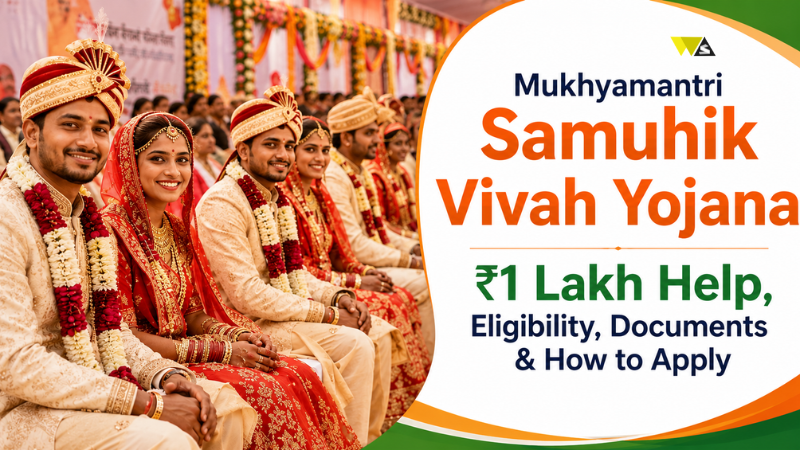
Mukhyamantri Samuhik Vivah Yojana (CM Mass Marriage Scheme) is a welfare scheme run by the Government of Uttar Pradesh. It gives ₹1,00,000 (₹1 lakh) of help for the marriage of a daughter from a poor family. The money is split into cash for the bride, wedding gifts, and event costs.
To apply, the family must be a permanent resident of Uttar Pradesh and have a yearly income of ₹3 lakh or less. Marriages are held as group ceremonies, and you register through your local Block office, Municipal office, or the District Social Welfare Department.
Table of Contents
ToggleMukhyamantri Samuhik Vivah Yojana Overview
| Point | Detail |
| Scheme Name | Mukhyamantri Samuhik Vivah Yojana (CM Mass Marriage Scheme) |
| Run By | Social Welfare Department, Government of Uttar Pradesh |
| Started In | October 2017 |
| Total Help | ₹1,00,000 (₹1 lakh) per couple |
| Income Limit | ₹3 lakh per year (family) |
| Bride’s Minimum Age | 18 years |
| Groom’s Minimum Age | 21 years |
| Mode of Payment | Direct Bank Transfer (DBT) to bride |
| Who Can Apply | Poor families, widows, divorced & abandoned women |
| Apply Through | Block / Municipal / District Social Welfare office |
What is Mukhyamantri Samuhik Vivah Yojana?
Mukhyamantri Samuhik Vivah Yojana is a Uttar Pradesh government scheme that helps poor families with marriage expenses. Under the scheme, many couples get married together in a government-organized ceremony, and financial assistance is provided to support the wedding. The scheme is open to all religions and communities.
Key Features of the Scheme:
- Financial assistance is provided for eligible couples.
- Mass marriage ceremonies are organized by the government.
- The scheme aims to reduce the financial burden of marriage on poor families.
- It is managed by the Social Welfare Department of Uttar Pradesh.
- People from all communities and religions can apply.
- Marriage ceremonies are conducted according to the customs and traditions of the couple’s religion.
Why Was Mukhyamantri Samuhik Vivah Yojana Scheme Started?
Understanding the goals of the scheme helps you see why it is so popular and useful.
- To help poor families: Weddings are expensive. This scheme removes the heavy money pressure from families who cannot afford a marriage.
- To stop debt and loans: Many families borrow money for weddings and stay in debt for years. Group marriages cut the cost and stop this cycle.
- To reduce show-off spending: The scheme discourages wasteful, grand spending on marriage and promotes simple, dignified ceremonies.
- To support women: It is not only for first marriages. Widows, divorced women, and abandoned women can also get help for remarriage.
- To build social harmony: Couples from different communities marry together in the same event, which promotes unity and equality.
- To make sure no daughter stays unmarried due to money: The government wants that poverty should never stop a daughter’s marriage.
Since 2017, the scheme has helped a very large number of families. In about eight years, more than 4.76 lakh girls from poor families have been married under this scheme, and it has especially helped backward classes, Dalit families, and minority families.
Mukhyamantri Samuhik Vivah Yojana Amount: ₹1 Lakh Breakdown
This is the part most people search for. When the scheme started in 2017, the help amount was ₹35,000. Later it was raised to ₹51,000. Now, from the financial year 2025-26 (April 2025), the government has increased it to ₹1,00,000 (₹1 lakh) per couple.
The ₹1 lakh is not given as one single cash amount. It is divided into three clear parts. Here is the easy breakdown:
| Part | Purpose | Amount |
| Part 1 | Cash sent to the bride’s bank account | ₹60,000 |
| Part 2 | Wedding gifts & household items for the couple | ₹25,000 |
| Part 3 | Event costs (food, pandal, furniture, water, etc.) | ₹15,000 |
| Total | ₹1,00,000 |
Let us understand each part simply:
Part 1 — ₹60,000 cash to the bride: The biggest share of the benefit goes directly to the bride’s bank account. She can use the money for her new home or keep it as savings.
Part 2 — ₹25,000 in gifts: The government also provides gifts to help the newly married couple start their new life. These may include clothes, household items, and other useful essentials.
Part 3 — ₹15,000 for the ceremony: The government pays for the wedding arrangements, including food, tents, chairs, lighting, and other event expenses. Families do not have to bear these costs.
Who is Eligible for Samuhik Vivah Yojana? (Eligibility Criteria)
Before you apply, check all the conditions below carefully. Missing even one can lead to rejection.
1. Residency The family must be a permanent resident of Uttar Pradesh. You will need address proof such as Aadhaar, ration card, or domicile certificate.
2. Family Income The total yearly family income must be ₹3 lakh or less. Earlier this limit was ₹2 lakh, but the government raised it to ₹3 lakh so that more families can benefit. You will need an income certificate.
3. Age of the Couple
- The bride must be at least 18 years old.
- The groom must be at least 21 years old. This rule follows the legal minimum marriage age in India, and it also helps stop child marriage.
4. Open to All Communities The scheme is open to all categories and religions — General (BPL), SC, ST, OBC, and minorities. Marriages are performed as per each couple’s own customs.
5. Widows and Divorced Women The scheme also supports the remarriage of widows, divorced women, and abandoned women from poor families. This is a special and caring feature of the scheme.
6. Group Ceremony Rule Because it is a “mass” marriage scheme, the weddings are organised as group ceremonies with many couples together. Local bodies usually arrange these events when enough couples are registered.
Documents Required for Mukhyamantri Samuhik Vivah Yojana
Keep these documents ready before you apply. Having clear photocopies and scans saves a lot of time.
- Aadhaar card of the bride and groom
- Age proof of bride (18+) and groom (21+) — such as birth certificate, school certificate, or voter ID
- Income certificate (showing family income up to ₹3 lakh)
- Caste certificate (if applying under a reserved category)
- Residence proof / domicile certificate
- Bank account passbook of the bride (Aadhaar-linked)
- Passport-size photographs of the bride and groom
- Marriage invitation card or proof of the planned marriage
- A working mobile number for updates
Tip: The bank account must be in the bride’s name and linked with Aadhaar, because the ₹60,000 cash goes directly to her account.
How to Apply for Samuhik Vivah Yojana (Step-by-Step)
The application for this scheme is mainly handled by local government bodies, because the weddings are organised as public events in each area. Follow these steps.
Step 1 — Find your local registration office
- If you live in a village (rural area), contact your Gram Panchayat or the Block Development Officer (BDO) office.
- If you live in a city (urban area), contact your Nagar Nikay / Municipal office (Nagar Palika or Nagar Nigam).
- You can also contact the District Social Welfare Officer (DSWO) office for guidance.
Step 2 — Get and fill the application form Collect the application form from the office (or the official portal if available in your district). Fill in the details of the bride and groom carefully, including names, age, address, and bank details.
Step 3 — Attach the documents Attach photocopies of all the required documents listed above. Make sure the bride’s bank account details and Aadhaar are correct.
Step 4 — Submit the form Submit the completed form along with the documents to the local office before the deadline announced for the next mass marriage event.
Step 5 — Verification Government officials will verify your documents and confirm your eligibility. They check income, age, and residence details.
Step 6 — Attend the group ceremony Once approved, the couple’s name is added to the list for the next mass marriage event. On the wedding day, the marriage is performed as per your customs, gifts are given, and the ₹60,000 is transferred to the bride’s bank account.
Note: Some districts may also offer an online registration option through the Social Welfare Department portal. Always check with your local office or the official UP Social Welfare Department for the exact method in your area, and use only official channels.
How to Check Samuhik Vivah Yojana Application Status
After you apply, you will want to know if your form is approved. Here is how to follow up.
- Visit the same local office (Block, Municipal, or District Social Welfare office) where you submitted your form.
- Carry your application receipt or reference details.
- Ask the staff about the status of your verification and the date of the next mass marriage event.
- If your district has an online portal, you can log in and check your status there.
If the cash help does not reach the bride’s account within a reasonable time after the wedding, contact the District Social Welfare Officer with your application details.
Samuhik Vivah Yojana : Common Mistakes to Avoid
Many applications get delayed or rejected for small reasons. Avoid these errors:
- Wrong bank details: The bride’s account number and IFSC code must be correct, or the ₹60,000 will not arrive.
- Income above the limit: If your income certificate shows more than ₹3 lakh, you will not qualify.
- Age proof problems: The bride must be clearly 18+ and the groom 21+. Wrong or missing age proof leads to rejection.
- Bank account not in bride’s name: The money goes to the bride, so the account must be hers and Aadhaar-linked.
- Missing the registration window: Apply before the deadline for the next event. Late forms wait for the next round.
- Trusting middlemen: Apply only through official offices. Never pay a bribe or share your bank OTP with anyone.
Why Mukhyamantri Samuhik Vivah Yojana Important
This scheme is more than just money for a wedding. For a poor family, the marriage of a daughter can mean years of debt and worry. By taking on this cost, the government removes a huge burden from the shoulders of parents who struggle every day to make ends meet.
It also protects the dignity of the family. Instead of feeling shame for not affording a big wedding, parents can see their daughter married in a respectable public ceremony, with gifts and arrangements provided. The cash support helps the bride start her new life with some savings in hand.
The scheme also supports widows, divorced women, and abandoned women who wish to remarry. It helps them start a new chapter in life with dignity and financial assistance. Over the years, the scheme has benefited lakhs of families across Uttar Pradesh, especially those from economically weaker sections.
Mukhyamantri Samuhik Vivah Yojana Old Amount vs New : ₹1 Lakh
The scheme has been updated over time. Here’s how the financial assistance has increased:
| Year / Stage | Help Amount Per Couple |
| 2017 (when scheme started) | ₹35,000 |
| After first revision | ₹51,000 |
| From FY 2025-26 (current) | ₹1,00,000 (₹1 lakh) |
Along with the money, the income limit was also raised from ₹2 lakh to ₹3 lakh per year. This was a big step, because it means many more families now qualify for the scheme. So if you read somewhere that the limit is ₹2 lakh, treat the new ₹3 lakh limit as the current rule, but always confirm on official sources before applying.
The government has also added useful and symbolic items to the gift package over time. For example, brides may receive a sindoor daani as part of the wedding gifts. These updates show that the scheme is regularly improved to better support beneficiaries.
Mukhyamantri Samuhik Vivah Yojana Important Dates and Deadlines
There is no single fixed “last date” for this scheme, because mass marriage events are held many times during the year in different districts. However, each event has its own registration window.
Local offices announce when the next group wedding will be held and when forms must be submitted. The safest approach is simple:
- Contact your local Block, Municipal, or Social Welfare office early, even before the marriage date is fixed.
- Submit your form well before the announced deadline for the next event.
- If you miss one event’s deadline, your application can usually be carried forward to the next mass marriage event in your area.
Applying early gives officials enough time to verify your documents and reduces the chance of last-minute problems.
Mukhyamantri Samuhik Vivah Yojana Helpline and Contact Information
If you face any problem during application, verification, or payment, you have several ways to get help:
- Visit your District Social Welfare Officer (DSWO) office for direct guidance on the scheme.
- Contact your Block Development Officer (BDO) office in rural areas or your Municipal / Nagar Nikay office in urban areas.
- Check the official Uttar Pradesh Social Welfare Department for contact details, notices, and any online portal links for your district.
When you visit any office, carry your application details and document copies so the staff can find your case quickly and help you faster.
How to approve Mukhyamantri Samuhik Vivah Yojana
To make sure your application is approved without delays, keep these points in mind:
- Apply early, before the deadline for the next mass marriage event.
- Make sure the bank account is in the bride’s name and linked with Aadhaar.
- Double-check the account number and IFSC code before submitting.
- Keep age proof ready showing the bride is 18+ and the groom is 21+.
- Ensure your income certificate shows ₹3 lakh or less.
- Use only official offices and channels never trust agents who ask for money.
- Keep your mobile number active for updates and verification calls.
Following these small steps can be the difference between a smooth, dignified wedding and a frustrating delay.
Conclusion
Mukhyamantri Samuhik Vivah Yojana is a caring and practical scheme. It makes sure that no daughter in Uttar Pradesh stays unmarried just because her family is poor. With ₹1 lakh of total help cash for the bride, gifts for the couple, and a fully arranged wedding it removes a heavy burden from struggling families and lets them celebrate the marriage with dignity.
If your family lives in Uttar Pradesh, earns up to ₹3 lakh a year, and there is a marriage in the house, you should not miss this benefit. The key is to apply on time through your local office, keep all your documents ready, give correct bank details in the bride’s name, and use only official channels. By doing this, you can give your daughter a respectful wedding and a stronger start to her new life.
Frequently Asked Questions (FAQ)
Q1. What is Mukhyamantri Samuhik Vivah Yojana?
It is a welfare scheme by the Uttar Pradesh government, started in 2017, that organises group marriages for daughters of poor families and provides ₹1 lakh of help per couple. It is also called the CM Mass Marriage Scheme.
Q2. How much money is given under this scheme?
The total help is ₹1,00,000 (₹1 lakh) per couple. This includes ₹60,000 sent to the bride’s bank account, ₹25,000 in wedding gifts and household items, and ₹15,000 for the cost of the ceremony.
Q3. Who is eligible to apply?
Permanent residents of Uttar Pradesh with a yearly family income of ₹3 lakh or less can apply. The bride must be at least 18 years old and the groom at least 21. It is open to all communities, and widows, divorced, and abandoned women can also apply for remarriage.
Q4. What documents are needed?
You need Aadhaar cards of the bride and groom, age proof, income certificate, caste certificate (if applicable), residence proof, the bride’s bank passbook, passport-size photos, and a marriage invitation card or proof of the planned marriage.
Q5. How do I apply for this scheme?
You apply through your local government office — the Gram Panchayat or Block office in villages, the Municipal office in cities, or the District Social Welfare Office. Some districts may also offer online registration through the Social Welfare Department.
Q6. Where does the wedding take place?
The marriages are held as group ceremonies at a common public place, such as a community hall or ground. Each couple is married as per their own religion and customs, and the event is arranged and paid for by the scheme.
Q7. Is this scheme only for Hindus?
No. The scheme is open to all communities and religions, including SC, ST, OBC, minorities, and General BPL families. Each couple is married according to their own customs.
Q8. Can widows and divorced women apply?
Yes. The scheme specially supports the remarriage of widows, divorced women, and abandoned women from poor families, giving them a chance to settle down again.
Q9. How does the ₹60,000 reach the bride?
The ₹60,000 cash is sent directly to the bride’s own bank account through Direct Bank Transfer (DBT). This is why the account must be in the bride’s name and linked with her Aadhaar.
Q10. What was the old amount before ₹1 lakh?
When the scheme started in 2017, the help was ₹35,000. It was later raised to ₹51,000, and now, from the financial year 2025-26, it has been increased to ₹1 lakh per couple.
Kanya Sumangala YojanaKerala Free Bus Travel for Women Scheme
TVK ₹4,000 Youth Scheme