
Choosing your company structure is an important decision when starting a business. Changing it later can be difficult and expensive. The wrong choice may lead to higher taxes, more compliance work, or restructuring problems when you want to raise money.
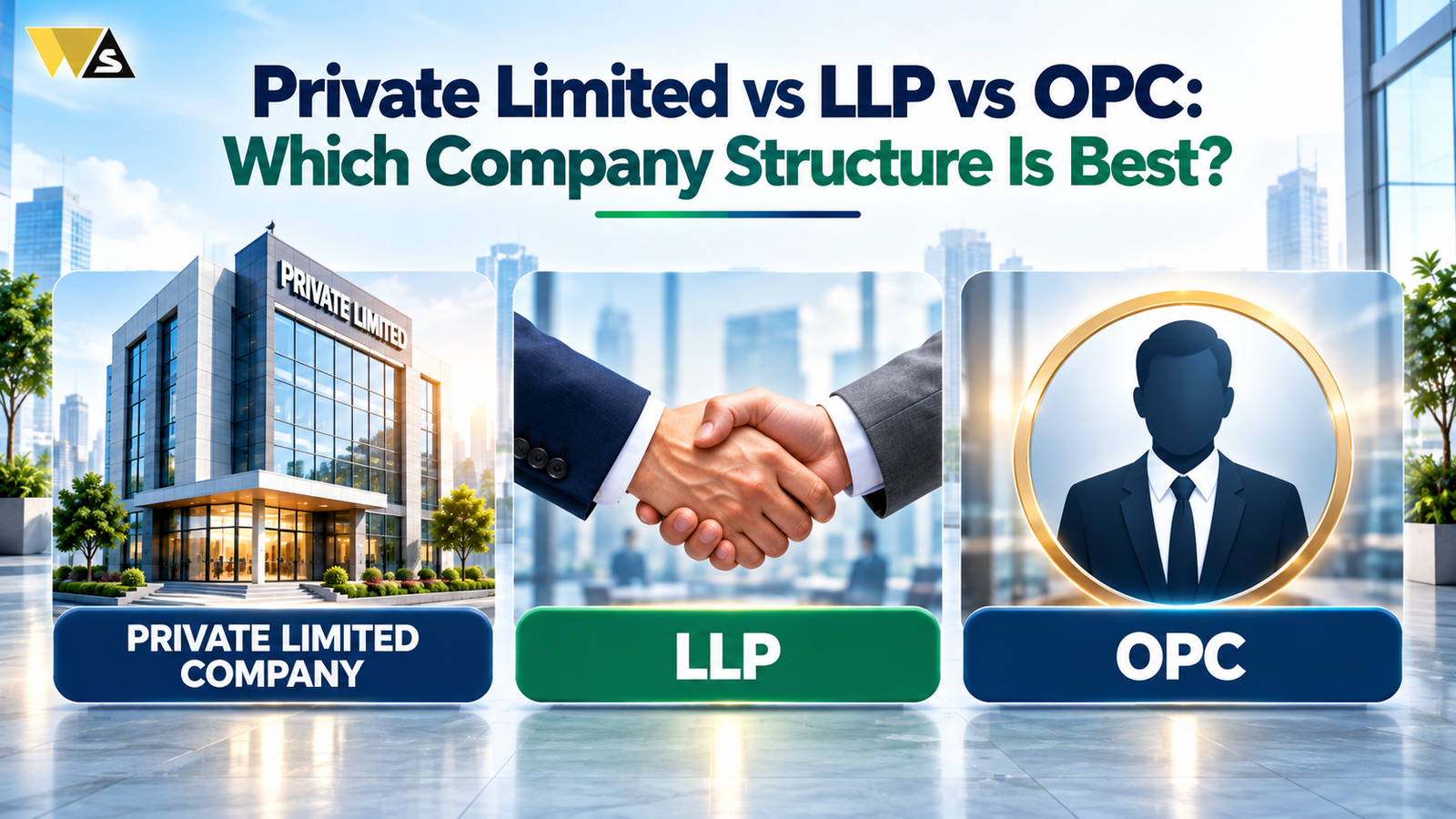
The three common options in India are Private Limited Company (Pvt Ltd), LLP, and One Person Company (OPC). This blog explains the differences and helps you choose the structure that best matches your business plans.
Table of Contents
TogglePrivate Limited vs LLP vs OPC
| Point | Private Limited Company | LLP | OPC |
| Governing law | Companies Act, 2013 | LLP Act, 2008 | Companies Act, 2013 |
| Minimum owners | 2 shareholders | 2 partners | 1 member + 1 nominee |
| Maximum owners | 200 shareholders | No limit | 1 member only |
| Minimum directors | 2 (one resident Indian) | 2 designated partners | 1 |
| Income tax rate | 22% under Sec 115BAA + surcharge and cess | 30% + surcharge and cess | 22% under Sec 115BAA + surcharge and cess |
| MAT / AMT | No MAT if you opt for 115BAA | No MAT, but AMT can apply | No MAT if you opt for 115BAA |
| Statutory audit | Always | Only above ₹40 lakh turnover or ₹25 lakh contribution | Always |
| Board meetings | 4 per year | Not required | 2 per year |
| ITR form | ITR-6 | ITR-5 | ITR-6 |
| Can issue ESOPs | Yes | No | No |
| Equity funding from VCs | Yes | Difficult | Not practical |
| Foreign nationals as owners | Allowed | Allowed | Not allowed (NRIs with Indian citizenship can) |
| FDI | Automatic route | Automatic route | Effectively not available |
| DPIIT startup recognition | Eligible | Eligible | Eligible (see section below) |
| Forced conversion on growth | No | No | No — rule removed in 2021 |
| Running cost | Highest | Lowest | Medium |
What Is a Private Limited Company?
A Private Limited Company is a separate legal company registered under the Companies Act, 2013 with the Ministry of Corporate Affairs. It can own property, sign contracts, sue and be sued in its own name, and it continues to exist even if the owners change.
Key features of Private Limited Company:
- Needs at least 2 shareholders and 2 directors, and at least one director must be resident in India. The same two people can be both shareholders and directors.
- Shareholders’ liability is limited to the money they put in, so personal assets are protected in normal circumstances.
- Ownership moves by transferring shares, which is why investors like it.
- It can issue ESOPs to employees.
- Registration happens through the MCA’s SPICe+ form, which bundles name reservation, DIN, PAN and TAN. After incorporation you must file Form INC-20A within 180 days before starting business.
The trade-off: it carries the compliance load — statutory audit regardless of turnover, four board meetings a year with no more than 120 days between two consecutive meetings, minutes, registers, and annual filings in Forms AOC-4 and MGT-7.
What Is an LLP?
An LLP gives you the flexibility of a partnership along with limited liability protection. It is registered under the LLP Act, 2008 through the MCA.
Key features of LLP:
- Needs at least 2 partners, with no upper limit, and 2 designated partners, one resident in India.
- Each partner’s liability is limited to their agreed contribution, and importantly, one partner is not liable for another partner’s independent wrongdoing. In a firm where several partners sign off on client work separately, that protection is real.
- The internal rules come from the LLP Agreement, which you can draft to suit yourselves. Filed in Form 3 within 30 days of incorporation.
- Registration uses LLP-RUN for the name and FiLLiP for incorporation.
- Annual filings are just Form 11 (annual return, within 60 days of the financial year end) and Form 8 (statement of accounts and solvency, within 30 days from the end of six months of the financial year).
Advantage: a statutory audit is required only if turnover crosses ₹40 lakh or contribution crosses ₹25 lakh. A small LLP below both limits saves real money every year.
Limitation: no ESOPs, and venture investors almost never invest in LLPs because their fund documents are built around shareholding.
What Is an OPC?
An OPC is a company with a single member, created under the Companies Act, 2013 for solo founders who want limited liability without taking on a partner just to satisfy the law.
Key features of OPC:
- One member, one director minimum, and a mandatory nominee who steps in if the member dies or becomes incapable. Nominee consent is filed at incorporation.
- Only 2 board meetings a year are needed instead of 4, and one-director OPCs are relieved of several meeting formalities.
- Registered through SPICe+, same as a Pvt Ltd, and also needs Form INC-20A within 180 days.
- The member must be an Indian citizen. Since the 2021 amendment, NRIs holding Indian citizenship can also incorporate an OPC, and the residency requirement was reduced from 182 days to 120 days.
Limitations: statutory audit is mandatory regardless of turnover, no ESOPs, and no practical route for outside equity because there can only be one member.
Which Business Structure Is Best for Startups Raising Funding?
Private Limited is effectively the only workable option. Angel investors, VCs and accelerators invest by buying shares, sometimes through convertible instruments. That machinery needs share capital, a shareholders’ agreement and a cap table. A Pvt Ltd has all three.
An LLP cannot issue shares. An investor would have to become a partner in the LLP, which changes their legal position, complicates their fund’s own reporting, and gives them no clean exit through a share sale. Most institutional investors simply decline.
An OPC cannot take an equity investor at all, because the law allows only one member. The moment you bring in a second owner, it stops being an OPC.
ESOPs follow the same logic. Only a Pvt Ltd can issue them. If your hiring plan involves offering equity to a senior engineer or a first sales lead, that decision is made at incorporation, not later.
If you expect to raise money or hire with stock within 24 months, start as a Pvt Ltd. Converting later is possible but costs time, money and sometimes a lost funding window.
Tax Comparison: Which Business Structure Actually Pays Less?
- Pvt Ltd and OPC: 22% under Section 115BAA, plus 10% surcharge and 4% cess, giving an effective rate of about 25.17%. Important detail many pages get wrong: a company that opts for 115BAA is not liable to MAT under Section 115JB. You cannot pay 22% and also pay MAT.
- LLP: flat 30%, plus 4% cess and a 12% surcharge only where income exceeds ₹1 crore. So an LLP below ₹1 crore pays about 31.2%.
- LLPs have no MAT, but they can be caught by Alternate Minimum Tax (AMT) if they claim certain deductions. It is not the same as MAT, and it does not hit every LLP, but “LLPs pay no minimum tax” is too simple a statement.
The second layer of tax.
Company profits get taxed twice. Once in the company, and again in your hands when you take the money out as dividend, taxed at your personal slab rate. LLP profits are taxed once, at the LLP level. Your share of profit received as a partner is not taxed again in your hands.
Example. Consider a business that earns ₹50 lakh in profit, and the founder wants to take the full amount home. For this example, we assume a 30% tax rate.
| Step | Pvt Ltd (115BAA) | LLP |
| Profit | ₹50,00,000 | ₹50,00,000 |
| company-level tax | approx ₹12.6 lakh at 25.17% | approx ₹15.6 lakh at 31.2% |
| Left after company tax | approx ₹37.4 lakh | approx ₹34.4 lakh |
| Tax when founder takes it out | approx ₹11.7 lakh as dividend | Nil |
| Money in hand | approx ₹25.7 lakh | approx ₹34.4 lakh |
The company looked cheaper on paper and ended up costing more.
If the business keeps its profit for growth and does not pay any dividend, the company pays about 25.17% tax. The LLP has already paid 31.2% tax. So, in this situation, the company is better from a tax point of view.
So the real rule is:
- Money stays in the business → Pvt Ltd or OPC is cheaper.
- Money comes out every year → LLP is usually cheaper.
An LLP can deduct partner remuneration and interest on capital from its taxable profit. A company can also pay a director’s salary, which can reduce taxable profit. So, check your own numbers before making a decision. The final tax amount may be different for each business.
Compliance Comparison: Which Is Cheapest to Run?
| Requirement | Pvt Ltd | LLP | OPC |
| Statutory audit | Always | Only above ₹40 lakh turnover or ₹25 lakh contribution | Always |
| Board meetings | 4 a year, max 120-day gap | None required | 2 a year |
| Annual MCA filings | AOC-4 + MGT-7 | Form 8 + Form 11 | AOC-4 + MGT-7A |
| Statutory registers and minutes | Full set | Minute book only | Full set |
| Income tax audit u/s 44AB | Above ₹1 crore turnover | Above ₹1 crore turnover | Above ₹1 crore turnover |
| Internal audit | Above ₹200 crore turnover, or borrowings above ₹100 crore | Not applicable | Not applicable |
Tax audit: The ₹1 crore audit limit can go up to ₹10 crore when cash receipts and cash payments are each 5% or less of the total. This can benefit many businesses that mainly use digital payments. Still, ask your CA whether this rule applies to your business before assuming that an audit is not required.
Business cost: In general, an LLP costs the least, an OPC is in the middle, and a Pvt Ltd company costs the most. The difference can be more noticeable during the early years of the business.
OPC Turnover Limit: The ₹2 Crore Rule Explained
The old rule: an OPC whose paid-up capital crossed ₹50 lakh, or whose average annual turnover crossed ₹2 crore, had to compulsorily convert into a Private Limited or Public Company within six months.
What changed: the Companies (Incorporation) Second Amendment Rules, 2021, effective 1 April 2021, substituted Rule 6 and removed both thresholds. The MCA’s stated purpose was to let OPCs grow without restrictions on paid-up capital and turnover, allow conversion into any other company type at any time, cut the residency requirement from 182 days to 120 days, and permit NRIs to incorporate OPCs.
What this means today:
- There is no turnover figure that forces an OPC to convert. It can cross ₹2 crore, ₹10 crore, or more, and remain an OPC.
- Conversion is voluntary, using Form INC-6. The old Form INC-5 intimation has been discontinued.
- The two-year waiting period before voluntary conversion was also removed, so an OPC can convert whenever the founder decides.
- The ₹50 lakh and ₹2 crore figures survive only in a narrow way in some readings, as an eligibility marker for early conversion, not as a compulsion.
Can an OPC Get DPIIT Startup India Recognition?
According to the official Startup India FAQ, an OPC can get benefits under the Startup India initiative. An OPC is a type of private company under Section 2(62) of the Companies Act, 2013. Private companies are covered under the startup definition.
Some websites incorrectly say that OPCs are excluded. Do not rely only on such websites. Check the latest information on the official Startup India portal before applying, as the rules and FAQs may change.
Two related points for solo founders:
- The 80-IAC tax holiday is available for Private Limited Companies and LLPs. An OPC is a type of private company, so it may qualify. However, it is better to confirm with your CA before relying on this tax benefit. The Inter-Ministerial Board also checks these applications.
- Angel tax should no longer influence your choice of business structure. Section 56(2)(viib) has been abolished. Therefore, old articles promoting Pvt Ltd companies for angel tax exemption are no longer up to date.
Liability Protection: What “Limited Liability” Does Not Cover
All three structures give limited liability. None of them makes you untouchable, and founders routinely misunderstand this.
What is protected: in normal business, if the company cannot pay a supplier or a lender, the claim stops at the company. Your house and personal savings are not on the line.
What is not protected:
- Fraud, gross negligence and statutory default. Directors can be held personally liable, and officers in default face penalties under the Companies Act and the Income Tax Act.
- Personal guarantees. This is the one that catches everybody. Most banks require the founder to personally guarantee a business loan. Once you sign that, limited liability is gone for that debt, in every structure.
- Certain tax and statutory dues, where directors can be pursued personally.
In an LLP, there is one extra protection worth naming: your liability does not extend to another partner’s independent acts. In a five-partner consulting firm where each partner signs their own client work, that separation is a genuine reason to choose LLP over a partnership firm.
Company Rules Founders Break Without Realising
These three provisions of the Companies Act apply to Pvt Ltd and OPC but not to LLPs. Founders who ran an informal business for years often carry old habits into a company and breach them without any bad intent.
- Section 73 — deposits. A Pvt Ltd or OPC cannot casually accept money from the public as deposits. Taking a “loan” from a friend who is not a director or shareholder can fall foul of this.
- Section 185 — loans to directors. Moving money from the company account to a director, or to a company in which a director is interested, is tightly restricted. “I will adjust it later” is not a defence.
- Section 186 — investments and inter-corporate loans. Limits and approvals apply when a company lends to, invests in, or guarantees another company.
LLPs have no equivalent restrictions under the LLP Act, though your LLP Agreement can impose its own. For founders who need flexibility in moving money between related businesses, this is an underrated argument for LLP.
Can You Change Your Structure Later?
Yes, all three convert, but conversion costs time and money and sometimes arrives too late.
- OPC to Pvt Ltd: voluntary at any time, via Form INC-6. You add at least one more member and one more director. This is the smoothest of the three.
- LLP to Pvt Ltd: possible but procedural, needing consent of all partners and ROC approval with Form 18 and Form 27. Founders usually do this when a funding round appears, which is exactly when they have the least time.
- Pvt Ltd to LLP: allowed where the company has no outstanding liabilities and all shareholders agree. Check tax implications carefully before starting, as conversion can trigger consequences if conditions are not met.
Conversion is a real option, not a free one. If you can already see funding or ESOPs in your plan, incorporating correctly the first time is cheaper than converting under deadline pressure.
Which Company Structure Fits Your Business?
| Your situation | Best fit | Why |
| Solo consultant or freelancer going formal | OPC | Limited liability, one owner, moderate compliance |
| Two-person CA, law or design firm | LLP | Low compliance, partner liability separation, single-layer tax |
| SaaS startup planning to raise a seed round | Pvt Ltd | Shares, ESOPs, investor-ready |
| D2C brand with two co-founders | Pvt Ltd | Credibility, funding readiness |
| Profitable solo agency taking all profits home | LLP if you add a partner, else OPC | Avoids the dividend layer of tax |
| Family business, profits reinvested | Pvt Ltd | 25% effective rate on retained profits |
| Business needing foreign investment | Pvt Ltd or LLP | FDI allowed; OPC is not practical |
| Solo founder who may hire with equity in 2 years | Pvt Ltd from day one | OPC and LLP cannot issue ESOPs |
Conclusion
Most founders overthink the tax rate and underthink the funding question. The tax difference between these structures is a few percentage points and can be modelled with your CA in an hour. The funding difference is binary: a VC can invest in your Pvt Ltd and cannot practically invest in your LLP or OPC.
So decide in this order. First, will outside equity or ESOPs enter the picture in the next two years? If yes, Pvt Ltd, and stop there. If not, then choose between LLP and OPC based on whether you have a partner, and let the profit-distribution question decide the tax side.
Frequently Asked Questions (FAQs)
1. Which is better, Private Limited or LLP?
It depends on funding and profit distribution. Pvt Ltd is better if you will raise equity, issue ESOPs, or reinvest profits into the business. LLP is better for professional and service firms that take profits out each year and want lower compliance cost. Neither is universally superior.
2. Is an LLP really cheaper on tax than a Private Limited Company?
Often yes, once you count both layers. A company pays about 25.17% under Section 115BAA, and shareholders pay tax again on dividends at their slab rate. An LLP pays about 31.2% once, and partners are not taxed again on their profit share. If profits are retained rather than distributed, the company is cheaper.
3. Does an OPC have to convert to a Private Limited Company after ₹2 crore turnover?
No. The Companies (Incorporation) Second Amendment Rules, 2021, effective 1 April 2021, removed the mandatory conversion thresholds of ₹50 lakh paid-up capital and ₹2 crore turnover. An OPC can now keep growing and convert voluntarily whenever it wants, using Form INC-6.
4. Can an OPC get Startup India (DPIIT) recognition?
The official Startup India FAQ says One Person Companies are eligible for Startup India benefits, since an OPC is a private company under the Companies Act, 2013. Some websites claim otherwise, so verify on the portal before relying on it for a funding or scheme application.
5. Can an LLP issue ESOPs to employees?
No. Only a company with share capital can issue ESOPs, which in practice means a Private Limited Company. This is one of the most common reasons founders convert an LLP later, and converting under time pressure during a hiring or funding push is expensive.
6. Which structure has the lowest compliance cost?
LLP. A statutory audit is required only if turnover exceeds ₹40 lakh or contribution exceeds ₹25 lakh, there are no compulsory board meetings, and annual filing is just Form 8 and Form 11. Pvt Ltd and OPC need a statutory audit regardless of turnover.
7. Can foreign nationals or NRIs be owners?
Foreign nationals can be directors or shareholders in a Pvt Ltd and partners in an LLP, and both allow FDI through the automatic route. An OPC member must be an Indian citizen, though since 2021 an NRI holding Indian citizenship can incorporate one. FDI is not practically available in an OPC.
8. Does limited liability mean my personal assets are always safe?
No. Protection falls away for fraud, gross negligence and statutory default, and it does not apply at all to any loan where you have signed a personal guarantee — which most banks require from founders. In that case your personal assets back the loan in every structure.
9. Which structure should a solo founder pick?
If you are certain you will stay solo and want simple limited liability, OPC works and no longer forces conversion on growth. If you expect a co-founder, investors or ESOPs within a couple of years, incorporate as a Pvt Ltd from the start and save yourself a conversion.
10. How long does registration take, and what does it cost?
All three registered with the MCA — Pvt Ltd and OPC through SPICe+, LLP through LLP-RUN and FiLLiP. Timelines are usually a few working days once documents and DSCs are ready. Government fees vary by state, capital and professional charges, so ask for a written quote covering both incorporation and first-year compliance, since the recurring cost differs far more between structures than the setup cost does.
Read our article:
Read our article: