
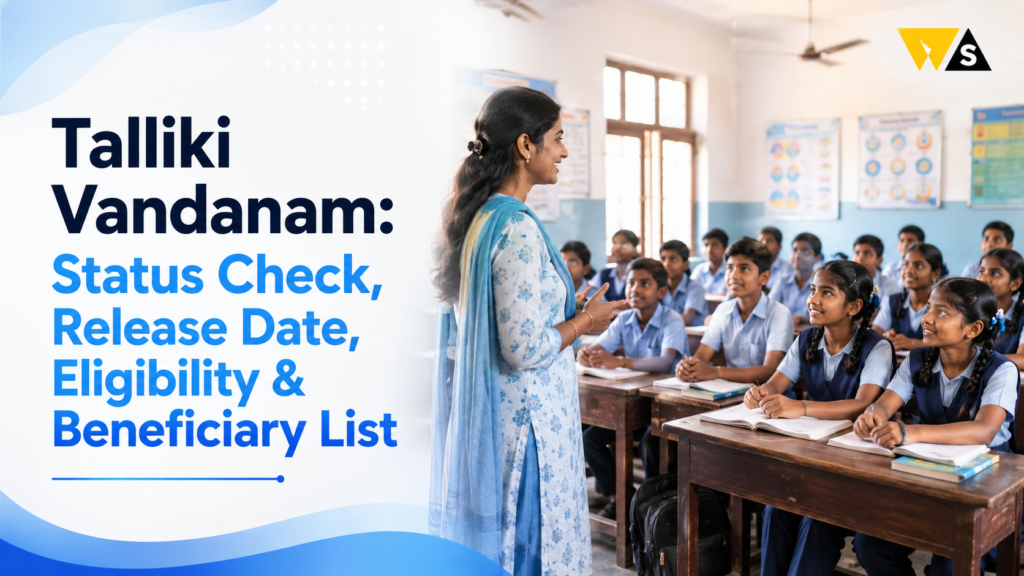
Talliki Vandanam (also written as Thalliki Vandanam, meaning “Salute to Mother”) is an education support scheme by the Andhra Pradesh government. It gives ₹15,000 per student every year for children in Class 1 to Class 12. Out of this, ₹13,000 is sent to the mother’s bank account through DBT and ₹2,000 is kept for school development. To check your status, visit the official NBM portal gsws-nbm.ap.gov.in , select the scheme, enter the mother’s Aadhaar number, and verify with OTP. You can also check instantly on WhatsApp at +91 95523 00009.
Table of Contents
ToggleTalliki Vandanam: Overview
| Point | Detail |
| Scheme Name | Talliki Vandanam (Thalliki Vandanam) |
| Meaning | “Salute to Mother” |
| Run By | Government of Andhra Pradesh |
| Launched | 12 June 2025 |
| Total Amount | ₹15,000 per student per year |
| Credited to Mother | ₹13,000 (via DBT) |
| Kept for School | ₹2,000 |
| Class Covered | Class 1 to Class 12 (including Intermediate) |
| Paid To | Mother’s / guardian’s bank account |
| Official Portals | gsws-nbm.ap.gov.in, bm-sgsw.ap.gov.in |
| WhatsApp Helpline | +91 95523 00009 |
What is the Talliki Vandanam Scheme?
Talliki Vandanam is a welfare scheme launched by the Andhra Pradesh government on 12 June 2025. Under this scheme, financial assistance is given to the mother of a school-going child to support the child’s education.
Many families find it difficult to pay for school-related expenses such as books, uniforms, shoes, bags, and other educational needs. To reduce this burden and help children continue their studies, the government provides financial support directly to eligible families every year.
The scheme is implemented through the Navasakam Beneficiary Management (NBM) system and is administered by Grama and Ward Secretariats across Andhra Pradesh.
Talliki Vandanam Release Date 2026: When Will You Get Paid?
For the 2025–26 academic year, the first Talliki Vandanam payments were released in June 2025, and most eligible families received the benefit by early July 2025, around the time schools reopened.
For the 2026–27 academic year, the government is expected to release the financial assistance during the June–July 2026 period, when the new school session begins. However, the exact payment date may vary.
It is important to remember that payment schedules can change. Always check the official NBM portal or government announcements for the latest updates. Avoid relying on unofficial websites, social media posts, or rumours for payment dates and status information.
Talliki Vandanam Amount 2026: How Much Money Will You Get?
People often get confused about how much money they will actually receive. Here is the simple truth.
The scheme promises ₹15,000 per student per year. But the full ₹15,000 does not come to your bank account. The amount is split into two parts:
| Part | Where It Goes | Amount |
| Part 1 | Mother’s bank account (via DBT) | ₹13,000 |
| Part 2 | School development & maintenance | ₹2,000 |
| Total | ₹15,000 |
So, ₹13,000 is credited directly to the mother’s bank account. This money can be used for the child’s uniform, books, fees, and other study needs.
The remaining ₹2,000 is not given as cash. It is used by the government for improving the school things like cleaning, sanitation, toilets, drinking water, and basic facilities. This part is handled through official accounts, so it helps all students in the school, not just one.
The scheme does not limit benefits to just one child. Families with multiple eligible children can receive assistance for each child studying in Classes 1 to 12. All payments are deposited into the mother’s bank account.
Why Was the Talliki Vandanam Scheme Started?
Understanding the goals helps you see why the scheme matters so much.
- To reduce school dropouts: Money problems are a big reason children leave school. This helps keep them studying.
- To support poor families: It eases the pressure of paying for uniforms, books, and fees every year.
- To empower mothers: By giving money to the mother, the scheme gives her more say and respect in family decisions.
- To promote education for all: Every child, rich or poor, gets a fair chance to study.
- To improve schools: The ₹2,000 part keeps schools clean and better equipped for students.
Together, these goals make the scheme a complete support system for both the child and the school.
Talliki Vandanam Eligibility 2026: Who Can Get ₹15,000?
Before checking your status, make sure you meet all the conditions below. If even one condition is not met, your status may show “Not Eligible.”
1. Residency The family must be a permanent resident of Andhra Pradesh.
2. Class of Student The child must be studying in Class 1 to Class 12 (including Intermediate) in a recognized Government, Aided, Private Unaided, or Residential school.
3. Rice Card / Ration Card The family must have a valid Rice Card (White Ration Card). At least one valid card in the family is needed.
4. Family Income
- For rural areas, monthly family income must be ₹10,000 or less.
- For urban areas, monthly family income must be ₹12,000 or less.
5. Attendance The student must have at least 75% attendance in the previous academic year. This rule is strict and is checked carefully.
6. Mother’s Bank Account The mother’s bank account must be linked with Aadhaar and mapped with NPCI for DBT. Without this, the money cannot be transferred.
7. Land and Property Limits The family should not own more than 3 acres of wetland, 10 acres of dryland, or 10 acres combined. There are also limits on owning large property.
Who is NOT Eligible for Talliki Vandanam?
You will not be eligible if:
- The family owns a four-wheeler (car).
- Any family member is a government or PSU employee.
- The family pays income tax.
- The family’s electricity usage is very high (above the set unit limit).
- The student is enrolled in ITI, Polytechnic, IIIT (RGUKT), or any course that already gets fee reimbursement.
- The student has stopped attending school or has very low attendance.
- The family fails the GSWS field verification or is not in the official household database.
If you fall into any of these groups, your application will be rejected even if you apply.
Documents Required for Talliki Vandanam
Keep these documents ready and correct, because most problems come from wrong or mismatched details.
- Aadhaar card of the mother (and child)
- Rice Card / White Ration Card of the family
- Mother’s bank passbook (Aadhaar-linked and NPCI-mapped)
- Student’s school details and admission proof
- Attendance record (school maintains this)
- Income certificate / details as per scheme rules
- A working mobile number linked to Aadhaar (for OTP)
Note: The single most important thing is that the mother’s bank account is Aadhaar-linked and NPCI-mapped. Most payment failures happen because of this one missing step.
Talliki Vandanam Status Check 2026: How to Check Online (Step-by-Step)
This is the most important part for most people. Follow these simple steps to check your status from home.
Step 1 — Open the official portal Go to the official NBM portal at gsws-nbm.ap.gov.in (you can also use bm-sgsw.ap.gov.in). Always use only the official site to keep your details safe.
Step 2 — Open the status section On the home page, click on the “Application Status” or “Scheme Eligibility / Status” option.
Step 3 — Select the scheme From the list of schemes, choose “Thalliki Vandanam”.
Step 4 — Select the academic year Choose the correct academic year, for example 2026-27.
Step 5 — Enter Aadhaar number Enter the mother’s Aadhaar number and the captcha code shown on the screen.
Step 6 — Get and enter OTP Click on “Get OTP.” An OTP will be sent to the mobile number linked with the Aadhaar. Enter the OTP to verify.
Step 7 — View your status After verification, your status will appear on the screen. It may show whether you are Eligible, Not Eligible, Pending, or whether the payment has been credited.
This whole process is free and takes only a few minutes. No login or password is needed — just the Aadhaar number and OTP.
Talliki Vandanam Status Check on WhatsApp Using Aadhaar
If you do not want to use the website, you can check your status on WhatsApp very easily.
- Save the official number +91 95523 00009 on your phone (this is the Andhra Pradesh government “Mana Mitra” WhatsApp service).
- Open WhatsApp and send a message like “Hi” to this number.
- A menu will appear. Choose the option for Talliki Vandanam status.
- Enter the Aadhaar number when asked, and your status will be shown instantly.
This is a quick and handy way to check, especially on a mobile phone.
Talliki Vandanam Beneficiary List 2026: How to Check Your Name
You can also check your name in the beneficiary list without using the internet.
- Visit your local Grama Sachivalayam (village secretariat) or Ward Secretariat (in cities).
- The eligible and ineligible beneficiary lists are usually displayed there on a notice board.
- You can also ask the Welfare and Education Assistant (WEA) to check your status using their official login.
This offline option is useful for families who do not have a smartphone or internet at home.
Talliki Vandanam Status Showing “Not Eligible” or “Inactive”? How to Fix It
Many people see their status as “Not Eligible,” “Inactive,” or “Unsatisfied.” Do not panic. Here is what each usually means and how to fix it.
If status is “Inactive” or payment fails: This usually means the mother’s bank account is not Aadhaar-linked or not NPCI-mapped. Visit your bank branch and ask them to complete Aadhaar seeding and NPCI mapping for DBT. This is free.
If status is “Not Eligible”: Check whether you crossed an income limit, a land limit, or whether the child’s attendance was below 75%. Sometimes the Aadhaar details or household data are wrong. Visit your Grama or Ward Sachivalayam to correct the details.
If OTP does not arrive: Make sure the mobile number is linked with the Aadhaar and is active. If it still fails, get help from your local Sachivalayam.
If money has not come after the release date: Check your NPCI mapping at the bank, and use the WhatsApp helpline +91 95523 00009 to verify. You can also raise a grievance at your Sachivalayam.
Fixing these issues quickly is important so you do not miss the payment.
How to Apply for Talliki Vandanam (How Names Are Added)
Many parents ask how to “apply.” For this scheme, much of the work is done by the school and the government, not by the parents filling a long form.
The school provides the list of eligible students to the officials. The government then verifies the details through the GSWS field staff, checking income, attendance, ration card, and other rules. If everything is correct, the student’s name is added to the eligible list, and the money is released to the mother’s account.
So the most important job for parents is to make sure all their details are correct and update Aadhaar, ration card, bank account, and the child’s school attendance. If any detail is missing or wrong, get it fixed at the Grama or Ward Sachivalayam.
Talliki Vandanam Payment Not Received?
Many applications face delays or rejection because of small errors. Be careful to avoid the following common mistakes.
- Bank account not NPCI-mapped: The biggest reason for failed payments.
- Aadhaar not linked to the bank account.
- Wrong or mismatched name between Aadhaar and bank records.
- Attendance below 75% in the previous year.
- Income or land details crossing the allowed limit.
- Inactive mobile number, so OTP and alerts do not arrive.
Checking and fixing these in advance saves a lot of trouble later.
Benefits of Talliki Vandanam Scheme for Families
- ₹13,000 per year per child provides important financial support to poor families.
- The money can be used for school uniforms, shoes, books, bags, and education-related expenses.
- It helps reduce the financial burden on parents and lowers the risk of children dropping out of school.
- The benefit is paid to the mother, helping ensure the money is spent on the child’s education and welfare.
- The scheme also strengthens the role of mothers in family financial decisions.
- An additional ₹2,000 is provided to schools for improving basic facilities.
- Schools can use this support for clean toilets, drinking water, maintenance, and other essential needs.
- Better school facilities create a healthier and more comfortable learning environment for students.
- The scheme supports both students and schools, improving education at multiple levels.
- It benefits a large number of families and students across Andhra Pradesh.
- For many children, this financial assistance helps them continue their education without interruption.
- Talliki Vandanam has become one of the most popular and widely discussed welfare schemes in Andhra Pradesh.
Talliki Vandanam Status Meaning: Eligible, Pending, Inactive & More
When you check your status online, you may see different words. Here is what they usually mean and what you should do:
| Status Shown | What It Means | What To Do |
| Eligible / Sanctioned | You qualify and are approved | Wait for the payment to be credited |
| Payment Credited | Money has been sent to the account | Check your bank passbook |
| Pending | Verification is still going on | Wait and check again later |
| Not Eligible | You did not meet one or more rules | Visit Sachivalayam to find the reason |
| Inactive | Bank account not NPCI-mapped | Visit your bank for Aadhaar-NPCI mapping |
| Unsatisfied | A detail did not pass verification | Correct details at Grama/Ward Sachivalayam |
Checking your status early — before the payment date — gives you enough time to fix any problem and avoid missing the money.
Tips to Get Your Talliki Vandanam Payment on Time
To make sure your money comes on time, keep these points in mind:
- NPCI mapping is a must. Visit your bank and confirm the mother’s account is Aadhaar-linked and NPCI-mapped for DBT. This is the number one cause of failed payments.
- Keep attendance above 75%. Make sure the child attends school regularly, as low attendance cancels eligibility.
- Match all names. The name on Aadhaar, ration card, and bank account should match. Mismatches cause rejection.
- Keep your mobile active. The mobile linked to Aadhaar must work, because the status check needs an OTP.
- Check status early. Do not wait for the payment date. Check a few weeks before so you can fix issues in time.
- Use only official sources. Use gsws-nbm.ap.gov.in or the WhatsApp helpline. Never share your OTP or bank details with strangers or agents.
Following these small steps can be the difference between getting your ₹13,000 on time and facing a long delay.
Conclusion
The Talliki Vandanam Scheme helps children continue their education by providing financial support to families. The money is sent directly to the mother’s bank account, making it easier to manage school-related expenses.
To receive the benefit, ensure that your documents and bank details are correct. Regularly check your status on the official portal and follow government updates. This will help you receive the assistance on time and support your child’s education.
Frequently Asked Questions (FAQ)
Q1. What is Talliki Vandanam scheme?
It is an education support scheme by the Andhra Pradesh government, launched on 12 June 2025. It gives ₹15,000 per student per year for children in Class 1 to 12, with ₹13,000 sent to the mother’s bank account and ₹2,000 used for school development.
Q2. How much money will I get in my account?
You will get ₹13,000 in the mother’s bank account per eligible student. The other ₹2,000 of the total ₹15,000 is kept by the government for school maintenance and facilities.
Q3. How can I check my Talliki Vandanam status?
Visit the official portal gsws-nbm.ap.gov.in, open the application status section, select “Thalliki Vandanam,” choose the academic year, enter the mother’s Aadhaar number, verify with OTP, and your status will be shown. You can also check on WhatsApp at +91 95523 00009.
Q4. What is the release date for 2026?
Payments are usually released in June or July when schools reopen. Always check the official NBM portal or government announcements for the latest payment date.
Q5. Who is eligible for the scheme?
Eligible families must be permanent residents of Andhra Pradesh, possess a valid rice card, and have children enrolled in Classes 1 to 12. The family’s income, attendance percentage, and property details must meet the government’s eligibility requirements.
Q6. Who is not eligible?
Families that own a four-wheeler, pay income tax, have a government or PSU employee, use very high electricity, or have a child in ITI/Polytechnic/IIIT are not eligible. Low attendance also makes a student ineligible.
Q7. Why does my status show “Not Eligible” or “Inactive”?
Your application or payment may be delayed if Aadhaar is not linked properly, the bank account is not NPCI-mapped, school attendance is below 75%, or your income and property details do not meet the eligibility rules.
If you face any of these issues, contact your bank or visit the nearest Grama/Ward Sachivalayam for assistance.
Q8. To whose account is the money sent?
The money is sent to the mother’s bank account through Direct Benefit Transfer (DBT). The account must be Aadhaar-linked and NPCI-mapped. If there is no mother, the guardian’s account is used.
Q9. How do I check the beneficiary list?
You can check the eligible and ineligible lists displayed at your Grama or Ward Sachivalayam, ask the Welfare and Education Assistant (WEA) to check for you, or view your status online on the NBM portal.
Q10. Does the scheme cover more than one child in a family?
Yes. All eligible children in a family studying in Class 1 to 12 are covered. The benefit for all of them is sent to the mother’s account.
Read our article:UP Old Age Pension Scheme
Read our article:Encumbrance Certificate (EC) Karnataka