

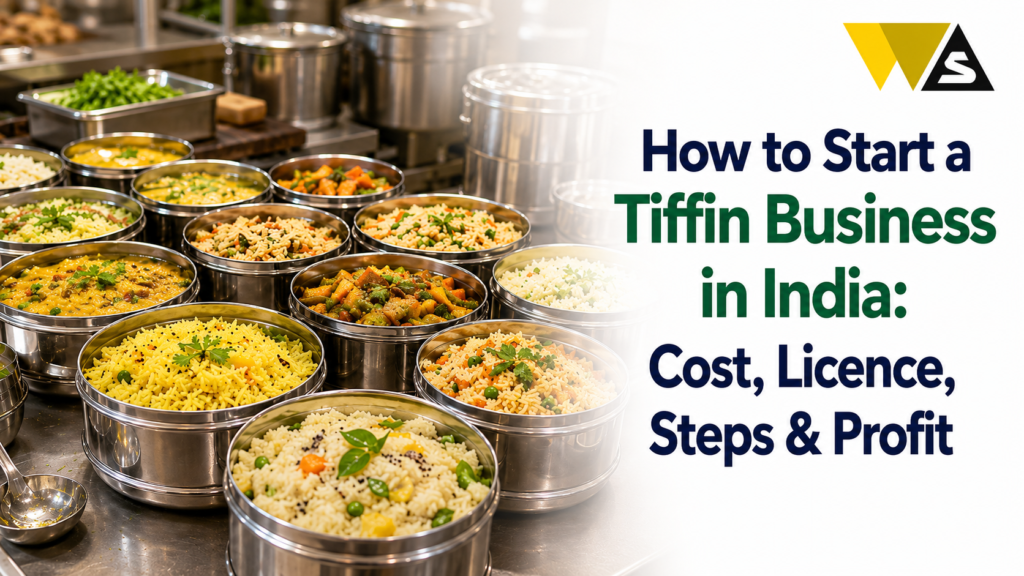
To start a tiffin business in India, you can begin from your home kitchen with low investment (often ₹10,000–₹50,000). The main steps are: decide your target customers (students, working professionals, or offices), plan a simple menu and price, get an FSSAI Basic Registration (for small businesses as of 1 April 2026, basic registration covers turnover up to ₹1.5 crore, and the government fee is about ₹100 per year), arrange packing (tiffin boxes/containers), fix delivery, and market on WhatsApp, Instagram, and local groups.
Start small with 10–20 customers, keep the food fresh, tasty, and on time, and grow by word of mouth. A tiffin business can be profitable within a few months if the food is good and delivery is reliable.
Do you want to start a tiffin (lunch box) business from home? This blog tells you everything in the plan, the licence, the cost, and how to get customers.
Table of Contents
ToggleWhat is a Tiffin Business?
A tiffin business is a food delivery service that provides homemade meals to customers on a daily basis. Most customers order lunch or dinner because they cannot cook every day.
Common customers include:
- Students living away from home (hostels, PG accommodation)
- Working professionals — IT employees, office staff, factory workers
- Bachelors who do not know cooking
- Elderly people who cannot cook daily
- Offices wanting bulk lunch for staff
Because everyone needs to eat every day. It is a business with repeat customers, low startup cost, and high demand in every city and town in India. You can even run it from your own home kitchen, which makes it perfect for homemakers, students, and first-time entrepreneurs.
Tiffin Business Overview Table 2026
| Detail | Information |
| Business Type | Home food / tiffin service |
| Startup Cost | About ₹10,000 – ₹50,000 (home-based) |
| Main Customers | Students, office workers, bachelors |
| Key Licence | FSSAI (Basic Registration for small scale) |
| FSSAI Basic Limit (2026) | Turnover up to ₹1.5 crore |
| FSSAI Basic Fee | About ₹100 per year |
| FSSAI Portal | foscos.fssai.gov.in |
| Best Marketing | WhatsApp, Instagram, local groups, flyers |
| Profit Margin | Often 30% – 50% (varies) |
| Break-even | Often within a few months |
Is a Tiffin Business Profitable in India?
Yes. Many people earn a good income from a tiffin business. Here are the main reasons:
- Daily repeat income: Customers pay monthly, so you get steady money every month, not one-time sales.
- Low cost: You start from home, so there is no big rent or setup.
- High demand: Every city has lakhs of students and workers eating outside food they do not like.
- Good margins: Food cost is often 50–60% of the price, so you can earn a 30–50% margin if you plan well.
example: If you serve 30 customers at ₹3,000 per month, that is ₹90,000 monthly income. If your food and delivery cost is around ₹55,000, you keep about ₹35,000 profit from a home kitchen.
Step 1: Decide Your Target Customers for Tiffin Business
Before you start, decide who you want to serve. This decision will help you plan your menu, pricing, and delivery.
- Students: Students in hostels and PGs want low-cost, tasty, and filling food. There are many potential customers near colleges and hostels, making them a good place to start a tiffin business.
- Working professionals: Want tasty, hygienic, on-time lunch. Willing to pay more for quality and variety.
- Offices (bulk orders): Want many meals at once. Higher income, but you need capacity.
- Special diets: Diet food, Jain food, South Indian, North Indian, or regional meals — a niche with less competition.
Start with one clear group near your home (for example, office workers within 3 km). Serving everyone at once is hard for a beginner.
Step 2: Plan Your Menu for Tiffin Business
Choose a simple, tasty menu that is easy to cook. Follow these rules:
- Offer a balanced thali — for example, rice, 2–3 rotis, one sabzi, dal, curd, pickle, and salad.
- Keep a weekly rotating menu so customers do not get bored.
- Use seasonal vegetables to keep cost low.
- Add a special item once a week (like a sweet or a paneer dish) to make customers happy.
- Decide veg only, or veg + non-veg, based on your area.
Step 3: Get Your FSSAI Registration
Food safety registration is legally required for any food business in India, including a tiffin service. A small tiffin business does not require a big investment. It is easy to set up.
FSSAI = Food Safety and Standards Authority of India. It has three levels:
- Basic Registration — A small tiffin business does not require a big investment. It is easy to set up. A small tiffin business does not require a big investment. It is easy to set up.
- State Licence — for turnover ₹1.5 crore to ₹50 crore.
- Central Licence — for turnover above ₹50 crore.
For a home tiffin business, you almost always need only the Basic Registration.
Key facts (2026):
- Apply online on the FoSCoS portal (foscos.fssai.gov.in ) — the old FLRS portal is closed.
- The Basic Registration government fee is about ₹100 per year.
- Under the 2026 amendment, new registrations/licences carry perpetual validity (no more 1–5 year renewal), subject to compliance.
Documents usually needed: your photo, Aadhaar/ID proof, address proof of the kitchen, and a simple food business declaration.
Getting the FSSAI number also builds customer trust — you can print it on your tiffin label and flyers.
Step 4: Other Registrations You May Need for Tiffin Business
Besides FSSAI, consider these as you grow:
- GST registration: No. You do not need GST registration when you start a small tiffin business. Register only if your annual turnover crosses the GST limit that applies in your state.
- Shop and Establishment registration: May be needed once you rent a commercial space (not usually for a home kitchen).
- Local municipal / trade licence: Some cities ask for this for food businesses — check with your local municipal office.
- Udyam (MSME) registration: Free and optional, but it helps you get bank loans and government scheme benefits as a small business.
Start with just FSSAI Registration when small, and add the others as you grow. Do not over-complicate the start.
Step 5: Set Up Your Kitchen
You can start with your existing home kitchen. To run smoothly, make sure you have:
- Clean cooking area with good hygiene this is very important for food business
- Large vessels and cookware for bulk cooking
- A good gas stove (or two burners) and maybe a commercial cylinder as you grow
- Storage — fridge, containers, and dry storage for grains
- Clean water supply
- Basic packing area — a clean table for filling tiffins
Hygiene rules that keep customers (and are required):
- Keep the kitchen clean and pest-free
- Store raw and cooked food separately
- Use fresh ingredients daily
- Cooks should keep clean hands, tied hair, and clean clothes
Hygiene is not optional one bad food experience spreads fast and can shut your business.
Step 6: Fix Your Pricing for Tiffin Business
The right price helps your business earn a profit. Use this simple pricing method:
- Calculate cost per tiffin: Add up ingredients + gas + packing + delivery + your labour.
- Add your profit margin: Usually 30–50% on top of cost.
- Compare with local rates: Check what nearby tiffin services charge.
- Fix a monthly price: Most customers prefer a monthly plan (for example, ₹2,500–₹4,000/month), which gives you stable income.
Example: If one tiffin costs you ₹70 to make and deliver, price it around ₹100–₹110. For a monthly plan (26 days), that is about ₹2,600–₹2,850.
Note: Do not price too low just to get customers. Very low prices leave no profit and make the business unsustainable. Compete on taste and reliability, not just price.
Step 7: Arrange Packing and Delivery
Packaging is an important part of your tiffin business. Select the type of packaging that best suits your customers:
- Steel/reusable tiffin boxes: Good for monthly customers (you collect and reuse). Eco-friendly and premium feel.
- Disposable containers: Good for one-time or office orders. Choose food-grade, leak-proof ones.
- Add a label with your business name, phone number, and FSSAI number.
Delivery options:
- Self-delivery — cheapest at the start, if customers are nearby.
- Hire a delivery boy with a bike as you grow.
- Delivery apps / local delivery services — useful, but they take a commission.
On-time delivery is everything. A late lunch is a lost customer. Fix a delivery time window and keep it strictly.
Step 8: Market Your Tiffin Business and Get Customers
You can have great food, but you need customers to know about it. Use these free and low-cost methods:
Free / low-cost marketing:
- WhatsApp: Share your menu and photos in local groups, PG groups, and office groups.
- Instagram/Facebook page: Post daily food photos — good photos sell food.
- Local WhatsApp status: Post your weekly menu every day.
- Flyers/pamphlets: Distribute near colleges, hostels, PGs, offices, and hospitals.
- Word of mouth: Give great food so customers tell their friends — this is the strongest marketing.
Offers to attract first customers:
- First-day free trial meal to let people taste
- Discount on the first month or a “refer a friend” offer
- Free delivery for monthly customers
Online listing (as you grow):
- List on food delivery apps (Swiggy, Zomato) for extra orders — but remember their commission.
Step 9: Manage Daily Operations
Once you start, a daily routine keeps things smooth:
- Plan the menu the night before and buy fresh ingredients.
- Cook early so food is ready before delivery time.
- Pack carefully — correct quantity, leak-proof, and clean.
- Deliver on time in your fixed window.
- Collect payments on a fixed date (monthly plans are easiest).
- Take feedback regularly and improve.
How Much Money Can You Start With for Tiffin Business?
Here is the estimated cost to start a home-based tiffin business:
| Item | Approx. Cost |
| FSSAI Basic Registration | ₹100/year (+ small service charge if via agent) |
| Extra vessels/cookware | ₹3,000 – ₹10,000 |
| Tiffin boxes/containers | ₹2,000 – ₹8,000 |
| Raw material (first stock) | ₹3,000 – ₹8,000 |
| Packing labels/branding | ₹500 – ₹2,000 |
| Marketing (flyers, etc.) | ₹1,000 – ₹5,000 |
| Delivery (initial) | ₹0 (self) – ₹10,000 |
| Total | About ₹10,000 – ₹50,000 |
You can start small from home with a modest amount, and grow slowly as customers increase. Many people start with just ₹15,000–₹20,000.
Common Mistakes to Avoid for Tiffin Business
Learn from others’ mistakes:
- Pricing too low — no profit, business dies.
- Poor hygiene — one bad batch loses many customers.
- Late delivery — the fastest way to lose customers.
- Same menu every day — customers get bored and leave.
- No FSSAI registration — illegal and risky, and loses trust.
- Ignoring feedback — customers quietly leave instead of complaining.
- Growing too fast — taking more orders than you can cook well.
Golden rule: Fresh food + fixed timing + fair price = happy customers who stay for months.
How to Grow Your Tiffin Business
- Add dinner service, not just lunch.
- Add weekend specials or festival meals.
- Take office/bulk orders — higher income per delivery.
- Hire help — a cook and a delivery person — to serve more customers.
- List on delivery apps for extra reach.
- Build a brand — a good name, logo, clean packing, and an Instagram page.
- Later, consider a cloud kitchen setup if demand is high.
Conclusion
Starting a tiffin business in India is one of the easiest and lowest-cost businesses you can begin from home and the demand is everywhere, because students, workers, and bachelors all want fresh home-style food every day.
Choose your customers, make a tasty menu, get your FSSAI registration, fix fair prices, and deliver fresh food on time.
If your food is good and your service is reliable, your tiffin business can earn a good monthly income. Cook every meal with care, just like you cook for your own family.
Frequently Asked Questions (FAQs)
1. How much money do I need to start a tiffin business in India?
You can start a home-based tiffin business with about ₹10,000 to ₹50,000. This covers extra cookware, tiffin boxes, the first stock of ingredients, packing, and basic marketing. Many people begin with just ₹15,000–₹20,000 and grow slowly.
2. Do I need a licence to start a tiffin service?
Yes. You need an FSSAI registration for any food business. For a small tiffin service, the Basic Registration is enough. From 1 April 2026, Basic Registration covers turnover up to ₹1.5 crore, and the government fee is about ₹100 per year on the FoSCoS portal.
3. Is a tiffin business profitable?
Yes. A tiffin business can make good money. If 30 customers pay ₹3,000 every month, your monthly revenue can be around ₹90,000. Keep your costs low and avoid food waste to earn more profit.
4. Can I start a tiffin business from home?
Yes. You can start a tiffin business from your home kitchen. Keep your kitchen clean, have enough cooking and packing space, and maintain good hygiene.
5. Who are the best customers for a tiffin business?
Your customers may be students, office workers, bachelors, elderly people, and offices. Start with customers near your home and expand later.
6. How do I get customers for my tiffin service?
Tell people about your business through WhatsApp, Instagram, Facebook, and flyers. Offer a free trial meal or a discount, and ask happy customers to tell others about your service.
7. How should I price my tiffin?
Calculate the total cost of one tiffin, add a 30–50% profit, and compare your price with local businesses. Monthly plans of ₹2,500–₹4,000 can give you regular income.
8. Do I need GST for a tiffin business?
Very small tiffin businesses usually do not need GST. It generally becomes relevant when your turnover crosses the GST threshold (commonly ₹20 lakh for services in most states). Check the current limit for your state as your business grows.
9. What food should I serve in a tiffin?
A balanced thali works best — rice, rotis, one sabzi, dal, curd, pickle, and salad — with a weekly rotating menu so customers do not get bored. Use seasonal vegetables to control cost and add a special item once a week.
10. What are the biggest mistakes to avoid in a tiffin business?
Do not charge too little, keep your kitchen clean, deliver on time, change the menu regularly, get FSSAI registration, and listen to customer feedback. Fresh food and fair prices help keep customers.
Read our article:
Read our article: