
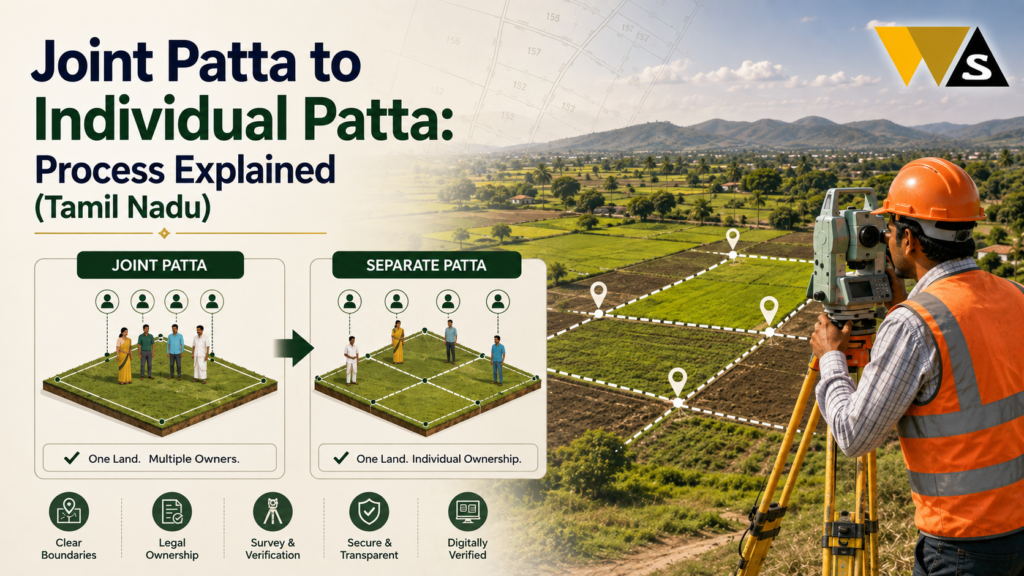
To convert a Joint Patta into Individual Pattas, the co-owners must divide the land and apply for separate pattas at the Tahsildar (Taluk) office. The safest way is to prepare and register a Partition Deed (which clearly marks each owner’s share and boundaries), then submit it with the current joint patta, sale/inheritance deed, EC, and IDs of all co-owners to the Tahsildar. A land surveyor inspects the property, a subdivision is created for each share (using the FMB), and individual pattas are issued in each owner’s name.
There is no fully online “split patta” button; this is a subdivision/partition process that involves the Taluk office and a field survey. It takes longer than a simple transfer (often several weeks to months). A registered partition deed is strongly recommended to avoid future boundary disputes.
Table of Contents
ToggleWhat is a Joint Patta?
A Joint Patta is a land ownership record that lists two or more owners together for the same piece of land. All listed people are legal co-owners with rights over the land, but the patta does not mark each person’s separate boundary it just shows them as joint owners of the whole.
How joint pattas usually happen:
- Inheritance: When a landowner dies, the patta is transferred to all legal heirs (spouse, sons, daughters) together creating a joint patta.
- Joint purchase: When friends, relatives, or partners buy land together under one sale deed, they all appear on one joint patta.
- Layout subdivision: When large land is divided into plots, a temporary joint patta may exist before individual pattas are issued.
Because individual boundaries are not marked, no one has a clearly defined portion. This causes practical problems surveyors cannot mark exact shares, and it leads to disputes over boundaries, access paths, and measurements. It also makes it hard to sell, mortgage, or build on your share alone.
Joint to Individual Patta Overview 2026
| Detail | Information |
| What it does | Splits joint patta into separate pattas |
| Process | Partition / sub-division |
| Where to apply | Tahsildar (Taluk) office |
| Legally safest method | Registered Partition Deed |
| Key step | Land surveyor field inspection |
| Result | Individual patta for each owner |
| Main documents | Partition deed, joint patta, EC, IDs |
| Fully online? | No — involves Taluk office + survey |
| Timeline | Several weeks to months |
| Benefit | Clear boundaries, independent ownership |
Why Convert a Joint Patta to an Individual Patta?
Getting your own separate patta gives you full control of your share. Here is why co-owners do it:
- Clear boundaries: Your portion is marked and measured with no confusion.
- Independent sale: You can sell your share without needing every co-owner’s signature.
- Bank loans: You can mortgage your own plot for a loan.
- Building approval: You can build on your clearly defined land.
- Avoid disputes: A marked boundary prevents family and neighbour disputes.
- Property tax and utilities: Easier to get separate tax, electricity, and water in your name.
- Clean inheritance: Your children inherit a clearly defined plot, not a share.
Two Ways to Divide a Joint Patta
There are two main approaches to split a joint patta:
Method 1: Registered Partition Deed (Safest)
- The co-owners agree on who gets which portion.
- A Partition Deed is prepared, clearly marking each owner’s area and boundaries.
- The deed is registered at the Sub-Registrar office.
- This is the legally safest method — it avoids future boundary disputes.
Method 2: Mutual Settlement (Without Registered Deed)
- If all co-owners agree but do not want to register a partition deed, they may jointly apply to the Tahsildar with a written mutual agreement and NOC from all co-owners.
- This is simpler, but less protected than a registered deed — disputes are harder to settle later.
For safety and legal strength, use the registered Partition Deed — especially for valuable land or where relations may sour. The mutual-settlement route suits small, fully-agreed family cases.
Documents Required to Split a Joint Patta
Keep these ready (from all co-owners):
- Current Joint Patta copy
- Sale deed / gift deed / inheritance proof (how the joint patta arose)
- Registered Partition Deed (for Method 1) or mutual agreement + NOC (for Method 2)
- Encumbrance Certificate (EC)
- Chitta / Adangal extract
- FMB sketch (for boundary division)
- ID proof (Aadhaar) of all co-owners
- Property tax receipt
- NOC from the lender — if the land has a home/loan mortgage
- Legal Heir Certificate + Death Certificate — if the joint patta came from inheritance
- Passport-size photos of applicants
Step-by-Step Process: Joint Patta to Individual Patta
Here is the full process in simple steps:
Step 1 — Agree on the division: All co-owners agree on who gets which portion (size and boundaries).
Step 2 — Prepare the Partition Deed: Draft a Partition Deed marking each share and boundary, and register it at the Sub-Registrar office (Method 1).
Step 3 — Apply at the Tahsildar office: Submit the application for sub-division / separate patta with the partition deed, joint patta, EC, FMB, and IDs of all co-owners.
Step 4 — Land survey inspection: A land surveyor visits the property and measures each portion as per the partition, using the FMB.
Step 5 — Sub-division created: Based on the survey, a sub-division number is created for each owner’s portion (for example, 123/1, 123/2).
Step 6 — Individual pattas issued: The Tahsildar approves, and separate individual pattas are issued in each owner’s name.
Step 7 — Download/collect the new pattas: Each owner gets their own patta with their marked survey/sub-division and extent — download from eservices.tn.gov.in or collect from the office.
The Role of the Land Survey (FMB)
The land survey is the heart of this process; it turns an unmarked share into a marked plot.
- The surveyor visits the land and physically measures each owner’s portion.
- The division is done using the FMB (Field Measurement Book), which shows the plot’s boundaries.
- After measuring, the surveyor fixes the subdivision for each share.
- This creates a clear boundary for each owner which is exactly what a joint patta lacks.
Without this survey, your share stays undefined. The survey gives you a measured, mapped portion you can sell, mortgage, or build on.
Is There an Online Process to Split a Joint Patta?
there is no simple online “split patta” button.
- Basic patta viewing is online (eservices.tn.gov.in ), and simple sale transfers even auto-mutate.
- But splitting a joint patta involves a partition, a field survey, and sub-division which needs the Tahsildar office and a surveyor’s visit.
- You may be able to submit the application online (or via e-Sevai/CSC), but the survey and approval are offline steps.
So the realistic route is:
- Register the partition deed (Sub-Registrar office).
- Apply (online via e-Sevai/CSC, or at the Taluk office).
- Attend the survey and complete the offline verification.
Fees and Timeline
- Partition Deed registration: attracts stamp duty and registration fees (partition among family members often has concessional stamp duty to confirm the current rate).
- Sub-division / patta application fee: a nominal government fee.
- Surveyor charges: as applicable for the field survey.
- Timeline: longer than a simple transfer — often several weeks to a few months, depending on the survey schedule, number of co-owners, and any disputes.
Special Case: Joint Patta from Inheritance
When a joint patta comes from inheritance (after the owner’s death), splitting it needs a few extra documents:
- Death Certificate of the deceased owner.
- Legal Heir Certificate naming all heirs.
- Release Deeds if some heirs give up their share in favour of others.
- A Partition Deed or family settlement dividing the land among heirs.
Process: First, the patta is transferred to all legal heirs (joint patta), then the partition/sub-division creates individual pattas for each heir’s share.
Common Problems and Solutions
- Co-owner not agreeing: Without agreement, you may need a court partition suit — try mutual settlement first.
- Missing co-owner NOC/ID: Collect documents from all co-owners before applying.
- Survey delayed: Follow up at the Taluk office; the survey is often the slow step.
- Loan/mortgage on the land: Get an NOC from the lender first.
- Boundary dispute during survey: Resolve it as per the partition deed; be present during the survey.
- Application rejected: Fix the document/mismatch and re-apply.
- Someone demanding a bribe: Fees are officially escalated instead of paying extra.
What If Co-Owners Do Not Agree?
Sometimes co-owners cannot agree on the division. In that case:
- Try mediation first; a mutual settlement is faster and cheaper than court.
- If agreement is impossible, any co-owner can file a partition suit in civil court.
- The court divides the property and orders separate shares, after which you apply for individual pattas based on the court decree.
Conclusion
Converting a Joint Patta into individual Pattas helps separate each co-owner’s share. The co-owners first agree on the division and may register a Partition Deed. Then, they can apply at the Tahsildar office with the Joint Patta, deed, EC, FMB, and ID proofs. After the land is measured and subdivided, separate Pattas can be issued in each owner’s name.
The registered Partition Deed is the safest method (it prevents future boundary disputes); the land survey is a mandatory offline step (there is no instant online split); and inheritance cases need the Legal Heir Certificate and possibly Release Deeds. The process takes longer than a simple transfer often weeks to months so start early and keep all co-owners cooperative.
Frequently Asked Questions (FAQs)
1. How do I convert a joint patta to an individual patta?
The co-owners divide the land ideally through a registered Partition Deed marking each share — and apply for sub-division at the Tahsildar office with the joint patta, deed, EC, FMB, and IDs. A surveyor measures each portion, a sub-division is created, and individual pattas are issued.
2. Can I split a joint patta online?
Basic Patta services are available online, but Joint Patta splitting is not fully online. It requires a field survey, land subdivision, and Tahsildar approval.
3. What is the safest way to divide a joint patta?
A registered Partition Deed is a safer way to divide the land. It clearly shows each owner’s share and boundaries and can help avoid future disputes. A simple mutual agreement is easier, but it may provide less legal protection.
4. What documents are needed to split a joint patta?
The current joint patta, the sale/inheritance deed, a registered partition deed (or mutual agreement + NOC), EC, Chitta/Adangal, FMB, IDs of all co-owners, property tax receipt, and a lender NOC if there is a loan. Inheritance cases also need the Legal Heir and Death Certificates.
5. How long does it take to get an individual patta from a joint patta?
It takes longer than a simple transfer — often several weeks to a few months — because it involves registering a partition deed, a field survey, and Tahsildar approval. Inheritance and multi-owner cases can take longer, especially if there are disputes.
6. Why should I convert my joint patta to an individual patta?
An individual Patta clearly shows your share and land boundaries. It makes it easier to sell, mortgage, or use your land separately. It can also help avoid disputes and make inheritance easier.
7. What is the role of the land survey in splitting a patta?
The land survey is essential — a surveyor visits and physically measures each owner’s portion using the FMB, then fixes a sub-division for each share. This turns an unmarked joint share into a measured, mapped individual plot with clear boundaries.
8. How do I split a joint patta that came from inheritance?
Transfer the Patta to all legal heirs first and create a Joint Patta. Then divide the land using a Partition Deed or family settlement. If someone gives up their share, use a Release Deed. After the division, apply for individual Pattas.
9. What if the co-owners do not agree on the division?
Try to settle the matter through mediation or a family agreement first. This can save time and money. If the owners cannot agree, any co-owner can go to civil court for partition. After the court decides the shares, apply for separate Pattas using the court order.
10. Is a partition deed compulsory to split a joint patta?
It is not always compulsory — if all co-owners agree, a mutual settlement with NOC may be accepted — but a registered partition deed is strongly recommended. It is the legally safest method and prevents future boundary and ownership disputes.
Read our article:
Read our article:
Read our article:
Read our article:
Read our article:
Read our article: