
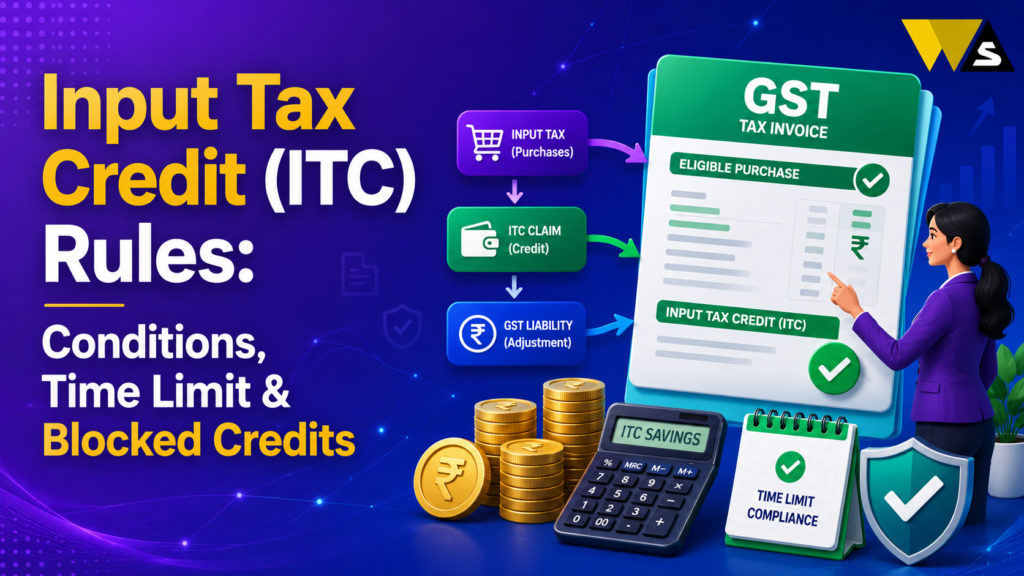
Input Tax Credit (ITC) lets a GST-registered business subtract the GST it paid on purchases from the GST it collected on sales — so you pay tax only on your value added. To claim ITC in 2026, you must meet four conditions under Section 16(2): (1) have a valid tax invoice, (2) have actually received the goods/services, (3) the invoice must appear in your GSTR-2B (meaning your supplier filed and paid), and (4) you must have filed your GSTR-3B.
To claim ITC, pay your supplier within 180 days and claim the credit before the deadline. If you do not pay within 180 days, you may need to reverse the ITC. Some expenses are not eligible for ITC under Section 17(5).
Table of Contents
ToggleWhat is Input Tax Credit (ITC)?
Input Tax Credit (ITC) is the GST you paid on your business purchases, which you can subtract from the GST you collected on your sales. It makes sure tax is charged only on the value you add, not on the full price again and again.
Simple example:
- You buy goods for ₹5,00,000 + ₹90,000 GST (this ₹90,000 is your input tax).
- You sell them for ₹7,00,000 + ₹1,26,000 GST (this ₹1,26,000 is your output tax).
- You claim ₹90,000 ITC, so you pay the government only ₹1,26,000 − ₹90,000 = ₹36,000 in cash.
Why ITC matters:
- It reduces your tax cost and improves cash flow.
- It avoids double taxation (tax on tax).
- It is often 12–18% of your purchase value real money.
Input Tax Credit (ITC) Rules Overview 2026
| Detail | Information |
| What it is | GST on purchases set off against GST on sales |
| Governing Law | Section 16, 17, 18 of CGST Act |
| Conditions | 4 conditions under Section 16(2) |
| ITC Source | Only invoices in your GSTR-2B |
| Claimed In | GSTR-3B (Table 4) |
| Supplier Payment Rule | Pay within 180 days or reverse ITC |
| Time Limit | 30 Nov of next FY / GSTR-9, whichever earlier |
| Blocked Credits | Section 17(5) list |
| Reversal Rules | Rule 42/43, 180-day rule |
| 2025–26 Change | IMS (accept/reject invoices) |
The 4 Conditions to Claim ITC Input Tax Credit (Section 16)
To claim Input Tax Credit (ITC), you must meet all four conditions under Section 16(2). If even one fails, you cannot claim:
1. You have a valid tax invoice (or debit note).
- You must hold a proper GST invoice with all mandatory details.
2. You have actually received the goods or services.
- The goods/services must be received not just billed.
3. The invoice appears in your GSTR-2B (supplier filed and paid).
- Your supplier must have filed their GSTR-1 so the invoice shows in your GSTR-2B, and the tax must have reached the government.
4. You have filed your GSTR-3B return.
- ITC is claimed through GSTR-3B, so you must file your return.
You must claim within the time limit and pay the supplier within 180 days.
The GSTR-2B Rule: No 2B, No ITC (Input Tax Credit)
You can claim Input Tax Credit (ITC) only for invoices that appear in your auto-drafted GSTR-2B. (This has been the rule since January 2022, under Rule 36(4).)
- GSTR-2B is a read-only monthly statement listing the invoices your suppliers actually reported in their GSTR-1.
- If an invoice is not in your GSTR-2B, you cannot claim its ITC even if you have a valid invoice and paid the GST.
- This means your Input Tax Credit (ITC) depends on your supplier’s compliance.
Why your ITC may be less than the GST you paid:
because some suppliers did not file or filed wrong/late, so those invoices did not appear in your GSTR-2B.
Download GSTR-2B after the 14th of each month and reconcile it with your purchase register. Follow up with suppliers who have not filed otherwise you lose that Input Tax Credit (ITC).
The IMS (Invoice Management System) and ITC (2026)
The Invoice Management System (IMS) now sits between your supplier’s invoice and your GSTR-2B.
- On the IMS dashboard, you can accept, reject, or keep pending each supplier invoice.
- Accepted invoices flow into your GSTR-2B and become claimable ITC.
- Rejected or pending invoices do not flow into your ITC.
The 180-Day Payment Rule
You must pay your supplier the full invoice value (including GST) within 180 days of the invoice date.
- If you do not pay within 180 days, the Input Tax Credit (ITC) you already claimed must be reversed, with interest.
- Once you later pay the supplier, you can re-claim that Input Tax Credit (ITC) in a future return.
Example: You claimed Input Tax Credit (ITC) on a supplier’s invoice but did not pay them for 7 months. You must reverse that Input Tax Credit (ITC) with interest and can re-claim it only after you pay.
Track your unpaid supplier invoices and clear them within 180 days, so you do not lose ITC and pay interest.
The ITC Time Limit Claim Before It Lapses
Input Tax Credit (ITC) must be claimed within the time limit set by Section 16(4).
- ITC for a financial year must be claimed by the earlier of:
- 30th November of the next financial year, or
- the date of filing the annual return (GSTR-9) for that year.
Example: ITC on an invoice dated 15 June 2026 (FY 2026–27) must be claimed by 30 November 2027. After that, it lapses permanently there is no late-claim option.
Do not wait for the November deadline. Claim Input Tax Credit (ITC) in the same month you receive the invoice and it appears in GSTR-2B this gives you immediate cash flow and avoids forgetting old invoices.
Blocked Credits: Where Input Tax Credit (ITC) is NOT Allowed (Section 17(5))
Even if you meet all four conditions, Section 17(5) lists items where ITC is blocked you cannot claim it. These are called blocked credits.
Common blocked credits:
- Motor vehicles for passenger transport (up to 13 seats) unless you are in the business of vehicles/transport.
- Food and beverages, outdoor catering unless you resupply them.
- Club, health, and fitness memberships (gym, clubs).
- Health and life insurance unless required by law.
- Rent-a-cab for employees (with exceptions).
- Construction of immovable property (building) on your own account — even for business.
- Goods lost, stolen, destroyed, or given as free samples/gifts.
- Personal-use purchases.
- Tax paid under fraud (Section 74), detention (129), or confiscation (130).
ITC on construction of the building is blocked, but ITC on plant and machinery (factory equipment) is allowed. This confuses many businesses. The structure is blocked, the machinery inside is not.
You cannot claim ITC on a personal-use car by arguing “mostly business” Section 17(5) has no predominant-use exception.
Keep a Section 17(5) checklist and never claim these blocked credits wrongly claiming them is a common audit problem.
ITC Reversal Rules (Rule 42, 43 and More)
Sometimes, you need to reverse the Input Tax Credit (ITC) you claimed. Here are the main cases:
- 180-day non-payment: reverse ITC if you did not pay the supplier within 180 days (re-claim after paying).
- Rule 42 (inputs/services): if you use purchases for both taxable and exempt supplies, reverse the ITC portion for exempt supplies.
- Rule 43 (capital goods): for capital goods used for both taxable and exempt supplies, reverse the exempt portion over 60 months.
- Switching to Composition Scheme or your supplies becoming exempt: reverse ITC (via Form ITC-03).
ITC on Capital Goods
You can claim ITC on capital goods like machinery and equipment, with some rules:
- ITC is allowed on capital goods used for business (taxable supplies), if not blocked under Section 17(5).
- You cannot claim both ITC and depreciation on the GST portion. If you claim depreciation on the GST amount under Income Tax, you forfeit the ITC — so choose one.
- For capital goods used for both taxable and exempt supplies, ITC is reversed over 60 months (Rule 43).
How to Claim ITC in GSTR-3B (Step-by-Step)
Input Tax Credit (ITC) is claimed in Table 4 of GSTR-3B. Here is the simple flow:
- Collect and verify purchase invoices — check GSTIN, invoice number, tax, and your business name.
- Download GSTR-2B after the 14th of the month.
- Check the IMS and accept genuine invoices so they flow into GSTR-2B.
- Reconcile your purchase register with GSTR-2B — flag any mismatches or missing invoices.
- Separate the ITC into eligible, blocked (17(5)), and to-be-reversed (Rule 42/43, 180-day).
- Enter the eligible ITC in Table 4 of GSTR-3B, split into IGST, CGST, and SGST/UTGST.
- File GSTR-3B — the ITC reduces your tax payable.
Common ITC Mistakes to Avoid
- Do not claim ITC if it is not showing in GSTR-2B.
- Check IMS regularly so you do not miss eligible invoices.
- Pay your supplier within 180 days to avoid ITC reversal.
- Claim ITC before the deadline.
- Do not claim blocked ITC under Section 17(5).
- Do not claim both ITC and depreciation on the same GST amount.
- Check your GSTR-2B every month.
- Use the correct GSTIN and invoice details.
Conclusion
Input Tax Credit (ITC) is one of the biggest benefits of GST it lets you subtract the GST paid on purchases from the GST collected on sales, so you pay tax only on your value added. But it is also the most rule-bound and audit-sensitive area of GST.
To claim Input Tax Credit (ITC), meet the four Section 16 conditions: a valid invoice, receipt of goods/services, the invoice appearing in your GSTR-2B, and filing your GSTR-3B. On top of that, pay suppliers within 180 days (or reverse with interest), claim within the time limit (by 30 November of the next year or GSTR-9, whichever is earlier), and never claim blocked credits under Section 17(5) — like personal vehicles, food, insurance, and building construction (though plant and machinery is allowed).
Frequently Asked Questions (FAQs)
1. What is Input Tax Credit (ITC) in GST?
ITC is the GST you paid on business purchases, which you can subtract from the GST you collected on sales. It ensures tax is charged only on the value you add, avoiding double taxation and reducing your overall tax cost and improving cash flow.
2. What are the conditions to claim ITC?
For ITC, make sure you have a valid invoice, receive the goods or services, and see the invoice in GSTR-2B. File GSTR-3B, pay the supplier within 180 days, and claim ITC within the allowed time.
3. Why is my ITC less than the GST I paid on purchases?
Because ITC is restricted to invoices appearing in your auto-drafted GSTR-2B. If a supplier did not file their GSTR-1, filed it wrong, or filed late, those invoices will not appear in your GSTR-2B, so you cannot claim that ITC.
4. What is the time limit to claim ITC?
For a financial year, you must claim it by 30 November of the following financial year or before filing GSTR-9, whichever comes first. After the deadline, the ITC may no longer be available.
5. What is the 180-day rule in ITC?
You must pay your supplier the full invoice value (including GST) within 180 days of the invoice date. If you do not, the ITC you claimed must be reversed with interest. You can re-claim it later once you actually pay the supplier.
6. What are blocked credits under Section 17(5)?
These are items where ITC is not allowed even if all conditions are met — such as personal motor vehicles (up to 13 seats), food and beverages, club and gym memberships, health/life insurance (unless required by law), and construction of immovable property. Plant and machinery is an exception and is allowed.
7. Can I claim ITC on capital goods like machinery?
Yes, ITC on capital goods used for business is allowed if not blocked under Section 17(5). But you cannot claim both ITC and depreciation on the GST portion — if you take depreciation on the GST amount, you forfeit the ITC, so choose one.
8. What is the GSTR-2B in relation to ITC?
GSTR-2B is a monthly statement that shows invoices reported by your suppliers. You cannot edit it. If your supplier reports an invoice correctly, it can appear in your GSTR-2B and may support your eligible ITC claim.
9. How does the IMS affect my ITC?
The Invoice Management System (IMS) lets you accept, reject, or keep supplier invoices pending. Accepted invoices can flow into GSTR-2B and may be available for eligible ITC. Rejected or pending invoices are not available for ITC at that stage. Check IMS regularly to make sure you do not miss eligible ITC.
10. What happens if I claim wrong or ineligible ITC?
when claiming ITC. If you claim ITC incorrectly, you may have to reverse it and pay interest. Common mistakes include claiming credit not shown in GSTR-2B, claiming blocked credits, and not paying the supplier within 180 days.
Read our article:
Read our article:
Read our article:
Read our article:
Read our article:
Read our article: