
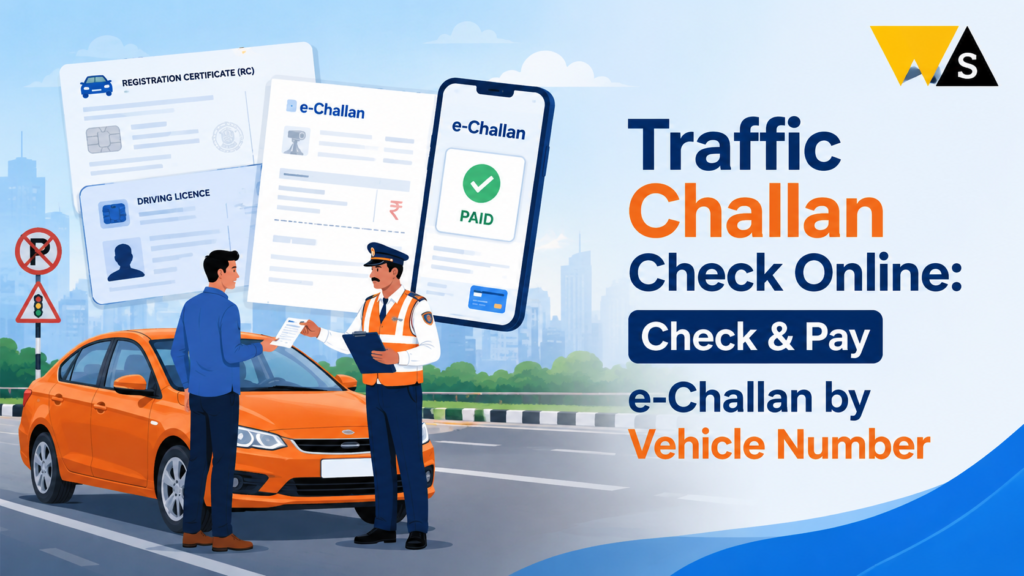
To check your traffic challan online, go to the official portal echallan.parivahan.gov.in, click “Check Challan Status”, enter your vehicle number, driving licence (DL) number, or challan number, fill the captcha, and click Get Detail. Your pending challan with the violation date, offence, fine amount, and photo proof will show on the screen. You can pay online using UPI, debit/credit card, or net banking, and download the receipt. This is a government system run by MoRTH (Ministry of Road Transport and Highways).
Pay or dispute a challan within 45 days, or it may be treated as accepted and can be sent to court. Beware of fake challan SMS with links — always check only on echallan.parivahan.gov.in, and never click SMS/WhatsApp payment links.
Table of Contents
ToggleWhat is a Traffic Challan (e-Challan)?
A traffic challan is a fine issued when you break a traffic rule like over-speeding, jumping a red light, no helmet, no seatbelt, wrong parking, or driving without documents.
An e-Challan (electronic challan) is the digital version of this fine. It has replaced the old paper challan system. Today, the government uses CCTV cameras, speed cameras, body-worn cameras, and handheld devices to catch violations often automatically, without stopping you.
You usually receive an SMS on your registered mobile number with the challan details. The challan is also recorded on the central government portal, where you can check and pay it online.
The NextGen e-Challan system is run by the Ministry of Road Transport and Highways (MoRTH) with NIC, and it connects all state traffic departments on one platform echallan.parivahan.gov.in .
A challan is a traffic fine, and you can now check and pay it from your phone in minutes.
Traffic Challan Check Online Overview 2026
| Detail | Information |
| System | NextGen e-Challan |
| Run By | MoRTH + NIC (Government of India) |
| Official Portal | echallan.parivahan.gov.in |
| App | mParivahan |
| Check By | Vehicle number / DL number / Challan number |
| Payment Modes | UPI, debit/credit card, net banking |
| Resolution Time | Pay/dispute within 45 days |
| Unpaid Challan | May go to court / RTO blacklist |
| Receipt | Downloadable after payment |
| Scam Helpline | 1930 / cybercrime.gov.in |
How to Check Traffic Challan Online by Vehicle Number (Step-by-Step)
Follow these simple steps:
Step 1: Go to the official portal echallan.parivahan.gov.in.
Step 2: Click on “Check Challan Status” (or Check Online Services).
Step 3: Select “Vehicle Number” as your search option.
Step 4: Enter your vehicle registration number (for example, DL01AB1234) in capital letters.
Step 5: You may also need to enter the last 5 characters of the chassis/engine number for verification.
Step 6: Fill in the captcha code.
Step 7: Click “Get Detail”.
Step 8: Your challan status appears — showing any pending challans, the violation, date, location, fine amount, and photo proof.
If there are no pending challans, it will show “No challan found” which means you are clear.
How to Check Traffic Challan by DL or Challan Number
You can also check using other details:
By Driving Licence (DL) Number:
- Go to echallan.parivahan.gov.in → Check Challan Status.
- Select “DL Number”.
- Enter your driving licence number and captcha.
- Click Get Detail to see challans linked to your licence.
By Challan Number:
- Select “Challan Number”.
- Enter the challan number from your SMS or notice.
- Enter the captcha and click Get Detail.
Checking by vehicle number shows all challans on the vehicle, while DL number shows challans issued against your driving.
How to Check Traffic Challan on the mParivahan App
You can also check on your phone using the official app:
- Download the mParivahan app (by MoRTH) from the Play Store or App Store.
- Open the app and go to the challan/e-challan section.
- Enter your vehicle number, DL number, or challan number.
- View your challan status and details.
- Pay directly through the app if there is a pending fine.
The mParivahan app also keeps your RC and DL in digital form, which are valid documents to show to traffic police.
How to Pay Your Traffic Challan Online (Step-by-Step)
Once you see a pending challan, paying it is easy:
- On echallan.parivahan.gov.in , after checking your challan, click “Pay Now” next to the pending challan.
- Verify the challan details — offence, date, and amount.
- Choose your payment method — UPI, debit/credit card, or net banking.
- Complete the payment.
- Download and save the payment receipt as proof.
After payment: The status usually updates to “Paid” or “Disposed” within a short time. If it still shows pending, re-check after 24–48 hours.
Always download the receipt you may need it later for RC transfer, insurance, or resale.
What if My Payment Fails but Money is Deducted for Traffic Challan?
Here is what to do:
- If money is deducted but the challan still shows pending, do not pay again immediately.
- Wait 24–48 hours — the status often updates automatically.
- Use the “Verify” option (if available) next to the challan to force a manual sync with the bank.
- If it still fails, the amount is usually auto-refunded to your account within 5–7 working days.
- Keep your transaction ID safe as proof.
What Do the Traffic Challan Status Words Mean?
When you check, you may see different words. Here is what they mean in simple words:
- Pending / Unpaid: The challan is not yet paid — pay it before the deadline.
- Paid / Disposed: The challan is cleared — no action needed.
- Sent to Court / Court Challan: The matter has gone to court — you may need to appear or settle through Lok Adalat / traffic court.
- Cash / On-spot: Paid on the spot to the officer.
If a challan shows “Sent to Court”, do not ignore it attend the traffic court or a Lok Adalat to settle it, often at a reduced amount.
The 45-Day Rule (Do Not Ignore Traffic Challan)
You should pay or dispute your challan within 45 days.
- If you take no action within 45 days, the challan may be treated as accepted.
- Unpaid challans can be sent to court, leading to court notices and possibly higher penalties.
- Repeated unpaid challans can lead to RTO blacklisting — which can block your fitness certificate, RC renewal, and ownership transfer.
Do not let challans pile up. Check regularly and clear them within 45 days.
How to Dispute or Challenge a Wrong Traffic Challan
Sometimes a challan is a wrong mistaken vehicle, wrong reading, or you were not at fault. You can dispute it:
- Go to echallan.parivahan.gov.in and select the “Grievance” or dispute option.
- Enter your vehicle/challan number and captcha.
- Explain your reason and upload proof (photos, GPS logs, documents).
- Submit and note the reference ID.
- Follow up with the local traffic police if needed.
Court option: If needed, the matter can go to traffic court or Lok Adalat, where challans are often settled at a reduced amount. Some cities (like Delhi) have started weekend traffic courts and Lok Adalats for faster, cheaper settlement.
Note: A 50% advance deposit may apply only if you take the dispute to court not for every challan. Keep clear evidence (like a timestamped photo or GPS record) to support your dispute.
Buying a Used Car? Check Old Traffic Challans First
When you buy a second-hand vehicle, the previous owner’s unpaid challans may still be recorded on the vehicle and after RC transfer, they can become your headache.
What to do:
- Before buying, check the vehicle’s challans on echallan.parivahan.gov.in by vehicle number.
- Make sure the seller clears all pending challans before the RC transfer.
- After transfer, re-check to confirm no old challans remain.
Example: A buyer in Ghaziabad bought a used car, and months later got an SMS about a ₹2,000 pending challan — which was actually from the previous owner, because the VAHAN database had not updated. He cleared some through dispute and one through Lok Adalat.
Always do a challan check before buying any used vehicle. It saves you from paying someone else’s fines.
Beware of Fake Traffic Challan SMS Scams
Scammers send fake challan SMS and WhatsApp messages with links, to steal your money.
How the scam works:
- You get an SMS/WhatsApp saying “Your vehicle has a pending challan, pay here” with a link.
- The link looks real but is fake.
- Clicking it and “paying” sends your money to the scammer or steals your bank details.
How to stay safe:
- Never click links in challan SMS, WhatsApp, or email.
- Only check challans on echallan.parivahan.gov.in type it yourself.
- Official SMS never sends a UPI link or personal QR code for payment.
- Do not act in a hurry scammers create false urgency.
- Verify the URL before entering any details.
If you are cheated: Report immediately to the National Cyber Crime Helpline 1930 or cybercrime.gov.in.
What Happens if You Do Not Pay Your Traffic Challan?
Ignoring challans has real consequences:
- The challan may go to court after 45 days, with a court notice.
- Higher penalties and legal trouble.
- RTO blacklisting, which can block RC renewal, fitness certificate, and ownership transfer.
- Problems during resale or insurance claims.
- For serious violations, the Motor Vehicles (Amendment) Act, 2019 even allows imprisonment in specific cases.
State Traffic Police Portals (If Parivahan Doesn’t Show It)
The Parivahan portal covers most states, but sometimes a new local challan appears on the state portal first, before syncing centrally. If you got a local SMS but cannot find the challan on Parivahan, check your state traffic police portal, such as:
- Delhi Traffic Police — for Delhi challans
- Maharashtra (Mumbai) — mahatrafficechallan.gov.in
- Karnataka, UP, and other states — their own e-challan pages
Steps are similar everywhere: enter your vehicle number, view the challan, and pay online. When in doubt, the Parivahan portal is the most reliable single source.
Conclusion
Checking your traffic challan online is easy. Visit the official eChallan website or use the mParivahan app, enter your details, and check if you have any pending challans.
If needed, pay online and save the receipt. Always use the official website, do not trust links sent through SMS or WhatsApp, and clear pending challans before buying a used vehicle.
Checking your challans regularly keeps your vehicle legally clear, protects you from court notices and RTO blocks, and gives you peace of mind all from your phone in a few minutes.
Frequently Asked Questions (FAQs)
1. How can I check my traffic challan online?
Go to echallan.parivahan.gov.in, click “Check Challan Status”, enter your vehicle number, DL number, or challan number, fill the captcha, and click Get Detail. Your pending challans with the offence, date, fine, and photo proof will appear.
2. Can I check my challan by vehicle number only?
Yes. Select “Vehicle Number”, enter your registration number in capital letters (you may need the last 5 characters of the chassis/engine number too), fill the captcha, and click Get Detail to see all challans on that vehicle.
3. How do I pay my traffic challan online?
Open your e-challan, click Pay Now, check that all the details are correct, choose a payment option, and make the payment. Save the receipt and wait for the status to update.
4. What is the time limit to pay a traffic challan?
If you receive an e-challan, pay it or challenge it without unnecessary delay. Ignoring it may result in legal action and problems with certain RTO services.
5. My money was deducted but the challan still shows pending. What should I do?
Do not pay again. Wait 24–48 hours, check the payment status again, and keep your transaction ID safe.
6. How do I check challans on a used car before buying it?
Check for pending e-challans before buying a used vehicle. Ask the seller to pay them before the RC transfer.
7. How can I dispute a wrong traffic challan?
On echallan.parivahan.gov.in, use the Grievance/dispute option, enter your vehicle or challan number, explain your reason, upload proof (photos, GPS logs), and submit. If needed, the matter can be settled in traffic court or Lok Adalat, often at a reduced amount.
8. What does “Sent to Court” mean in my challan status?
It means your challan was not resolved in time and has been referred to court. You may need to attend the traffic court or a Lok Adalat to settle it, sometimes at a reduced amount. Do not ignore it.
9. I got a challan SMS with a payment link. Is it safe?
No. Official challan SMS never sends a UPI link or personal QR code. Fake challan SMS with links is a common scam. Never click the link — check only on echallan.parivahan.gov.in, and report fraud to 1930 or cybercrime.gov.in.
10. What happens if I never pay my traffic challan?
Do not ignore a traffic challan. If you do not pay it, you may receive a court notice, pay a higher fine, and face problems with some RTO services.
Read our article:
Read our article:
Read our article: