
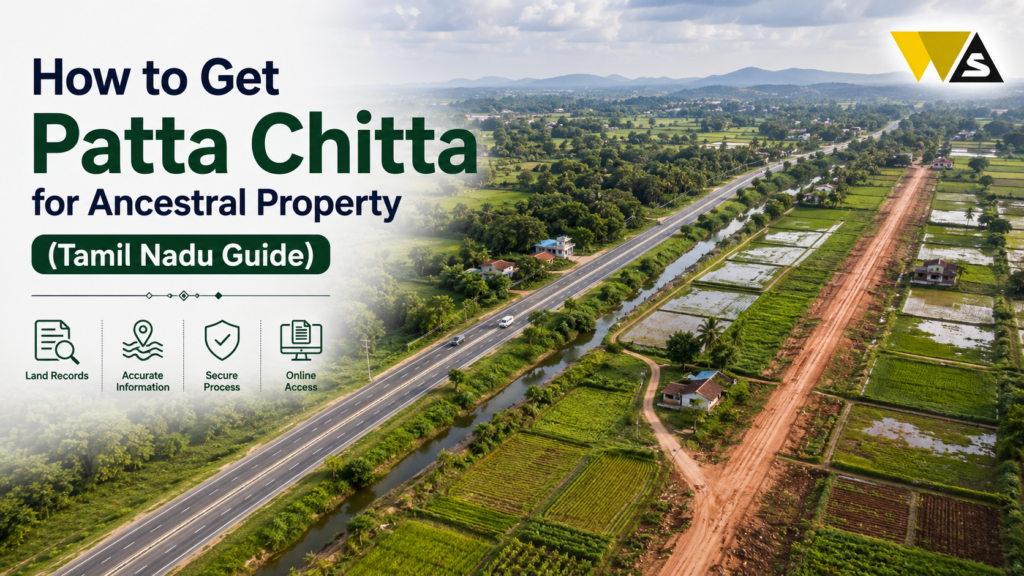
To get the Patta Chitta for ancestral (inherited) property, the legal heirs must transfer the Patta from the deceased owner’s name into their own names through mutation at the Tahsildar (Taluk) office. The key documents are the death certificate of the previous owner, a Legal Heir Certificate (or succession certificate) naming all heirs, the old Patta, the EC, and the heirs’ ID proofs.
If there is a will, a probate/will is used; if there is no will, the property passes to all legal heirs as per succession law. After a VAO field verification, the Tahsildar transfers the Patta to the heir(s). If the heirs want separate individual pattas, they then do a partition (sub-division). There is no instant online process inheritance mutation involves the Taluk office and verification, and takes longer than a simple transfer.
Table of Contents
ToggleWhat Does “Patta Chitta for Ancestral Property” Mean?
When a person inherits land from their parents, grandparents, or ancestors, the Patta usually still shows the old (deceased) owner’s name. To become the legal owner in government records, the heir must transfer the Patta into their own name — this is called mutation (transfer of registry).
Two important terms to understand:
- Inherited property: Any property you receive after the owner’s death — from a parent, spouse, or relative.
- Ancestral property: A specific legal type of undivided property passed down through generations of the family (traditionally up to four generations of the male line), where descendants have a birthright.
whether the land is “ancestral” or simply “inherited”, the practical step is the same — you must update the Patta from the deceased’s name to the living heirs’ names. Only then can you sell, mortgage, build, or divide the land.
Patta for Ancestral Property Overview 2026
| Detail | Information |
| Process | Inheritance mutation (transfer of Patta) |
| Where to apply | Tahsildar (Taluk) office / e-Sevai |
| Key document | Legal Heir / Succession Certificate |
| Also needed | Death certificate, old Patta, EC, IDs |
| If there is a will | Probate / registered will |
| If no will | Property to all legal heirs (succession law) |
| Verification | VAO field check + Tahsildar approval |
| For separate shares | Partition / sub-division |
| Fully online? | No — involves office + verification |
| Timeline | Longer than a simple transfer |
Step 1: Get the Death Certificate
The first document you need is the death certificate of the previous owner (the deceased parent/grandparent).
- Apply for it at the local municipality, corporation, or panchayat where the death occurred/was registered.
- It is the basic proof that the previous owner has passed away, starting the inheritance process.
Step 2: Get the Legal Heir Certificate
The Legal Heir Certificate is the key document for inheritance. It officially names all the legal heirs of the deceased. The Patta cannot be transferred to heirs without proof of who the heirs are and the Legal Heir Certificate provides exactly that.
How to get it:
- Apply at the Taluk office / e-Sevai centre (or the Tahsildar/RDO, depending on purpose).
- Submit the death certificate, the applicant’s ID, details of all family members/heirs, and an address proof.
- After a VAO/RI verification, the certificate is issued naming the legal heirs.
Legal Heir Certificate vs Succession Certificate:
- A Legal Heir Certificate is generally used for transfer of property, pensions, and benefits.
- A Succession Certificate (from a civil court) is often needed for debts, securities, and disputed cases.
Step 3: Gather the Other Documents
Along with the death certificate and Legal Heir Certificate, keep these ready:
- Old Patta / Chitta copy (in the deceased’s name)
- Encumbrance Certificate (EC)
- Property tax receipts
- Aadhaar / ID proof of all heirs
- Will / Probate — if the deceased left a will
- Release Deed / No-Objection (NOC) — if some heirs give up their share in favour of others
- Legal Heir Certificate (from Step 2)
- Death Certificate (from Step 1)
- Passport-size photos of the applicant heirs
Step 4: Apply for Patta Transfer (Mutation)
Now apply to transfer the Patta from the deceased’s name to the heirs’ names:
Step 1: Go to the e-Sevai centre or Taluk (Tahsildar) office (some steps may be available on eservices.tn.gov.in ).
Step 2: Fill the Patta transfer (mutation) application, selecting inheritance as the reason.
Step 3: Enter the land details — survey/patta number, village, extent.
Step 4: Attach all documents — death certificate, Legal Heir Certificate, old Patta, EC, IDs, will/release deed if any.
Step 5: Pay the nominal fee and submit.
Step 6: Note the Application ID for tracking.
Step 7: The VAO does a field verification, and the Tahsildar approves the transfer.
Step 8: The Patta is updated in the heir(s)’ name(s) — download/collect the new Patta.
Single Heir vs Multiple Heirs
The process differs slightly based on how many heirs there are:
If There is One Heir
- The Patta is transferred directly to the single heir’s name after verification.
- Simpler and faster, with fewer NOCs needed.
If There are Multiple Heirs
- The Patta is usually first transferred to all heirs jointly creating a joint patta.
- If heirs want separate individual pattas, they must then do a partition/sub-division.
- Heirs who give up their share must sign a Release Deed / NOC in favour of the others.
With a Will vs Without a Will
Inheritance works differently depending on whether there is a will:
If There is a Will (Testamentary Succession)
- The property passes as per the will.
- You may need a probate (court certification of the will) in some cases, especially for high-value or disputed property.
- The Patta is transferred to the person named in the will.
If There is No Will (Intestate Succession)
- The property passes to all legal heirs as per succession law (based on religion/personal law).
- The Legal Heir Certificate establishes the heirs.
- All heirs share the property equally (unless they agree otherwise via a partition/release).
Very Old Ancestral Property
Sometimes the Patta is in the name of a grandparent or great-grandparent who died long ago, and no transfer was ever done.
- You must prove the full chain of inheritance — from the original owner, through each generation, down to the current heirs.
- You may need multiple death certificates and legal heir proofs across generations.
- Old, un-digitised records may require a manual search at the Taluk/VAO office.
- If many heirs exist across branches of the family, a family settlement or partition deed helps divide the land clearly.
After Getting the Patta: Consider Partition
Once the Patta is transferred to all heirs (joint patta), you may want separate individual pattas:
- Prepare a registered Partition Deed marking each heir’s share and boundaries.
- Applying for sub-division at the Tahsildar office a surveyor divides the land, and individual pattas are issued.
- This gives each heir independent, dispute-free ownership they can sell, mortgage, or build on alone.
Common Problems and Solutions
Here are common issues:
- Patta still in the deceased’s name: Apply for inheritance mutation with the Legal Heir Certificate.
- Legal Heir Certificate delayed: Follow up at the Taluk office; it needs VAO verification.
- Disputed heirs: A disputed case may need a succession certificate or court order.
- Some heirs abroad/unavailable: They can give a Power of Attorney or a signed NOC/Release Deed.
- Very old records not digitised: Do a manual check at the VAO/Taluk office.
- Multiple branches of family: Use a family settlement / partition deed to divide clearly.
- Someone demanding a bribe: Fees are officially escalated instead of paying extra.
Why You Must Transfer the Patta for Inherited Land
- Proves you are the legal owner in government records.
- Needed to sell or mortgage the inherited land.
- Required for a bank loan against the property.
- Needed for building approval and property tax in your name.
- Prevents disputes — an old name invites family and third-party claims.
Conclusion
Getting the Patta Chitta for ancestral or inherited property means transferring the Patta from the deceased owner’s name into the heirs’ names through inheritance mutation. The journey is clear: get the death certificate, obtain the all-important Legal Heir Certificate (or succession certificate for disputed cases), gather the old Patta, EC, and IDs, and apply for mutation at the Tahsildar office — where the VAO verifies and the Tahsildar approves the transfer.
Remember the key points: with a will, the property passes as written (sometimes needing probate); without a will, it passes to all legal heirs equally; multiple heirs get a joint patta, which can later be partitioned into individual pattas; and very old ancestral property may need proof of the full chain of heirs across generations. There is no instant online process — inheritance mutation involves the office and verification, and takes longer than a simple transfer.
Frequently Asked Questions (FAQs)
1. How do I get the Patta Chitta for ancestral property?
Transfer the Patta from the deceased owner’s name into the heirs’ names through inheritance mutation at the Tahsildar office. You need the death certificate, Legal Heir Certificate, old Patta, EC, and IDs. After VAO verification, the Tahsildar transfers the Patta to the heir(s).
2. What is the most important document for inheriting a Patta?
The Legal Heir Certificate is the key document — it officially names all the legal heirs of the deceased. Without it, the Patta cannot be transferred, because there is no proof of who the rightful heirs are.
3. Does the Patta change automatically after the owner’s death?
No. Inheriting land does not automatically update the Patta — it usually still shows the deceased owner’s name. The heirs must apply for inheritance mutation to record their names in the revenue books.
4. What is the difference between a Legal Heir Certificate and a Succession Certificate?
A Legal Heir Certificate is used for transferring property, pensions, and benefits, and is issued by the Taluk/RDO. A Succession Certificate is issued by a civil court and is often needed for debts, securities, and disputed cases. For most Patta transfers, the Legal Heir Certificate is enough.
5. How is inherited Patta handled when there are multiple heirs?
The Patta is usually transferred to all heirs jointly, creating a joint patta. If heirs want separate individual pattas, they do a partition/sub-division. Heirs giving up their share sign a Release Deed or NOC in favour of the others.
6. What if there is a will for the property?
If there is a will, the property passes as per the will, and the Patta is transferred to the person named in it. A probate (court certification of the will) may be needed in some cases, especially for high-value or disputed property.
7. What if there is no will?
If there is no will, the property goes to the legal heirs under the applicable succession law. The Legal Heir Certificate shows who the legal heirs are. The heirs can divide the property through a Partition Deed or Release Deed if they agree.
8. How do I get the Patta for very old ancestral property?
You must prove the full chain of inheritance from the original owner through each generation to the current heirs, often needing multiple death certificates and legal heir proofs. Old un-digitised records may need a manual check, and a lawyer’s help is advisable.
9. Can I sell inherited land before transferring the Patta?
Do not rush to sell inherited land before updating the Patta. Complete the inheritance mutation first so the Patta shows your name as the owner.
10. How long does it take to transfer a Patta for inherited property?
Inheritance Patta transfer can take more time than a normal sale transfer. It may take a few weeks or even a few months. The process can take longer if there are many heirs, disputes, or old records.
Read our article:
Read our article:
Read our article:
Read our article:
Read our article:
Read our article: