
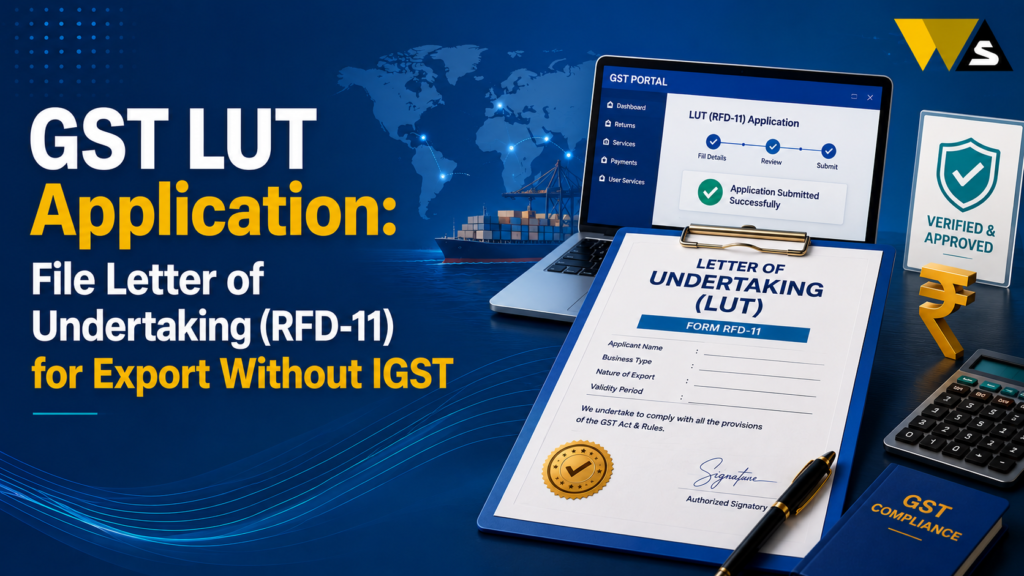
A GST LUT (Letter of Undertaking) lets exporters and SEZ suppliers export goods or services without paying IGST upfront. You file it in Form GST RFD-11 on gst.gov.in (Services → User Services → Furnish Letter of Undertaking (LUT)), select the financial year, tick the three self-declarations, add two witnesses, and submit using DSC or EVC — you instantly get an ARN.
It is free and takes about 20–30 minutes. Every GST-registered exporter/SEZ supplier can file, except those prosecuted for tax evasion above ₹2.5 crore (they must furnish a bond + bank guarantee instead). An LUT is valid for one financial year (1 April to 31 March) and must be renewed every year , it does not renew automatically. Filing an LUT saves your working capital by avoiding the pay-IGST-then-refund cycle.
Are you an exporter who wants to ship without paying IGST? This blog explains the GST LUT application– eligibility, documents, the step-by-step process, and renewal.
Table of Contents
ToggleWhat is a GST LUT (Letter of Undertaking)?
A Letter of Undertaking (LUT) is a declaration an exporter files with the government, promising to follow all export rules — in return for being allowed to export without paying IGST.
Under Section 16 of the IGST Act, exports and supplies to SEZ are treated as “zero-rated supplies” — meaning no GST should finally fall on them. But an exporter has two ways to get this benefit:
- Pay IGST first, then claim a refund — your money is stuck until the refund comes.
- File an LUT and export without paying IGST — no money blocked, no refund cycle.
The LUT is the smarter, more popular choice, because it saves your working capital. The LUT is filed in Form GST RFD-11 and is grounded in Rule 96A of the CGST Rules and Notification No. 37/2017, which let all eligible exporters use an LUT instead of a bond.
A GST LUT is a one-time yearly form that lets you export without paying IGST — keeping your cash free for your business.
GST LUT Application Overview 2026
| Detail | Information |
| What It Is | Letter of Undertaking for zero-rated export |
| Form | GST RFD-11 |
| Legal Basis | Rule 96A, Section 16 IGST Act, Notif. 37/2017 |
| Portal | gst.gov.in |
| Path | Services → User Services → Furnish LUT |
| Who Can File | All GST-registered exporters / SEZ suppliers |
| Who Cannot | Those prosecuted for evasion above ₹2.5 crore |
| Validity | One financial year (1 April – 31 March) |
| Renewal | Every year (no auto-renewal) |
| Cost | Free |
| Submission | DSC or EVC → instant ARN |
Why Do Exporters Need an LUT?
If you export without an LUT, you must pay IGST on every export and then claim it back as a refund which blocks your money for weeks or months. An LUT removes this problem.
Benefits of filing an LUT:
- Export without paying IGST — no upfront tax.
- Saves working capital — your cash is not locked in refunds.
- No refund paperwork for the IGST — less compliance.
- Faster, smoother exports — no waiting for refunds.
- Valid for the whole financial year — file once, use all year.
- Fully online and free — quick to file.
Without an LUT, your money goes to the government and comes back slowly. With an LUT, your money stays with you which is why almost all regular exporters file an LUT.
Who is Eligible to File an GST LUT?
Almost every exporter can file an LUT. You can file an LUT if:
- You are a GST-registered person, and
- You supply goods or services for export, or make supplies to SEZ units/developers, or make other zero-rated supplies.
Even new exporters can file: A newly registered business with a valid GSTIN can file an LUT immediately no export track record is needed, because the LUT is a forward-looking promise.
Who CANNOT file an LUT :
- Anyone who has been prosecuted for tax evasion of more than ₹2.5 crore under the CGST/IGST Act or any earlier law.
- Such taxpayers must furnish an export bond with a bank guarantee instead of an LUT.
If you are a regular exporter you are eligible , file the LUT before you export.
LUT vs Bond: What is the Difference?
Before 2017, most exporters had to furnish a bond. Now, most can use a simple LUT instead. Here is the difference in simple words:
- LUT (Letter of Undertaking): An online declaration in Form RFD-11 — no bank guarantee, free, valid for one year. For eligible exporters (almost everyone).
- Bond: A document on non-judicial stamp paper, usually with a bank guarantee (which costs money and effort), submitted manually. Required only for those not eligible for an LUT (like those prosecuted for large tax evasion).
Documents Required for the GST LUT Application
The LUT process is paperless and simple, but keep these ready:
- GST registration (GSTIN) and portal login credentials
- PAN of the business
- Details of two independent witnesses — their name, occupation, and address
- Authorised signatory details (with DSC for companies/LLPs)
- Board Resolution / Authorisation Letter — for companies, LLPs, and partnership firms, authorising the signatory to file RFD-11
- Previous year’s LUT copy (PDF/JPEG) — only if you filed manually earlier and are uploading it
- IEC (Import Export Code) — good to have ready for exporters
Arrange your two witnesses and (for companies/LLPs) the board resolution and DSC in advance these are the parts people forget.
How to File a GST LUT Application (Step-by-Step)
The whole process is online, free, and takes about 20–30 minutes. Follow these steps:
- Step 1: Log in to the GST portal (gst.gov.in ) with your username and password.
- Step 2: Go to Services → User Services → Furnish Letter of Undertaking (LUT).
- Step 3: Select the financial year for which you are filing (for example, 2026-27) from the drop-down.
- If you filed an LUT manually earlier, upload that copy (PDF/JPEG, max ~2 MB) here.
- Step 4: The RFD-11 form opens, with your GSTIN and legal name auto-filled.
- Step 5: Tick the three self-declaration checkboxes, promising to:
- Complete the export within 3 months (or the allowed time),
- Follow all GST laws for exports,
- Pay IGST with 18% interest if you fail to export in time.
- Step 6: Enter the name, occupation, and address of two independent witnesses.
- Step 7: Fill the place and authorize signatory details.
- Step 8: Sign and submit electronically using DSC (mandatory for companies/LLPs) or EVC (OTP).
- Step 9: You get a confirmation and an ARN — your LUT is filed and active for that financial year.
Selecting the wrong financial year cannot be undone after submission so choose the correct year carefully.
Understanding the Three Declarations in the GST LUT
Before filing an LUT, understand these three important conditions:
- Export within 3 months: You will complete the export of goods/services within three months of the invoice date (or the time allowed).
- Follow GST law: You will comply with all GST rules relating to exports.
- Pay IGST + 18% interest if you fail: If you do not export the goods/services in time, you will pay the IGST along with 18% interest.
If you use an LUT but do not export the goods, you may have to pay tax with interest. Only use an LUT for genuine exports. Keep your shipping bills, FIRC, and BRC as proof of export.
GST LUT Validity and Renewal
- An LUT is valid for only one financial year — from 1 April to 31 March.
- It does NOT renew automatically.
- You must file a fresh LUT (Form RFD-11) at the start of every financial year to keep exporting without IGST.
What happens if you do not renew:
If your LUT expires and you have not filed a new one, you may have to pay IGST on exports until the new LUT is submitted.
File your new LUT in March, before the new financial year begins, so there is no gap. The GST portal usually opens LUT filing for the next year in advance.
How to Check GST LUT Status and Download It
After filing, you can view, download, and track your LUT:
To download/view your LUT:
- Log in to gst.gov.in .
- Go to Services → User Services → View My Submitted LUTs.
- Select the period, find your LUT, and click VIEW.
- Download/print the LUT for your records.
LUT application status meanings:
- Submitted: You filed it successfully.
- Pending for Clarification: The officer asked for more details — reply within 15 working days.
- Pending for Order: Your reply is under review (or the 15 days passed).
- Approved: Your LUT is accepted.
An LUT is auto-approved on submission and can be used immediately but always download a copy for your records.
What to Do After Filing the GST LUT
- Mention the LUT ARN on all export and SEZ invoices — this shows you are exporting without IGST under the LUT.
- Write “Export under LUT without payment of IGST” on the invoice.
- Complete the export within the time limit (usually 3 months).
- Keep your export proof (shipping bill, BRC/FIRC) safely.
- Maintain copies of the LUT and acknowledgement for audits.
Common Mistakes to Avoid for GST LUT
- Selecting the wrong financial year — it cannot be changed after submission.
- Forgetting to renew the LUT each year — leads to paying IGST.
- Not mentioning the LUT ARN on export invoices.
- Missing the two witnesses’ details.
- Not exporting in time after taking the LUT benefit — leads to IGST + 18% interest.
- Companies/LLPs filing without a DSC or board resolution.
- Assuming auto-renewal — there is none.
Conclusion
A GST LUT application is a must for every exporter who wants to ship goods or services without paying IGST upfront. By filing Form GST RFD-11 on gst.gov.in (Services → User Services → Furnish LUT), selecting the financial year, accepting the three declarations, adding two witnesses, and submitting with DSC or EVC, you get an ARN and can export without blocking your money in IGST refunds.
Almost every GST-registered exporter is eligible (except those prosecuted for tax evasion above ₹2.5 crore, who need a bond); the LUT is valid for one financial year (1 April–31 March) and must be renewed every year — it does not renew automatically; and you must mention the LUT ARN on your export invoices and complete the export in time, or pay IGST with 18% interest.
Frequently Asked Questions (FAQs)
1. What is an LUT in GST?
An LUT is a simple undertaking filed on the GST portal. It allows eligible exporters and SEZ suppliers to make zero-rated supplies without paying IGST first. This keeps their working capital free and avoids the need to pay IGST and wait for a refund.
2. Who needs to file a GST LUT?
If your GST-registered business exports goods or services or makes eligible zero-rated supplies to SEZs, you can file an LUT. It allows you to make these supplies without paying IGST upfront. You can file an LUT even if you are a new exporter.
3. How do I file a GST LUT application?
Log in to gst.gov.in, go to Services → User Services → Furnish Letter of Undertaking (LUT), select the financial year, tick the three self-declarations, add two witnesses, and submit using DSC or EVC. You instantly receive an ARN and the LUT becomes active.
4. Is filing a GST LUT free?
Yes. Filing an LUT (Form RFD-11) on the GST portal is completely free and fully online, taking about 20–30 minutes. You only pay a fee if you hire a professional to file it for you, which is a service charge, not a government fee.
5. How long is a GST LUT valid?
An LUT is valid for one financial year only. It does not renew automatically. You need to file a new Form RFD-11 every year if you want to export without paying IGST.
6. Do I need to renew my LUT every year?
Yes. The LUT does not renew automatically. You must file a new LUT each financial year, ideally in March before the new year begins, so there is no gap. If it lapses, you may have to pay IGST on exports until the new LUT is filed.
7. Who cannot file an LUT and must furnish a bond?
You cannot file an LUT if you were prosecuted for tax evasion above ₹2.5 crore. In this case, you need to submit an export bond and bank guarantee instead.
8. What are the three declarations in the LUT?
By filing the LUT, you promise to complete the export within three months (or the allowed time), comply with all GST laws for exports, and pay IGST with 18% interest if you fail to export in time. These are self-declarations you accept before submitting.
9. What documents are needed for the LUT application?
You need your GST login, PAN, two witnesses’ details, and authorised signatory details. Companies and LLPs also need a DSC and authorisation documents. Keep the previous year’s LUT if you filed it manually.
10. What should I do after filing the LUT?
Note the ARN, download the LUT, and mention the LUT ARN on all export and SEZ invoices with a note like “Export under LUT without payment of IGST”. Complete the export within the time limit and keep your export proof and LUT copy for audits.
Read our article:
Read our article:
Read our article:
Read our article:
Read our article:
Read our article: