
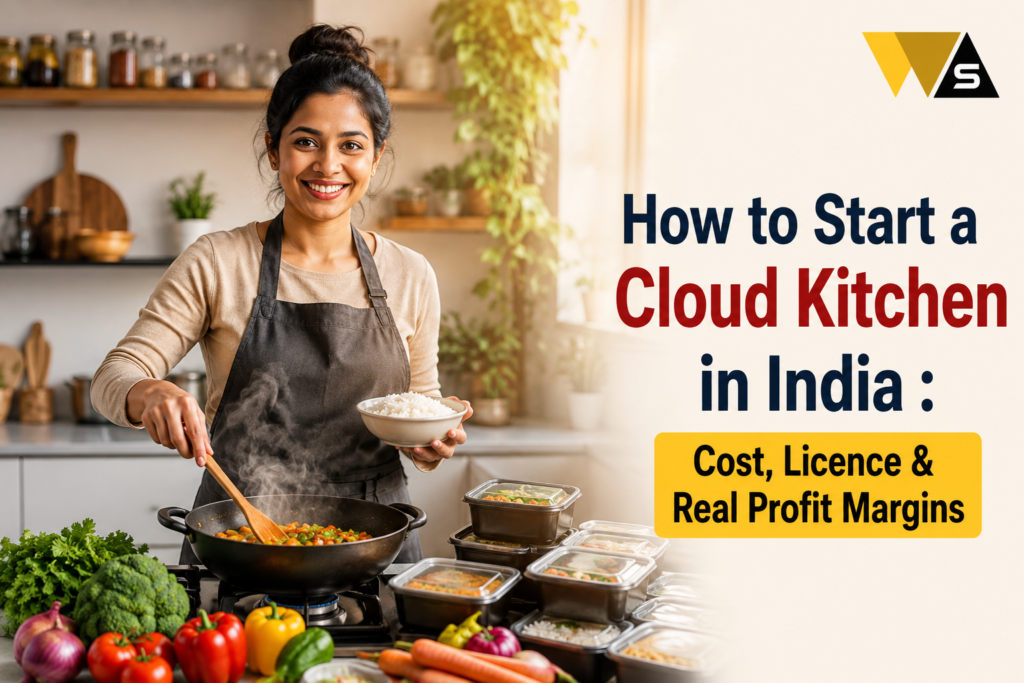
A cloud kitchen is a delivery-only food business with no dine-in seating. You cook and sell only through apps like Swiggy and Zomato, or your own WhatsApp/website. To start one in India, you need about ₹2–₹10 lakh (a small home-based one can start under ₹1 lakh), a rented kitchen space, FSSAI registration, listing on food delivery apps, and a focused menu of 1–2 popular cuisines.
Delivery apps take 25–35% of each order (commission + platform fee + GST + ad/discount costs), so you must price your delivery menu 15–25% higher than normal and slowly build direct orders to survive. A well-run cloud kitchen can be profitable, but margins are tight. Success depends on smart pricing, good ratings, and controlling costs.
Do you want to start a cloud kitchen? This guide you the cost, the licence, the real profit math, and how to survive app commissions.
Table of Contents
ToggleWhat is a Cloud Kitchen?
A cloud kitchen (also called a dark kitchen, ghost kitchen, or delivery-only kitchen) is a restaurant that has no dining area and no walk-in customers. You only cook food for delivery customers order through Swiggy, Zomato, your website, or WhatsApp, and the food is delivered to their home.
Cloud Kitchen vs Regular Restaurant
- No seating, no waiters, no fancy location so much lower cost.
- You can run it from a small kitchen space in a cheaper area.
- Your “shop” is your listing on the delivery apps, not a physical storefront.
People order food online more than ever. A cloud kitchen lets you reach thousands of customers without paying for an expensive restaurant in a prime location. You can even run multiple food brands from one kitchen (for example, a biryani brand and a rolls brand from the same space).
A cloud kitchen is a food business built for the delivery age lower cost than a restaurant, but you live and die by your app listing and your margins.
Cloud Kitchen Overview 2026
| Detail | Information |
| Business Type | Delivery-only food kitchen |
| Also Called | Dark kitchen, ghost kitchen |
| Startup Cost | ₹2–₹10 lakh (home-based: under ₹1 lakh) |
| Space Needed | 200–500 sq ft kitchen |
| Key Licence | FSSAI (Basic or State, by turnover) |
| Main Sales Channel | Swiggy, Zomato + direct (WhatsApp/website) |
| App Commission | 18–30% base (25–35% effective) |
| Platform Fee | ~₹17.58 per order (2026) |
| Profit Margin | Often below 10% early; 10–20% when optimised |
| Best Menu | 1–2 focused cuisines, delivery-friendly food |
How Does a Cloud Kitchen Work?
Follow these simple steps to understand how a cloud kitchen business work:
- You set up a kitchen (rented space or home kitchen).
- You get your FSSAI registration and other permissions.
- You list your food brand on Swiggy and Zomato.
- A customer orders on the app.
- You cook and pack the order.
- The app’s delivery partner picks it up and delivers it.
- The app pays you the order amount minus its commission and fees.
Because you have no dine-in, all your sales come from delivery. So the app commission applies to your entire income; this is the single most important thing to understand before starting.
Cloud Kitchen Startup Cost
Here is an estimated cost:
| Item | Approx. Cost |
| Kitchen rent (deposit + 1 month) | ₹30,000 – ₹2,00,000 |
| Kitchen equipment (stoves, fridge, vessels) | ₹1,00,000 – ₹4,00,000 |
| Interior/basic setup + chimney | ₹30,000 – ₹1,50,000 |
| FSSAI + licences | ₹5,000 – ₹15,000 |
| Raw material (first stock) | ₹20,000 – ₹50,000 |
| Packaging | ₹15,000 – ₹40,000 |
| Branding + app photos | ₹10,000 – ₹50,000 |
| Initial marketing/ads | ₹25,000 – ₹80,000 |
| Total (typical) | About ₹2 – ₹10 lakh |
If you start from your home kitchen with a simple single-brand menu, you can begin under ₹1 lakh, and grow into a proper rented cloud kitchen later.
Many cloud kitchens need time to become profitable. Keep a backup budget for the first few months so you can continue running your business even if orders are slow.
Step 1: Choose Your Food Concept and Menu for Cloud Kitchen
Your menu decides everything. Follow these rules:
- Pick 1–2 cuisines, not everything. A focused brand (like “only biryani” or “only rolls and momos”) is easier to run and market than a huge mixed menu.
- Choose delivery-friendly food — dishes that stay good for 30–45 minutes in a box. Avoid items that turn soggy or cold quickly.
- Keep the menu small — fewer items mean less waste, faster cooking, and easier stock.
- Have a few “hero” dishes that you do better than anyone.
- Check demand — see what sells well on Swiggy/Zomato in your delivery area before deciding.
Popular cloud kitchen ideas: biryani, North Indian thali, rolls, momos, Chinese, pizza, burgers, healthy/diet food, South Indian tiffin, cakes and desserts.
You can run more than one brand from the same kitchen later (for example, a biryani brand and a dessert brand) to get more orders without more rent.
Step 2: Find and Set Up Your Cloud Kitchen
You do not need a busy location. You need a clean kitchen in a place where you can deliver food easily.
Choosing the space:
- 200–500 sq ft is enough for a single-brand kitchen.
- Pick an area central to many customers (so delivery is fast), but with cheaper rent than a main market.
- Make sure it has water, drainage, power, and proper ventilation.
- Check that food business is allowed at that location.
Setting it up:
- Cooking zone — stoves, burners, tandoor if needed
- Prep zone — for cutting and preparation
- Storage — fridge, freezer, and dry storage
- Packing zone — a clean area to pack orders fast
- Washing zone — for hygiene
- Chimney/exhaust — very important for a busy kitchen
Design your kitchen so cooking and packing flow quickly. In delivery, speed keeps your app rating high.
Step 3: Get Your FSSAI Licence and Registrations for Cloud Kitchen
A cloud kitchen is a food business, so food safety registration is compulsory.
FSSAI – Food Safety and Standards Authority of India. It has three levels based on turnover:
- Basic Registration — for small businesses. As of the new rules from 1 April 2026, FSSAI Registration covers turnover up to ₹1.5 crore (raised from ₹12 lakh), fee about ₹100 per year.
- FSSAI State Licence — for turnover ₹1.5 crore to ₹50 crore.
- FSSAI Central Licence — for turnover above ₹50 crore.
Most new cloud kitchens need the Basic Registration or State Licence, depending on expected turnover. Apply online on the FoSCoS portal (foscos.fssai.gov.in ). New registrations do not need regular renewal. They stay valid as long as you follow the rules.
Other registrations you will likely need:
- GST registration — usually required to list on Swiggy/Zomato, regardless of turnover, so most cloud kitchens register for GST.
- Shop and Establishment registration — for your kitchen premises.
- Trade licence — from your local municipal body.
- Fire safety NOC — depending on your setup and local rules.
- Udyam (MSME) registration — free and optional, helpful for loans and benefits.
Get your FSSAI and GST ready early, because the delivery apps ask for them during onboarding.
Step 4: List your Cloud Kitchen on Swiggy and Zomato
Your app listing is like your shop. Here is how to list your cloud kitchen:
- Go to the Swiggy and Zomato partner/onboarding pages and register your restaurant.
- Submit your FSSAI, GST, PAN, bank details, and menu.
- Upload good food photos — photos directly affect your orders, so invest in quality images.
- Set your menu and delivery prices.
- Go live and start receiving orders.
List on BOTH apps (unless you truly cannot handle two order streams) — most single kitchens get orders from both Swiggy and Zomato, so being on both means more orders.
Also set up direct ordering (WhatsApp, Instagram bio link, or a simple website) from day one — you will understand why in the next section.
Step 5: Understand the Real App Commission
The commission is only one part of the cost. Here are the other charges you may pay:
- Base commission: Swiggy and Zomato charge roughly 18–30% of the order value, depending on city, cuisine, and your plan.
- Platform fee: A flat fee of about ₹17.58 per order (both platforms raised it in March 2026). This is the same on a ₹200 order and a ₹900 order, so it hurts small orders more.
- GST on commission: 18% GST applies on the commission amount.
- Discount funding: Apps often expect you to fund part of the discounts (“Flat ₹125 off”), which comes from your pocket.
- Ads: To get visible on the app, many kitchens pay for ads too.
Step 6: Price Your Menu to Survive Commissions
Now that you understand the commission, here is how to protect your profit:
- Price your delivery menu higher than dine-in. Successful operators keep delivery prices about 15–25% above normal prices, to absorb the commission.
- Know your cost per dish — ingredients + packing + gas + labour.
- Make sure each dish is still profitable after 30–35% is deducted. If a dish loses money after commission, fix its price or remove it.
- Increase order value — offer combos, add-ons, and drinks so the flat platform fee is spread over a bigger order.
- Watch food cost weekly, not monthly — small leaks add up fast.
If a dish costs you ₹100 to make and pack, and the app takes ~33%, then to earn a real profit you must price it around ₹200–₹230 on the app — not ₹150.
Step 7: Build Direct Orders for Cloud Kitchen
Smart cloud kitchens slowly move customers to direct ordering because a direct order costs only about 10–15% (payment gateway + delivery), compared to 25–35% on the apps.
How to build direct orders:
- Collect customer numbers from day one (from packaging inserts, QR codes).
- Build a WhatsApp broadcast list and share your menu and offers.
- Add a direct order link in your Instagram bio.
- Put an “order directly and save” card inside every delivery.
- Use a simple website or ordering tool for repeat customers.
- Arrange your own delivery (or a per-order delivery partner) for direct orders.
Moving even 20–30% of your orders to direct can save you lakhs of rupees a year. The apps are great for finding new customers but your profit grows when repeat customers order directly from you.
Step 8: Packaging and Food Quality of Cloud Kitchen
In a cloud kitchen, the customer never sees your kitchen; they only judge you by the food and packaging that arrives.
- Use good, leak-proof, food-grade packaging — spills ruin your rating instantly.
- Pack so food stays hot and fresh for 30–45 minutes.
- Keep gravies and dry items separate where needed.
- Add your brand sticker and a thank-you note — it builds a brand.
- Never compromise on taste and hygiene one bad order becomes a bad review that lowers your ranking.
Step 9: Get Good Ratings and Marketing for Cloud Kitchen
Good ratings bring more orders. To get better ratings, follow these tips:
For good ratings:
- Consistent taste, correct orders, and fast preparation.
- Never miss items — always double-check the order before packing.
- Respond to reviews and fix complaints quickly.
For marketing:
- App ads to appear higher in search (use carefully — track your cost per order).
- Attractive food photos and a clear menu.
- Instagram reels and WhatsApp to build a brand and push direct orders.
- Launch offers to get your first orders and reviews — early ratings matter a lot.
Aim for a rating above 4.3–4.5. Below 4.0, your orders drop sharply, because the app shows you to fewer customers.
Cloud Kitchen Profit Margins
- Cloud kitchens often make only a small profit in the beginning, especially if they depend only on food delivery apps.
- Good pricing, careful spending, and more direct orders can help your cloud kitchen earn better profits.
- About 25–30% of cloud kitchens close within their first year usually due to poor cost control, thin margins, or running out of cash, not bad food.
Tips for Long-Term Cloud Kitchen Success
- They calculate all delivery costs before setting menu prices, so every order remains profitable.
- They get more direct orders through WhatsApp or their website to save on delivery app charges.
- They check food costs every week and avoid wasting ingredients.
- They keep enough backup money for the first few months of business.
Common Mistakes to Avoid for Cloud Kitchen
- Pricing app menu too low — you lose money on every order after commission.
- Depending only on Swiggy/Zomato — build direct orders too.
- Too big a menu — causes waste, slow cooking, and errors.
- Ignoring packaging — spills and cold food kill your rating.
- No backup cash — many close before orders build up.
- Poor ratings — below 4.0, the app hides you.
- Not tracking costs — you think you are profitable when you are not.
- Skipping FSSAI/GST — you cannot even list properly without them.
How to Grow Your Cloud Kitchen
- Add a second brand from the same kitchen (more orders, same rent).
- Expand your menu carefully with proven best-sellers.
- Open a second kitchen in another delivery zone.
- Grow direct orders into a strong repeat-customer base.
- Build your brand on Instagram so people search for your name.
- Later, consider a franchise or multi-outlet model.
Conclusion
A cloud kitchen is a smart, lower-cost way to enter the food business in India — no dine-in, no prime location, just a kitchen and a strong delivery presence. You can start with about ₹2–₹10 lakh (or under ₹1 lakh from home), a focused 1–2 cuisine menu, an FSSAI licence and GST, and listings on Swiggy and Zomato.
A cloud kitchen can make good money if you control your costs and set the right prices. Do not depend only on food delivery apps. Try to get direct orders through WhatsApp or your website. Serve good food, keep your customers happy, and grow your business only after you start making regular profits.
Frequently Asked Questions (FAQs)
1. How much does it cost to start a cloud kitchen in India?
A typical cloud kitchen needs about ₹2–₹10 lakh, covering kitchen rent, equipment, licences, raw material, packaging, and marketing. A small home-based single-brand cloud kitchen can start under ₹1 lakh and grow later. Always keep 2–3 months of backup cash.
2. What licences do I need for a cloud kitchen?
You need an FSSAI registration (Basic covers turnover up to ₹1.5 crore from 1 April 2026, State Licence for higher), plus GST (usually required to list on Swiggy/Zomato), a Shop and Establishment registration, a local trade licence, and often a fire safety NOC.
3. How much commission do Swiggy and Zomato take?
Food delivery apps charge commission and other fees on every order. Make sure your menu prices cover these costs and still leave you with a profit.
4. Is a cloud kitchen profitable?
A cloud kitchen can be profitable if you control your costs, set the right prices, and provide good food and service. Regular customers help increase your profits.
5. Do I need GST for a cloud kitchen?
Swiggy and Zomato generally ask for GST registration before listing your cloud kitchen. Check the latest requirements when you register.
6. How do I price my cloud kitchen menu?
Set your menu prices high enough to cover all costs and make a profit. Offer combo meals to increase your sales.
7. How can I reduce Swiggy and Zomato commission?
You cannot avoid commission on app orders, but you can build direct orders (WhatsApp, Instagram link, website) that cost only about 10–15%. Moving even 20–30% of orders to direct ordering can save lakhs of rupees a year.
8. What food is best for a cloud kitchen?
Delivery-friendly food that stays good for 30–45 minutes — biryani, North Indian, rolls, momos, Chinese, pizza, burgers, healthy food, and desserts. Keep a focused 1–2 cuisine menu with a few strong “hero” dishes rather than a huge mixed menu.
9. Can I start a cloud kitchen from home?
Yes. You can start a small cloud kitchen from home. Get your FSSAI registration, keep your kitchen clean, and move to a commercial kitchen as your business grows.
10. Why do so many cloud kitchens fail?
Many cloud kitchens fail because they spend too much, charge too little, or do not get enough regular customers. Good pricing, cost control, and quality food help the business grow.
Read our article:
Read our article:
Read our article: