

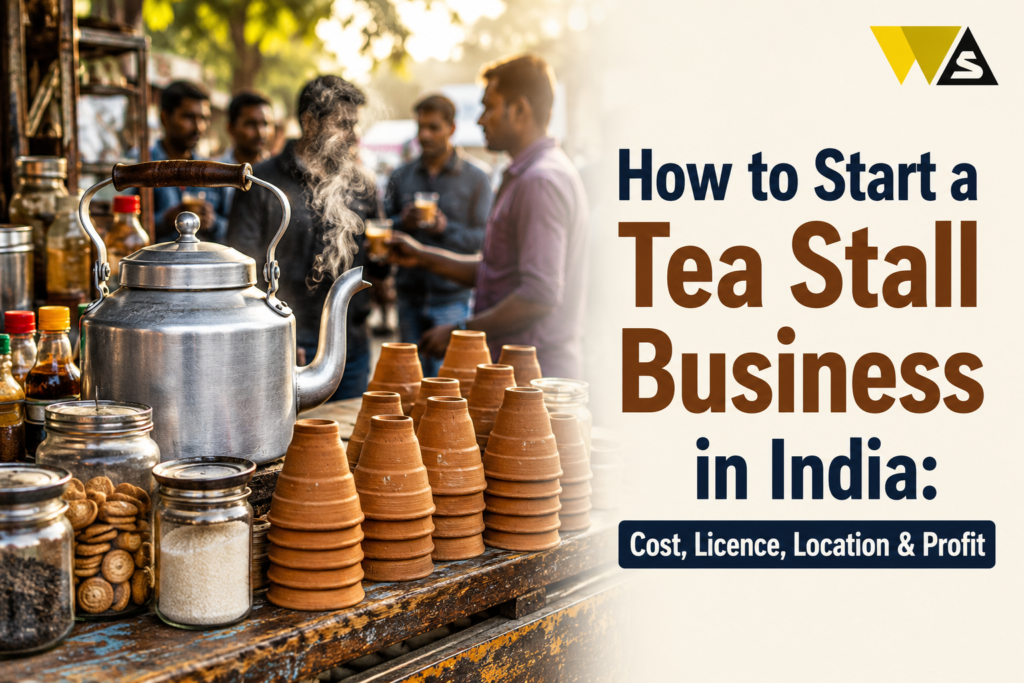
To start a tea stall business in India, you can begin with a small investment of about ₹15,000–₹60,000. The most important step is choosing a high-footfall location — near a bus stand, railway station, college, office area, hospital, or market. You need basic equipment (a gas stove or burner, a big tea kettle/pan, cups, and a table or cart), simple raw materials (tea, milk, sugar, ginger, cardamom), and an FSSAI Basic Registration (for small food businesses as of 1 April 2026, Basic Registration covers turnover up to ₹1.5 crore, fee about ₹100 per year on foscos.fssai.gov.in ).
Sell tea plus snacks (biscuits, samosa, vada, bun), keep the taste consistent, and a good stall can earn a healthy daily profit. Tea has very high margins, so a busy stall becomes profitable quickly.
Do you want to start a tea (chai) stall business? This blog tells you everything- location, cost, licence, equipment, and how to earn a good profit.
Table of Contents
ToggleWhy is a Tea Stall a Good Business in India?
India runs on chai. From early morning to late night, people drink tea everywhere — at bus stands, offices, colleges, and street corners. This is exactly why a tea stall is one of the best small businesses to start.
Here is why it works so well:
- Huge daily demand: Crores of Indians drink 2–3 cups of tea every day. The customers are always there.
- Very low startup cost: You can start with just a cart or small shop and basic equipment.
- Very high profit margin: A cup of tea costs a few rupees to make but sells for much more. Tea margins are among the highest in the food business.
- Cash business: You get instant cash daily, not monthly payments.
- Repeat customers: People come to the same stall every day, so you build a loyal crowd.
- Easy to learn: You do not need a big degree you need good tea and a good location.
A tea stall in a busy spot with tasty chai can earn more than many office jobs.
Tea Stall Business Overview 2026
| Detail | Information |
| Business Type | Tea (chai) stall / cart / small shop |
| Startup Cost | About ₹15,000 – ₹60,000 |
| Best Location | Bus stand, station, college, office, hospital |
| Key Licence | FSSAI Basic Registration (small scale) |
| FSSAI Basic Limit (2026) | Turnover up to ₹1.5 crore |
| FSSAI Basic Fee | About ₹100 per year |
| FSSAI Portal | foscos.fssai.gov.in |
| Profit Margin (tea) | Often 50% – 70% |
| Payment Type | Daily cash (and UPI) |
| Break-even | Often within a few months |
How Much Profit Can a Tea Stall Make?
Let us talk about real numbers, in simple words.
- One cup of tea costs about ₹4–₹7 to make (milk, tea, sugar, gas).
- You sell it for ₹10–₹20, depending on your area.
- So each cup gives you a profit of ₹5–₹13.
Example: If you sell 200 cups a day at ₹12, and each cup gives ₹6 profit, that is ₹1,200 profit a day from tea alone. Add snacks (biscuits, samosa, vada), and your profit grows further.
Monthly profit: ₹1,200/day × 26 days ≈ ₹31,000+ per month from a single small stall — and busy stalls near stations or colleges sell 400–600 cups a day.
Step 1: Choose the Right Location
For a tea stall, location is everything. The same stall can earn 10 times more in a busy spot than a quiet one. Look for places with high footfall:
- Bus stands and railway stations — travellers always want tea
- College and school areas — students are big tea drinkers
- Office and IT areas — professionals take tea breaks all day
- Hospitals — visitors and staff need tea day and night
- Markets and shopping areas — steady crowd
- Factory/industrial areas — workers on shift breaks
- Busy road junctions and auto/taxi stands
Location Checklist for Your Tea Stall
- Footfall — sit there for a day and count the people passing.
- Competition — a few tea stalls nearby is fine (it means demand), but do not pick an overcrowded corner.
- Space — enough room for your cart/stall and a few customers to stand.
- Water and cleaning — you need water access.
- Permission — check local municipal rules for street vending.
A slightly higher rent in a busy location is worth it. Footfall brings profit — never choose a cheap but empty spot.
Step 2: Decide Your Tea Stall Type
There are different ways to start, based on your budget:
- Tea cart (thela): Lowest cost, movable, good for footpaths and markets. Great for beginners.
- Small kiosk/stall: A fixed small stall or shop, slightly higher cost but more stable.
- Tea shop with seating: A small shop with benches or chairs, where people sit and drink. Higher cost, higher earning.
- Branded tea franchise: You can join a famous tea brand as a franchise. It costs more, but you get a well-known brand and help with setting up the business.
Note: Most people start with a cart or small kiosk to keep costs low, then move to a proper shop once they have regular customers.
Step 3: Get Your FSSAI Registration and Permissions
A tea stall serves food and drink, so you need food safety registration. The good news — for a small stall, it is cheap and simple.
FSSAI = Food Safety and Standards Authority of India. It has three levels:
- FSSAI Basic Registration — for small businesses. As of the new rules from 1 April 2026, Basic Registration covers annual turnover up to ₹1.5 crore (raised from the earlier ₹12 lakh). Almost every tea stall falls here.
- FSSAI State Licence — for turnover ₹1.5 crore to ₹50 crore.
- FSSAI Central Licence — for turnover above ₹50 crore.
For a tea stall, you need only Basic Registration.
Key facts (2026):
- Apply online on the FoSCoS portal (foscos.fssai.gov.in ) — the old FLRS portal is closed.
- The Basic Registration government fee is about ₹100 per year.
- Under the 2026 amendment, new registrations carry perpetual validity (no repeated renewal), subject to compliance. There are also easier rules being brought in for street vendors.
Other permissions to check:
- Municipal / street vending permission — for putting a stall/cart on a public spot.
- Local trade licence — some cities require it.
- No-objection — if you set up in front of a shop or private area.
Step 4: Buy Your Equipment
A tea stall needs simple, low-cost equipment. Here is the basic list:
- Gas stove / burner (single or double) with a commercial cylinder
- Big tea kettle or deep pan (patila) for boiling tea
- Milk vessel and a strainer (chalni)
- Cups — kulhads (clay cups), paper cups, glass cups, or steel glasses
- Serving tray
- Table or cart to work on
- Storage boxes for tea, sugar, and snacks
- Water storage and cleaning bucket
- Dustbin (keep your area clean)
- A display rack for biscuits and snacks
- A UPI QR code board (many customers pay by phone now)
A fridge (for cold drinks/milk), an induction stove as backup, and a branded board/banner.
Buy good-quality vessels, cheap ones burn tea and spoil the taste. Taste is your business.
Step 5: Plan Your Menu (Tea + Snacks)
Do not sell only plain tea. A good menu increases your income per customer:
Tea varieties:
- Normal milk tea (masala chai) — your main product
- Ginger tea (adrak chai)
- Cardamom tea (elaichi chai)
- Black tea (kadak/black chai)
- Lemon tea / green tea (for health-conscious customers)
- Special/elaichi-masala “cutting” chai
Snacks to add (high profit):
- Biscuits and rusk
- Samosa, vada, bonda, bajji
- Bun-butter / bread-omelette
- Cigarettes/paan (where allowed) and cold drinks/water bottles
- Cookies and small cakes
Because a customer who comes for ₹12 tea often also buys a ₹15 samosa — doubling your sale with almost no extra effort.
Note: Keep 2–3 signature items that people remember you for — like a strong special masala chai or fresh hot samosas.
Step 6: Source Your Raw Materials
Buy fresh and in bulk to keep costs low and taste high:
- Tea powder — choose a good strong brand; taste depends on this
- Milk — fresh, from a reliable dairy (fixed daily supply)
- Sugar
- Ginger, cardamom, and masala for flavour
- Gas — commercial cylinder
- Snacks — make fresh, or buy from a good local supplier
- Cups, tissues, and packing
Fix a daily milk and snack supplier so you never run short during rush hours. Running out of tea at peak time = lost money and lost customers.
Step 7: Fix Your Pricing
Pricing a tea stall is simple, but do it right:
- Find your cost per cup — add milk, tea, sugar, gas, and cup cost (usually ₹4–₹7).
- Check local rates — see what nearby stalls charge (₹10, ₹12, ₹15, ₹20).
- Price with a good margin — tea allows a 50–70% margin easily.
- Offer cup sizes — a small “cutting” chai and a regular cup, at different prices.
Example: If a cup costs you ₹6 and you sell at ₹12, you make ₹6 profit per cup (100% on cost).
Do not try to be the cheapest. Customers happily pay a rupee or two more for better-tasting tea. Compete on taste and cleanliness, not the lowest price.
Step 8: Focus on Taste and Consistency
This is the secret of every successful tea stall. People return to a stall because the tea tastes the same great way every single day.
To keep taste consistent:
- Use the same tea brand and same recipe daily.
- Measure your tea, milk, and sugar — do not guess every time.
- Boil properly — good chai needs the right boiling, not rushed.
- Use fresh milk — spoiled milk ruins everything.
- Keep the taste strong and fresh, the way your area likes it.
Once people love your taste, they become daily customers — and they bring friends. Consistency turns a stall into a daily habit for the whole neighbourhood.
Step 9: Keep Your Stall Clean and Hygienic
Cleanliness brings customers and keeps you legal. People avoid dirty stalls.
- Keep your cups and vessels clean — wash properly.
- Keep the work area and table clean.
- Keep a dustbin and do not throw waste around.
- Use clean water for tea and washing.
- Keep snacks covered to protect from dust and flies.
- Keep yourself neat — clean hands and clothes.
Step 10: Attract and Keep Customers
Getting the first crowd and keeping them is easy with small efforts:
To attract customers:
- Put a clear, attractive board with your stall name.
- Keep fresh hot tea ready during rush hours — smell and steam attract people.
- Offer a UPI QR code so people can pay easily.
- Be friendly and quick people love a cheerful chaiwala.
To keep customers:
- Remember regulars and their usual order this builds strong loyalty.
- Keep taste and timing consistent.
- Add a small free extra sometimes (an extra biscuit) small gestures build love.
- Serve fast during rush hour office and travel crowds are in a hurry.
Tea Stall Startup Cost Breakdown
Here is a rough startup cost for a small stall:
| Item | Approx. Cost |
| Cart / kiosk setup | ₹5,000 – ₹25,000 |
| Gas stove + commercial cylinder | ₹2,000 – ₹6,000 |
| Kettle, pans, vessels, strainer | ₹2,000 – ₹6,000 |
| Cups, tray, storage | ₹1,000 – ₹4,000 |
| First stock (tea, milk, sugar, snacks) | ₹2,000 – ₹5,000 |
| FSSAI Basic Registration | ₹100/year (+ small service charge if via agent) |
| Board / banner | ₹500 – ₹3,000 |
| Total | About ₹15,000 – ₹60,000 |
You can start small with a cart and grow into a proper tea shop as your customers increase. Many successful chaiwalas started with just ₹20,000.
Common Mistakes to Avoid
Learn from others’ mistakes:
- Wrong location — a quiet spot kills the business. Footfall is everything.
- Inconsistent taste — customers leave if the tea changes daily.
- Dirty stalls — loses customers and risks penalties.
- Poor-quality tea/milk — bad ingredients ruin taste.
- Slow service at rush hour — you lose the busiest, most profitable crowd.
- No FSSAI registration — illegal and loses trust.
- Only selling plain tea — you miss the big profit from snacks.
- Rude behaviour — a friendly chaiwala always wins.
How to Grow Your Tea Stall Business
Once your stall is running well, grow step by step:
- Add more snacks and a small breakfast menu (idli, poha, bread-omelette).
- Add seating — a few benches turn a stall into a hangout spot.
- Open a second stall in another busy area.
- Hire a helper to serve faster during rush hours.
- Build a brand — a good name, a nice board, clean packing, and a signature chai.
- Sell packed items — homemade tea masala, cookies, etc.
- Later, consider a branded tea café or a franchise model if demand is strong.
Conclusion
A tea stall business is one of the easiest, lowest-cost, and most profitable businesses you can start in India — because chai is a daily need for crores of people. Pick a high-footfall location, keep the taste great and consistent, keep your stall clean, serve fast and friendly, and add snacks to boost your income.
Start with a small tea cart or kiosk, get your FSSAI registration, and check local permissions. Serve tasty tea, keep your stall clean, and choose a busy location.
Make every cup of tea like you are serving a guest at home with great taste, a clean cup, and a warm smile. That is what turns a small stall into a daily habit for the whole neighbourhood.
Frequently Asked Questions (FAQs)
1. How much does it cost to start a tea stall in India?
You can start a small tea stall with about ₹15,000 to ₹60,000. This covers a cart or kiosk, a gas stove and cylinder, vessels, cups, the first stock of tea and snacks, and your FSSAI registration. Many people start with around ₹20,000.
2. Is a tea stall business profitable?
Yes. A tea stall can make good money. Tea is inexpensive to make but sells for a much higher price. A busy location and snack sales can help you earn more profit.
3. Do I need a licence for a tea stall?
Yes. Get an FSSAI Basic Registration before starting your tea stall. You may also need permission from your local municipality or street-vending authority.
4. Which is the best location for a tea stall?
Open your tea stall in a busy place like a bus stand, railway station, college, office area, hospital, market, or factory. Before choosing the location, check the number of customers, nearby tea stalls, and local rules.
5. What equipment do I need for a tea stall?
You need a gas stove, kettle, milk vessel, strainer, cups, a table or cart, storage boxes, a dustbin, and a UPI QR code. A fridge is not necessary at the beginning.
6. What should I sell besides plain tea?
Sell different types of tea and snacks like biscuits, samosa, vada, and bun-butter. Many customers buy a snack with their tea, helping you earn more profit.
7. How do I price my tea?
Calculate the cost of one cup of tea, add a good profit, and compare your price with nearby tea stalls. Sell both cutting tea and regular tea. Make your tea tasty instead of trying to be the cheapest.
8. How can I attract customers to my tea stall?
Open your tea stall in a busy place, serve fresh hot tea, keep a clear signboard, accept UPI payments, and always be friendly to customers.
9. What is the secret to a successful tea stall?
Make your tea the same tasty way every day. Keep your stall clean, serve customers quickly, and be friendly. A busy location and happy customers will help your business succeed.
10. What mistakes should I avoid in a tea stall business?
Open your tea stall in a busy place. Make tasty tea, keep the stall clean, serve customers quickly, use good ingredients, get FSSAI registration, and always be friendly.
Read our article:
Read our article:
Read our article: