
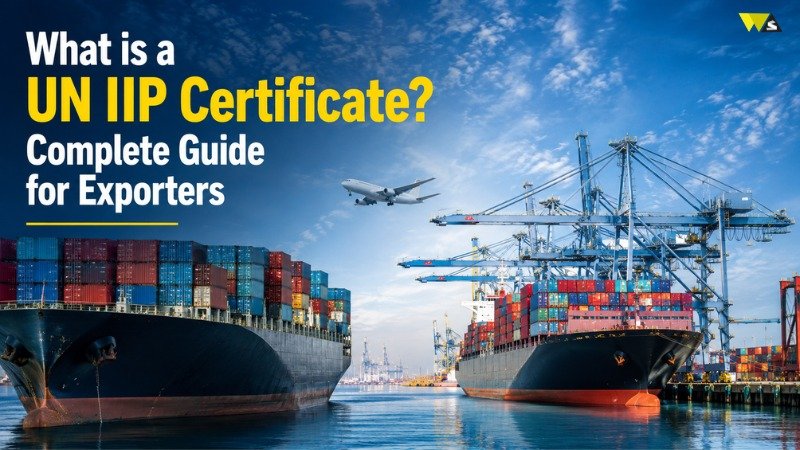
A UN IIP Certificate is an official certificate issued by the Indian Institute of Packaging (IIP) that proves your packaging drums, boxes, jerricans, cans, or bags has been physically tested and meets United Nations standards for carrying dangerous (hazardous) goods by sea, air, or road. In India, the IIP is the only government-authorised body for this certification, recognised by DG Shipping (for sea/IMDG) and DGCA (for air/ICAO).
It is mandatory that airlines and shipping lines will not accept dangerous cargo without it. The certified packaging carries a UN Mark code (like 4G/X15/S/26/IND/…). It is issued to the packaging manufacturer for a specific design (listing the exporter), after tests like drop, stack, and leak tests, and is generally valid for 18 months (ISO manufacturers) or 9 months (non-ISO).
Are you an exporter of chemicals, paints, batteries, or other hazardous goods? This guide explains the UN IIP Certificate – what it is, why you need it, and how to get it.
Table of Contents
ToggleWhat is a UN IIP Certificate?
Let us break down the name, because it explains everything:
- UN = United Nations. The UN sets global safety standards for packing and transporting dangerous goods.
- IIP = Indian Institute of Packaging. This is the Indian government body that tests packaging and issues the certificate.
So a UN IIP Certificate is a UN-standard packaging certificate issued by the IIP in India. It confirms that your packaging is strong and safe enough to carry dangerous goods without leaking, breaking, or bursting during transport.
It is not just a paper formality. Before the certificate is issued, real sample packages from your production are sent to a lab and physically tested — dropped, stacked, and pressure-tested. Only if they pass do you get the certificate and the right to print the UN Mark.
It is a safety pass for your packaging that lets you legally ship hazardous goods across the world.
UN IIP Certificate Overview 2026
| Detail | Information |
| Certificate Name | UN IIP Certificate (UN Mark Certificate) |
| Issued By | Indian Institute of Packaging (IIP) |
| Authority | Ministry of Commerce & Industry |
| Recognised By | DG Shipping (sea), DGCA (air) |
| Purpose | Certify packaging for dangerous goods |
| Applies To | Drums, boxes, jerricans, cans, bags, etc. |
| Transport Modes | Sea (IMDG), Air (ICAO/IATA), Road (ADR) |
| Mandatory? | Yes, for all hazardous goods by air & sea |
| Issued To | Packaging manufacturer (lists exporter) |
| Validity | 18 months (ISO) / 9 months (non-ISO) |
| Main Tests | Drop, stack, hydraulic, leak, vibration |
Who is the Indian Institute of Packaging (IIP)?
The Indian Institute of Packaging (IIP) is an apex national body, set up in 1966 by the packaging industry and the Ministry of Commerce, Government of India. It is an autonomous body working under the Ministry of Commerce.
Its role in UN certification:
- IIP is India’s only government-designated competent authority for UN packaging certification of dangerous goods.
- It tests packaging at its labs and issues the UN Certificate.
- It is recognised by the Directorate General of Shipping (DG Shipping) for sea transport and the Directorate General of Civil Aviation (DGCA) for air transport.
- It has testing centres in cities like Mumbai, Chennai, Delhi, Kolkata, Hyderabad, and others.
If you want UN-certified packaging in India, IIP is the official body that tests and certifies it. No other body can issue this certificate.
Why Do Exporters Need a UN IIP Certificate?
If you export dangerous goods, this certificate is not optional, it is mandatory. Here is why it matters:
- Carriers demand it: Airlines and shipping lines will refuse your cargo if the packaging does not have a valid UN Mark backed by the certificate.
- It is a legal requirement: International rules like the IMDG Code (sea) and ICAO/IATA (air) require certified packaging for dangerous goods.
- It ensures safety: Dangerous goods can leak, catch fire, or explode if badly packed. Certified packaging protects people, ships, planes, and the environment.
- It prevents delays and rejections: Non-compliant packaging can get your shipment stopped, returned, or fined at the port.
- It builds trust: Global buyers trust exporters whose packaging meets UN standards.
Without this certificate, your hazardous shipment cannot legally or practically leave the country. It is a must-have for dangerous goods exporters.
What Are “Dangerous Goods”? (The 9 Classes)
The certificate is needed for dangerous goods — items that can harm people, property, or the environment during transport. The UN classifies them into 9 classes:
- Class 1 – Explosives (fireworks, ammunition)
- Class 2 – Gases (compressed, flammable, or toxic gases; aerosols)
- Class 3 – Flammable liquids (paints, solvents, alcohol, petrol products)
- Class 4 – Flammable solids (matches, certain powders)
- Class 5 – Oxidizing substances and organic peroxides
- Class 6 – Toxic and infectious substances (pesticides, some chemicals)
- Class 7 – Radioactive material
- Class 8 – Corrosives (acids, batteries)
- Class 9 – Miscellaneous dangerous goods (lithium batteries, dry ice, etc.)
Common examples that need UN IIP certified packaging: chemicals, paints, solvents, pesticides, pharmaceuticals, lithium and lead-acid batteries, aerosols, and flammable liquids.
If your product falls in any of these 9 classes, you almost certainly need UN certified packaging.
Understanding the UN Mark Code
The UN Mark is a special code printed on your certified packaging. It looks complicated, but each part has a meaning. For example: 4G/X15/S/26/IND/…
Let us decode a typical mark:
- First part (e.g., 4G): The type of packaging.
- The number shows the container type — 1 = drum, 3 = jerrican, 4 = box, 5 = bag, 6 = composite.
- The letter shows the material — A = steel, G = fibreboard/cardboard, H = plastic, C = wood, etc.
- So 4G = a fibreboard (cardboard) box, 1A1 = a steel drum with non-removable head, 3H1 = a plastic jerrican.
- Next (e.g., X15): The packing group it is tested for, and related info.
- X = suitable for Packing Groups I, II, III (most dangerous allowed)
- Y = suitable for Packing Groups II and III
- Z = suitable for Packing Group III (least dangerous)
- The number relates to the specific gravity/weight it was tested for.
- S or a number: “S” means tested for solids or inner packagings; a number shows the hydraulic test pressure for liquids.
- Year (e.g., 26): The year of manufacture (2026).
- IND: The country of manufacture — IND = India.
- Final part: The manufacturer/certificate code issued by IIP.
Port and customs authorities read this code to confirm your packaging passed the right UN tests for your product. The mark must match your product’s packing group and type.
What Are Packing Groups (I, II, III)?
Dangerous goods are also divided into three packing groups, based on how dangerous they are:
- Packing Group I (PG I): High danger — needs the strongest packaging (marked X).
- Packing Group II (PG II): Medium danger (marked Y or X).
- Packing Group III (PG III): Low danger (marked Z, Y, or X).
Packaging tested for a higher (more dangerous) group can also carry lower groups. So X packaging can carry PG I, II, and III, while Z packaging can only carry PG III.
Before applying, you must know your product’s packing group — this decides which UN mark you need. A dangerous goods expert or your safety data sheet (MSDS/SDS) can help.
What Tests Does the Packaging Go Through?
Before the certificate is issued, IIP puts your sample packaging through tough tests to make sure it survives real transport conditions. The main tests are:
- Drop Test: The filled package is dropped from a set height to check it does not break or leak. (For some goods, done at very cold temperatures, like -18°C, for freezing conditions.)
- Stack Load Test: A heavy load is placed on top for a set time, to check it can be stacked in a container without collapsing.
- Hydraulic Pressure Test: For liquid packaging, internal pressure is applied to check it does not burst or leak.
- Leakproofness Test: Checks that liquid packaging does not leak air or liquid.
- Vibration Test: Simulates the shaking of transport (truck, ship, plane).
- Cobb Test: For paper/fibreboard, check water absorption (moisture resistance).
- Other tests as applicable righting, tear, top-lift, and topple tests for certain bag/IBC types.
Only if the samples pass these tests does IIP issue the certificate and allow the UN marking.
Prepare your prototype packaging exactly to UN specifications before testing. Getting it right the first time saves time and money.
Who Gets the UN IIP Certificate — Manufacturer or Exporter?
The UN IIP Certificate is issued to the PACKAGING MANUFACTURER, for a specific package design not to the product or directly to the exporter.
However:
- The certificate lists the exporter’s name who will use that specific packaging.
- It allows the manufacture of any number of packages of the same design and specifications during the validity period.
- The validity applies to packages with the same specifications, product annexure, net and gross weight, mode of shipment, and exporter.
What this means for exporters:
- You usually buy certified packaging from a UN-certified packaging manufacturer.
- Make sure the certificate covers your product, weight, and mode of shipment (sea/air).
- Check that your name (the exporter) is correctly listed, if required for your shipment.
Always ask your packaging supplier for a valid, matching UN IIP Certificate before you ship.
Documents Required for UN IIP Certification
The packaging manufacturer usually applies, with documents such as:
- Application form (via the IIP online portal)
- Details and drawings of the packaging (type, dimensions, material, weight)
- Product details — the dangerous goods to be packed, and their UN number and packing group
- MSDS / Safety Data Sheet of the product
- Exporter details (name, address)
- Company registration / GST details of the manufacturer
- ISO certificate (if any — it affects validity)
- Sample packages for testing
How to Apply for a UN IIP Certificate (Step-by-Step)
Here is the general process done mainly by the packaging manufacturer:
Step 1: Identify your product’s dangerous goods class and packing group (from the SDS/MSDS or a DG expert).
Step 2: The packaging manufacturer prepares a prototype strictly as per UN specifications.
Step 3: Apply online through the IIP portal with a Login ID, submitting details and documents, and pay the testing/certification fees.
Step 4: Send sample packages to the nearest IIP testing laboratory (e.g., Mumbai, Chennai, Delhi, etc.).
Step 5: IIP conducts the performance tests (drop, stack, hydraulic, leak, vibration, Cobb, as applicable).
Step 6: If the samples pass, IIP issues the UN Certificate and the UN Marking number.
Step 7: The manufacturer prints the UN Mark on the certified packaging and can produce it for your shipments.
Work with an experienced packaging manufacturer who has done UN certification before it makes the process smooth and fast.
Validity and Renewal of the UN IIP Certificate
The certificate is not permanent it must be renewed:
- 18 months validity for ISO-certified manufacturers.
- 9 months validity for non-ISO-certified manufacturers.
- You must renew it before it expires, or you cannot ship with that packaging.
Plan your renewal in advance. An expired certificate can stop your shipments at the last moment, causing costly delays.
Common Mistakes Exporters Should Avoid for UN IIP Certificate
- Wrong packing group — using packaging tested for a lower group than your product needs.
- Expired certificate — shipping with an out-of-date certificate; carriers will reject it.
- Mismatch of details — the certificate’s weight, mode (sea/air), or exporter name does not match your shipment.
- Wrong UN mark — the printed mark does not match the certified specification.
- No certificate at all — trying to ship dangerous goods with ordinary packaging.
- Buying from a non-certified supplier — always check the supplier’s valid UN IIP certificate.
- Ignoring the SDS/MSDS — not correctly identifying the product’s class and packing group.
Match your packaging’s UN mark to your product’s class, packing group, weight, and transport mode and keep the certificate valid.
Benefits of Getting a UN IIP Certificate
This certificate is required and offers many useful benefits:
- Smooth, legal export of dangerous goods by sea and air.
- No cargo rejection by airlines and shipping lines.
- Fewer delays, fines, and returns at ports.
- Safety for your goods, people, and the environment.
- Global trust buyers prefer exporters who follow UN standards.
- Access to international markets that strictly enforce these rules.
Conclusion
A UN IIP Certificate is a must-have for any exporter of dangerous goods in India. It is a UN-standard packaging certificate issued by the Indian Institute of Packaging (IIP) — India’s only government-authorised body for this proving that your drums, boxes, jerricans, or bags have been physically tested and are safe to carry hazardous goods by sea, air, or road.
It is mandatory: carriers will refuse your cargo without it. Your certified packaging carries a UN Mark code that shows its type, packing group, and origin, and it is issued to the packaging manufacturer for a specific design after tough tests like drop, stack, and leak tests. Remember, it is valid for 18 months (ISO) or 9 months (non-ISO), so renew it on time.
Choose the right UN-certified packaging, keep your certificates valid, and follow the shipping rules. This helps your goods reach their destination safely and on time.
Frequently Asked Questions (FAQs)
1. What is a UN IIP Certificate?
It is a UN-standard packaging certificate issued by the Indian Institute of Packaging (IIP) that proves your packaging has been physically tested and is safe to carry dangerous goods by sea, air, or road, as per United Nations standards.
2. Who issues the UN IIP Certificate in India?
The Indian Institute of Packaging (IIP), under the Ministry of Commerce & Industry, is the only government-authorised body in India for UN packaging certification. It is recognised by DG Shipping for sea transport and DGCA for air transport.
3. Is the UN IIP Certificate mandatory?
Yes. It is mandatory for transporting all types of hazardous and dangerous goods by air and sea from India. Airlines and shipping lines will not accept dangerous cargo without valid UN certified packaging.
4. Which products need UN certified packaging?
Products in the 9 classes of dangerous goods — chemicals, flammable liquids, paints, solvents, pesticides, pharmaceuticals, lithium and lead-acid batteries, aerosols, corrosives, and similar hazardous items — need UN certified packaging.
5. What is the UN Mark on packaging?
It is a unique code printed on certified packaging (for example, 4G/X15/S/26/IND/…) that shows the package type, the packing group it is tested for, the year and country of manufacture, and the certificate code. Authorities read it to confirm compliance.
6. What tests are done for UN certification?
The main tests are the drop test, stack load test, hydraulic pressure test, leakproofness test, vibration test, and Cobb test, along with others as applicable. The packaging must pass these tests before the certificate is issued.
7. Who gets the certificate — the exporter or the packaging manufacturer?
The certificate is issued to the packaging manufacturer for a specific package design, but it lists the exporter’s name who will use that packaging. Exporters usually buy certified packaging from a UN-certified manufacturer.
8. How long is the UN IIP Certificate valid?
It is valid for 18 months for ISO-certified manufacturers and 9 months for non-ISO-certified manufacturers. You must renew it before it expires, or you cannot ship with that packaging.
9. What are packing groups I, II, and III?
They show how dangerous the goods are — Packing Group I is high danger (marked X), II is medium (Y or X), and III is low (Z, Y, or X). Packaging tested for a higher group can also carry lower groups.
10. How do I apply for a UN IIP Certificate?
The packaging manufacturer applies online through the IIP portal with the packaging and product details and documents, pays the fees, and sends sample packages to the nearest IIP lab for testing. On passing, IIP issues the certificate and UN marking number.
Read our article:How to Get a UN IIP Certificate in India?